


Pakistan has existed in a state of perpetual crisis since its creation in 1947, dominated by military power and defined by opposition to India. Today, under Field Marshal Asim Munir’s unprecedented authority, the country faces its most perilous moment yet. As the United States pushes Islamabad to send troops to Gaza under President Donald Trump’s plan, Munir is caught between appeasing Washington and preserving Pakistan’s domestic legitimacy and standing in the Muslim world. The outcome may reshape Pakistan’s future—and destabilise the region.
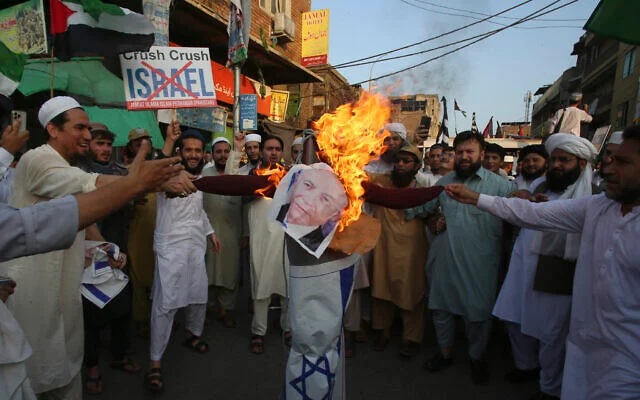
Pakistani Islamists burn an effigy of Prime Minister Benjamin Netanyahu, during a protest to condemn the killing of Hamas chief Ismail Haniyeh, in Peshawar, Pakistan, August 2, 2024. (AP Photo/Mohammad Sajjad)
By Subhash Dhuliya
Pakistan has lived in a state of near-permanent crisis ever since its birth in 1947. Unlike many post-colonial nations that gradually consolidated civilian institutions, Pakistan emerged with a fragile political structure, contested identity, and an overbearing military establishment. Over the decades, its state power has rested on two enduring pillars: hostility towards India and army domination of politics. This imbalance has produced a paradox that has often been repeated, half-jokingly but tellingly: Pakistan does not have an army; the army has Pakistan.
This structural reality has shaped Pakistan’s domestic governance, foreign policy, and ideological direction. It explains why the country has oscillated between military coups, weak civilian governments, economic breakdowns, and ideological radicalisation. It also explains why a former US Secretary of State once described Pakistan as “the most dangerous place in the world”—a nuclear-armed state plagued by internal extremism, external adventurism, and institutional decay.
Today, Pakistan stands at one of the most dangerous crossroads in its history. At the centre of this moment is Field Marshal Asim Munir, now the most powerful individual Pakistan has ever seen. His expanding authority, deepening alignment with the United States under President Donald Trump, and potential involvement in Gaza threaten to entangle Pakistan in a geopolitical and ideological trap from which escape may prove difficult.
Pakistan has survived crises before by diffusing responsibility and deflecting blame. That era is over. Gaza may not be Pakistan’s war, but it could become Pakistan’s reckoning. In trying to please Washington while preserving an Islamist narrative at home, Asim Munir has placed Pakistan in the most dangerous strategic trap since 1947—one where power offers no protection, and miscalculation could redefine the state itself.
The Deep State and the Anti-India Doctrine
From its earliest years, Pakistan’s ruling elite—particularly its military—constructed national identity in opposition to India. The trauma of Partition, unresolved disputes over Kashmir, and the fear of demographic and civilisational absorption became the foundational myths of the Pakistani state. Over time, these fears were institutionalised.
Instead of investing in democratic consolidation or economic self-reliance, Pakistan invested disproportionately in the military. The army positioned itself not merely as a defender of borders, but as the guardian of ideology, the arbiter of national interest, and ultimately, the real ruler of the state. Civilian governments were tolerated only when compliant.
This militarised worldview produced repeated confrontations with India, culminating in wars in 1947–48, 1965, 1971, and later the Kargil conflict. The dismemberment of Pakistan in 1971—leading to the creation of Bangladesh—should have forced a strategic rethink. Instead, it deepened military paranoia and reinforced the belief that only an all-powerful army could hold Pakistan together.
Islamisation as Strategy, Not Faith
Unable to match India conventionally or economically, Pakistan’s military establishment turned increasingly towards terrorism and Islamisation as a strategic tool. From General Zia-ul-Haq onwards, political Islam was weaponised—first against internal dissent, later as an instrument of foreign policy.
Militant groups were nurtured, trained, and deployed, especially in Afghanistan and Kashmir. While this strategy brought short-term tactical leverage, it also radicalised society and hollowed out the state. Extremist ideologies seeped into education, politics, and even the military itself.
For the first time in Pakistan’s history, power is so centralised that failure can no longer be blamed on civilians. If Gaza becomes Pakistan’s next military adventure, Asim Munir alone will own its consequences—on the streets of Pakistan and across the Muslim world.
Pakistan became a contradictory entity: a state that fought terrorism while simultaneously producing it; an ally of the United States while harbouring anti-Western sentiment; a self-proclaimed champion of Muslim causes while suppressing dissent at home.
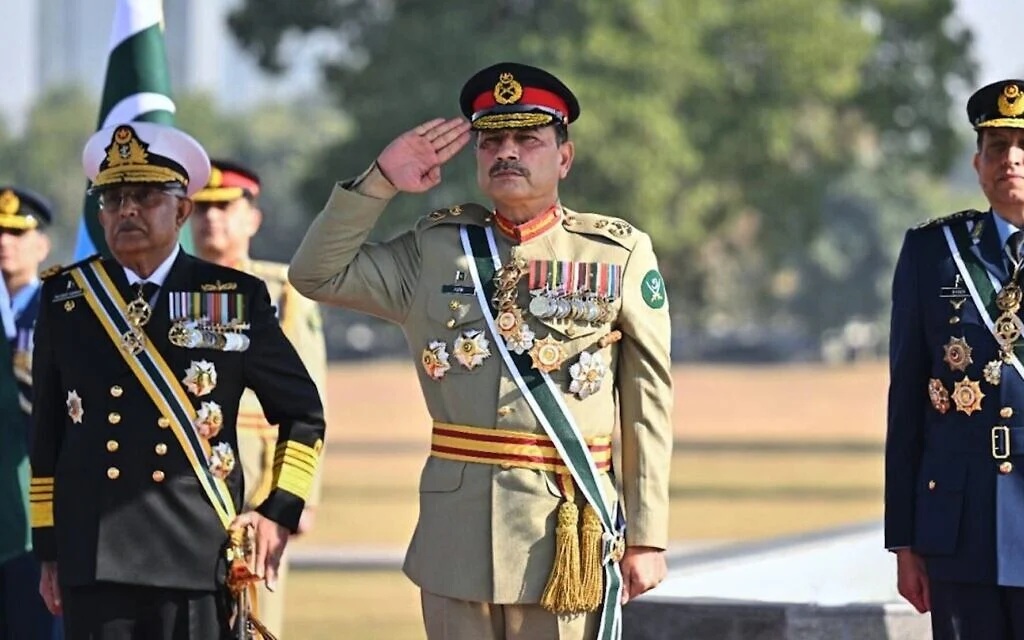
Photo: The Times of Israel
Enter Asim Munir: The Ultimate Concentration of Power
In this historical context, Asim Munir’s rise marks a qualitative shift, not merely a continuation of military dominance. Munir is not just the army chief. He is now the Chief of Defence Forces, commanding the army, navy, and air force simultaneously. His term has been extended until 2030, he holds the permanent title of Field Marshal, and constitutional amendments grant him lifetime immunity from prosecution.
No military leader in Pakistan’s history has wielded such unchallenged authority.
The civilian government exists largely as a façade. Parliament has been subordinated. The judiciary has been neutralised. Political opposition—especially supporters of jailed former Prime Minister Imran Khan—has been suppressed. Pakistan today resembles a praetorian state, where formal institutions exist but real power lies elsewhere.
Munir and Trump: A Transactional Alliance
Munir’s power at home is matched by his growing influence abroad—particularly in Washington. Under President Donald Trump, the United States has abandoned even the pretence of moral diplomacy. Human rights, democracy, and rule of law are no longer guiding principles. What matters now is hard power, loyalty, and transactional utility.
Trump is a pragmatic, interest-driven leader. He sees Pakistan not as a democracy in distress, but as a military asset: a nuclear-armed Muslim-majority state with a battle-hardened army capable of operating in volatile theatres.
At the heart of the Gaza question lies a deeper contradiction. Pakistan has long claimed moral leadership of the Muslim world while quietly aligning with great powers for strategic survival. Under Asim Munir, that contradiction has become unsustainable. Gaza forces Islamabad to choose between ideology and expediency—and exposes how hollow Pakistan’s long-cultivated narratives have become.
This explains why Trump hosted Munir for a private White House lunch, a symbolic gesture unprecedented in US–Pakistan relations. It also explains why Munir—not Pakistan’s elected leadership—has become Washington’s primary interlocutor.
Gaza and the Most Dangerous Trap
The current crisis revolves around Trump’s proposed Gaza stabilisation plan, which calls for troops from Muslim-majority countries to oversee a post-war transition following Israeli withdrawal. Pakistan, with its military capacity and Islamic identity, has emerged as a potential contributor.
For Munir, this presents a two-edged sword:
- If Pakistan sends troops to Gaza, it risks a massive domestic backlash. Islamist parties—deeply hostile to the US and Israel—retain formidable street power. Even banned groups continue to shape public sentiment. Any Pakistani military presence in Gaza under a US-backed framework would be portrayed as “doing Israel’s bidding.”
- If Pakistan refuses, Munir risks alienating Trump at a moment when Pakistan desperately seeks US investment, financial support, and strategic relevance.
This dilemma is uniquely dangerous for Pakistan because it strikes at the heart of its ideological narrative. Pakistan has long projected itself as the defender of Muslim causes, particularly Palestine. Any deviation from this posture would erode its credibility across the Muslim world.
The Islamist Perception Problem
Munir is already a controversial figure within Pakistan. He is widely perceived as an Islamist sympathiser, a reputation reinforced by his rhetoric and past associations. One US politician reportedly described him as “Osama bin Laden in a suit”—a crude phrase, but one that reflects unease in certain Western circles.
More significantly, a Sindh-based politician recently wrote to Indian Prime Minister Narendra Modi, describing Munir as a grave danger to regional peace. Such statements underscore the extent to which Munir is seen not merely as Pakistan’s military chief, but as an ideological actor with transnational implications. In many states/regions of Pakistan anti-army sentiments are strong which is Punjabi- dominated. Pakistan participation in Trump’s Gaza stabilisation plan is going to generate a strong backlash at home.
Many Muslim countries are wary of participating in a mission to demilitarise Hamas in Gaza, fearing it could draw them deeper into the conflict and inflame pro-Palestinian, anti-Israeli sentiment at home. Trump’s strategy is to deploy troops from Muslim-majority countries under a US-controlled framework, effectively outsourcing the political and security risks while retaining strategic command.
This perception complicates Munir’s Gaza calculus. If he aligns too closely with Trump and Israel’s post-war framework, he risks alienating Islamist constituencies at home and Muslim partners abroad. If he resists, he risks falling out of favour with Washington.
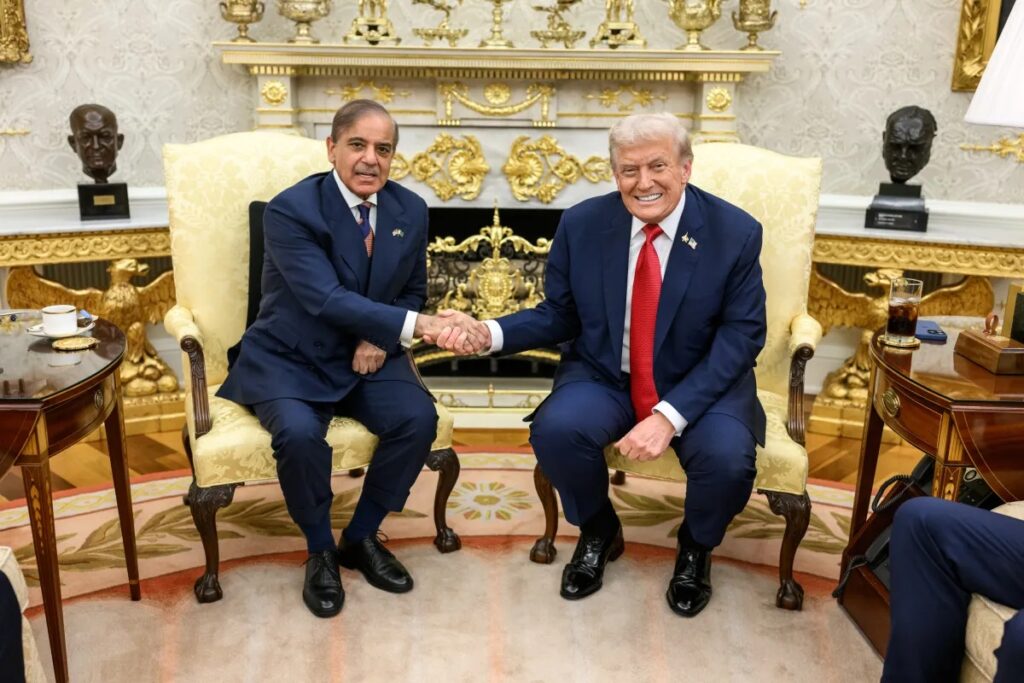
Photo: White House
Playing Pakistan Against the Muslim World
There is a deeper strategic game at play. Trump appears to be using Munir to fracture Muslim consensus, particularly vis-à-vis Iran and the Palestinian issue. By drawing Pakistan into a Gaza stabilisation role, Washington would effectively position Islamabad against large segments of Muslim public opinion.
This would weaken Pakistan’s longstanding aspiration to lead or influence the Muslim world. It would also entangle Pakistan in Middle Eastern rivalries far removed from its core national interests.
Munir, in agreeing even partially to this framework, has placed Pakistan into the most perilous strategic trap since 1947.
Domestic Fallout: A Perfect Storm
At home, the consequences could be severe:
- Islamist protests could spiral into violence.
- Imran Khan’s supporters could mobilise against the army.
- The legitimacy of the military itself could erode.
- Pakistan’s already fragile economy could suffer further shocks.
Unlike past crises, Munir cannot deflect blame onto civilian politicians. Power has been centralised too visibly. Responsibility now rests squarely with him.
Power Without Wisdom
Pakistan has long survived its crises by shifting blame between generals and civilians, hiding strategic failures behind ideology, and outsourcing legitimacy to foreign patrons. Under Field Marshal Asim Munir, that escape route has vanished. Power is now so centralised that responsibility can no longer be deflected.
If Pakistan sends troops to Gaza under a US-backed plan, it will be seen at home as serving American and Israeli interests, triggering Islamist anger and political instability. If it refuses, it risks alienating a transactional US president whose support Pakistan urgently seeks for economic and strategic survival. Either way, the costs will be immediate and internal.
Pakistan was created amid crisis in 1947, but it now faces something far more dangerous: a crisis of identity that amounts to an attack on the very foundations of the state. In trying to balance Washington’s demands with Islamic symbolism, Munir has placed Pakistan in its most perilous strategic trap. Gaza may not be Pakistan’s war, but it could become the moment when unchecked military power finally meets its limits.
About the Author: Prof. Subhash Dhuliya is a researcher, educator, and commentator with a focus on global politics, media, culture, and international communication. His academic interests extend to development and inter-cultural communication As the Founder-Director & Editor of Newswriters.in, he has significantly influenced the discourse on media and communication

