


President Vladimir Putin’s four-and-a-half-hour end-of-year press conference was less a routine media interaction and more a strategic signal—aimed simultaneously at domestic audiences, Ukraine, and Western capitals. By blending battlefield confidence with conditional openness to negotiations, institutional legitimacy with moral certainty, and geopolitical grievances with civilizational rhetoric, Putin sought to project Russia as a state both embattled and enduring. The event underscored Moscow’s belief that time, strategic depth, and national resolve remain on its side, even as the war grinds on and diplomatic pathways remain narrow.
By Newswriters News Desk
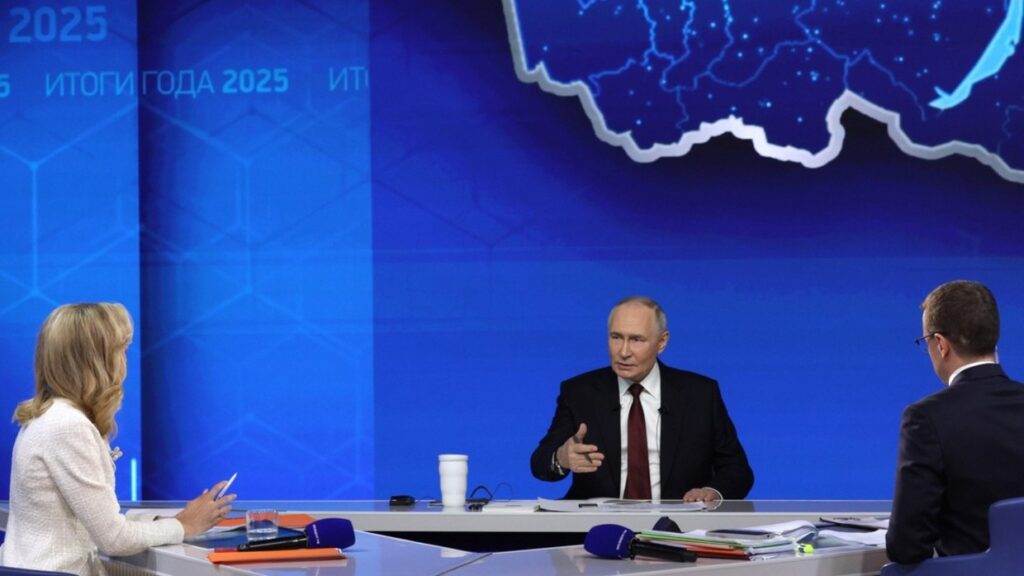
Russian President Vladimir Putin on Friday held his annual end-of-year press conference in Moscow, once again merging it with the traditional ‘Direct Line’ interaction with citizens. Stretching over four and a half hours, the event reaffirmed its status as one of the most exhaustive political engagements by any world leader, offering a sweeping overview of Russia’s domestic priorities, military campaign in Ukraine, relations with the West, and broader geopolitical outlook.
During the marathon Q&A session, Putin fielded questions submitted by more than two million citizens and journalists, including Western media representatives. By official estimates, the Russian president touched upon more than 70 topics—ranging from frontline military developments and frozen Russian assets in Europe to artificial intelligence, demographic challenges, space, and even intergalactic comets. The format, carefully choreographed yet improvisational in parts, allowed Putin to project control, continuity, and confidence at a time of prolonged war and geopolitical isolation.
Ukraine Elections and the Question of Legitimacy
One of the most politically sensitive issues addressed by Putin was the question of elections in Ukraine. He argued that for any meaningful peace process to move forward, Kiev must establish political legitimacy through elections The government in Ukraine must become legitimate, and without an election, this is impossible.”
Putin adeded that if Ukraine were to conduct elections, Moscow would insist that Ukrainian citizens currently living in Russia—estimated to number between five and ten million—be allowed to participate. He further stated that Russia could consider guaranteeing security during an election or, at the very least, refrain from strikes deep into Ukrainian territory on polling day.
However, he warned that if Kiev attempted to use elections merely as a tactic to buy time or freeze the battlefield situation, it would be a “wrong decision.” Drawing a contrast, Putin noted that Russia had conducted multiple elections in recent years, including the 2024 presidential vote, without any international security guarantees. He accused foreign actors of actively attempting to disrupt Russian elections and recalled Ukrainian strikes on polling stations.
Peace Talks and NATO’s ‘Broken Promises’
On the prospects for peace, Putin struck a familiar but calibrated tone. He said Russia seeks an end to military conflict and prefers negotiations, but only if the “root causes” of the war are addressed.
“We, too, would very much like to live in peace… and we strive to resolve all contentious issues through negotiations,” he said. “We need to eliminate the root causes of the conflict so that nothing similar happens again, so that peace is long-lasting, strong, and sustainable.”
Putin reiterated his long-standing grievance against NATO, accusing the alliance of breaking assurances regarding its eastward expansion. He insisted Russia was not demanding extraordinary concessions, only that other nations pursue security arrangements that do not threaten Moscow.
“We are ready to work with the UK, with Europe as a whole, and with the United States—but on an equal footing, with mutual respect,” he said, adding that such an outcome would benefit all sides.
Warning Against Escalation and a Kaliningrad Blockade
Putin also issued a stark warning against any attempt by NATO or European states to blockade Russia’s Kaliningrad exclave. Such actions, he said, would constitute a direct threat to Russian security.
“If we are threatened in this way, we will eliminate these threats,” Putin warned. “Actions of this kind will lead to an unprecedented escalation of the conflict, take it to another level, and expand it to a full-scale armed conflict.”
He placed responsibility squarely on Western capitals and the leadership in Kiev, while reiterating that Russia remains open to negotiations and a peaceful resolution—if its interests are respected.
Military Situation: Strategic Initiative and Battlefield Gains
A significant portion of the press conference was devoted to developments on the battlefield. Putin claimed that Russian forces had fully seized the strategic initiative following the expulsion of Ukrainian troops from Russia’s Kursk Region earlier this year.
He said the capture of Krasnoarmeysk (Pokrovsk) in early December had opened the way for deeper advances into what he described as Ukraine’s main fortified zone in Donbass, stretching across Slavyansk, Kramatorsk, and Konstantinovka. Fighting is ongoing in Konstantinovka, as well as Krasny Liman, Dmitrov, and Gulyay Pole in Zaporozhye Region.
In the south, Putin stated that Russian troops had captured Kupyansk and were pressuring a Ukrainian battlegroup positioned near a major railway junction. According to him, around 3,500 Ukrainian troops in the area had “virtually no chances” of survival after being denied permission to retreat.
“The time will come when our guys finish their work destroying the encircled Ukrainian forces and turn west. That will happen pretty soon,” Putin said, adding that Ukraine’s attempts to hold ground “at any cost” had only depleted its strategic reserves.
He expressed confidence that new military successes would be achieved before the end of the year, potentially pushing Kiev toward accepting a diplomatic settlement.
Troops, Drones, and the War Economy
Putin highlighted Russia’s expanding military manpower and technological capacity, particularly in drone warfare. He claimed Russia had become the “undisputed leader” in the number of drones deployed and revealed that more than 400,000 people had signed contracts for military service over the past year.
Interest in becoming drone pilots, he said, was so high that the Defense Ministry had introduced competitive selection. Putin also alleged atrocities by Ukrainian forces against civilians, claiming such actions had further hardened Russian soldiers’ resolve to advance and “finish off the viper.”
Frozen Assets and Economic Warfare
Addressing the EU’s attempts to use frozen Russian central bank assets, Putin described the move as outright robbery.
“Theft is done in secret. But here they are trying to do it openly. It’s robbery,” he said, warning that such actions would erode trust in the Eurozone and global financial system.
“Whatever they steal, no matter how they do it, will have to be repaid someday,” he added.
Putin framed the issue as part of a broader economic war against Russia—one that, he argued, would ultimately backfire on Europe’s credibility as a safe financial jurisdiction.
Domestic Issues: Demographics, Faith, and the Future
Beyond geopolitics and war, Putin addressed Russia’s demographic challenges, emphasizing the need to make family life socially aspirational.
“It’s important for starting a family to become fashionable,” he said, urging Russians to rediscover the joys of parenthood.
In a more personal moment, Putin said he had no plans to write memoirs, arguing that history should judge leaders rather than leaders judging themselves. He also improvised what he described as a “time capsule” message to future generations, reflecting on continuity, struggle, and responsibility across centuries.
On lighter and more speculative topics, Putin dismissed conspiracy theories about weapons in space, including rumors surrounding the 3I/ATLAS comet.
“It’s a comet. Our scientists know what’s going on there,” he said, adding with irony that Russia opposed placing weapons in space.
Faith, Force, and the Long War: Putin Frames Russia’s Struggle as a Test of Civilizational Endurance
Putin framed Russia’s struggle not merely as a geopolitical contest but as a civilizational test of endurance, signaling that the Kremlin views the war as a long-term confrontation in which resolve, rather than compromise, will ultimately determine the outcome.
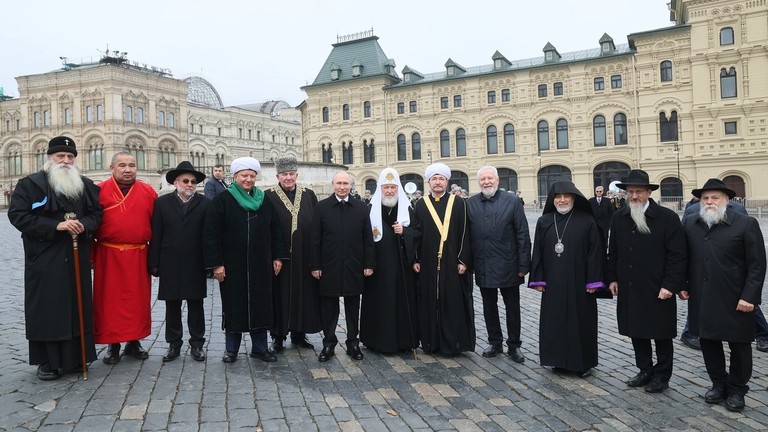
President Vladimir Putin and leaders of several religious confessions
“I believe in God, who is with us and will never abandon Russia,” Putin said, after the moderator noted that every person needs something to believe in.
Putin is known as a practicing Orthodox Christian and an ardent supporter of what he describes as traditional religions. He has repeatedly argued that such faiths embody time-tested wisdom that remains essential even in the modern world.
Taken as a whole, Putin’s marathon address reinforced a governing narrative that fuses military momentum, historical grievance, and moral legitimacy into a single worldview. The emphasis on elections, sovereignty, and “root causes” reflects Moscow’s attempt to reshape the terms of any future settlement on its own conditions, while repeated warnings to NATO signal clear red lines against further escalation.
Yet beneath the confidence lies an implicit recognition that prolonged conflict carries costs—demographic, economic, and political. By ending on faith rather than force, Putin framed Russia’s struggle not merely as a geopolitical contest but as a civilizational test of endurance, signaling that the Kremlin views the war as a long-term confrontation in which resolve, rather than compromise, will ultimately determine the outcome.
The war, as framed by Putin, is no longer presented merely as a contest over territory or security arrangements but as a broader test of civilizational endurance—of identity, memory, and historical continuity. By invoking faith, sacrifice, and time itself, the Kremlin signals that it views the conflict as one that must be withstood rather than swiftly resolved, where resilience is as decisive as military power.
Acknowledgement: Based on RT reports. Photos: Sputnik

