


AI and Job Loss in the News Industry: A Double-Edged Sword
The rise of artificial intelligence (AI) has sparked intense debate across industries, but few sectors feel its impact as acutely as journalism. In 2025, AI tools like automated content generation, data analysis, and even AI-driven search summaries have reshaped how news is produced, distributed, and consumed. While proponents hail AI as a productivity booster, critics warn of widespread job displacement.

By Rohit Dhuliya
This analysis explores the evidence of job loss in the news industry, balanced against emerging opportunities for job creation and transformation. Drawing from recent studies and real-world examples, it argues that AI is not simply eliminating jobs but fundamentally restructuring the field—often at the expense of entry-level roles—while creating new demands for human-AI collaboration. However, without proactive adaptation, the net effect could lean toward net losses, exacerbating inequality in an already strained media landscape.
Evidence of Job Displacement
The narrative of AI-induced job loss gained momentum , with data showing tangible impacts. According to Challenger, Gray & Christmas, AI was cited as a reason for nearly 55,000 layoffs across the U.S. economy, including significant cuts in media and tech sectors intertwined with news production. In journalism specifically, outlets like CNN, Vox Media, HuffPost, and NBC announced layoffs throughout the year, attributing declines partly to AI-driven changes in traffic and revenue. Google’s AI Overviews, for instance, have led to 70-80% drops in click-through rates to original news sites, starving publishers of ad revenue and forcing workforce reductions. This “zero-click” phenomenon, where users get summaries without visiting sources, has been flagged by over 57% of journalists as a direct threat to jobs, as highlighted in industry surveys.
Younger workers bear the brunt. A Stanford University study analyzing payroll data from millions of Americans found a 13% relative decline in employment for 22-25-year-olds in high-AI-exposure jobs, including those in media where tasks like research and basic reporting are automatable. Entry-level positions in journalism—such as fact-checkers, junior reporters, and content curators—are particularly vulnerable.
AI excels at codifying routine knowledge, displacing novices who traditionally handle these tasks while leaving experienced professionals, who rely on tacit expertise like source-building and ethical judgment, relatively unscathed. Anthropic CEO Dario Amodei echoed this, predicting that half of entry-level white-collar jobs, including in newsrooms, could vanish within five years.
A Columbia University Tow Report warned that AI is mature enough to replace some journalism jobs outright, either directly or by reducing the need for multiple staff. For example, automated tools now handle transcription, headline generation, and even basic article drafting, tasks that once employed interns and assistants.
Artificial intelligence is no longer a distant experiment in journalism—it’s actively reshaping newsrooms worldwide. While generative AI automates routine tasks, drives efficiency gains, and spawns new hybrid roles, it also compresses entry-level opportunities and raises urgent questions about ethics, trust, and the future of human storytelling.
For journalists, students, and media professionals, the message is clear: adapt proactively or risk being left behind. This article explores the global surge in AI adoption, the tough realities for fresh graduates, emerging opportunities in hybrid workflows, and practical steps to future-proof your career in an era where human insight and AI augmentation must work hand in hand.
Public perception aligns with these fears. A Pew Research survey found 59% of Americans believe AI will lead to fewer journalist jobs over the next two decades, with only 5% expecting gains. On social platforms like X, journalists and industry observers frequently voice concerns about AI hollowing out the profession, with posts highlighting real-time layoffs in creative fields like copywriting and PR, which overlap with news production.
Opportunities for Job Creation and Augmentation
Yet, the story isn’t solely one of doom. AI is also creating new roles and enhancing existing ones, potentially offsetting losses. McKinsey’s 2025 State of AI report indicated that while 17% of business functions saw workforce declines due to AI, many reported productivity gains leading to reinvestment in human talent. In journalism, AI tools are used for newsgathering, audience engagement, and production, as noted by IBM. For instance, Reuters Institute emphasizes AI’s role in exploring journalism’s future, from data journalism to personalized content delivery.
In newsrooms, this translates to emergent positions like AI ethics editors, prompt engineers for content tools, and data journalists who leverage AI for investigative work. The New York Times detailed how AI is sweeping newsrooms, not as a replacement but as a tool for global information dissemination. Media giants are striking deals with AI labs—Meta with CNN, Fox News, and others—for content licensing, potentially creating revenue streams that fund new hires. The Brookings Institution and UNRIC highlight opportunities: AI can democratize access, enabling smaller outlets to compete through automated translation and fact-checking, thus preserving or even expanding jobs in underserved areas.
Nieman Lab describes “divergent paths”: one where AI substitutes humans, leading to cuts, and another where it augments, fostering innovation. The New Yorker posits AI could “save” news by enhancing quality, though it risks hollowing if unchecked. Freelancers, for example, use AI to scale output, competing with agencies in ways that redistribute opportunities from corporations to individuals.
Broader Implications and Future Outlook
The uneven impact raises equity concerns. While overall unemployment hasn’t spiked—per Econofact and ADP Research—AI exacerbates generational divides, with young workers in media facing stagnant growth. Industries like consulting and law see similar patterns, but news is unique due to its public trust role; over-reliance on AI could erode credibility if human oversight diminishes.

As adoption grows, Indian media is actively grappling with AI ethics—debating accuracy, accountability, bias in algorithms, content ownership, transparency (e.g., disclosure policies), and the risk of eroding human editorial judgment. Industry forums (e.g., WAN-IFRA’s Bangalore AI Forum) and reports stress that AI should empower journalists rather than replace them, with concerns about over-reliance on big tech and perpetuating stereotypes (e.g., gendered AI anchors in some experiments). This has prompted calls for stronger internal policies, training, and potential regulation.
AI’s footprint in the news industry reveals a complex reality: undeniable job losses, particularly for juniors, tempered by nascent creations in specialized roles. The net effect tilts negative so far, with 48,414 AI-cited cuts underscoring the risks. Yet, as tools evolve, the industry has a chance to harness AI for augmentation, ensuring human journalists remain central. Without strategic intervention, however, the feared “reckoning” could deepen, transforming news from a vibrant profession into an automated echo chamber.
Emerging Roles The New Opportunities
The integration of artificial intelligence (AI) into journalism and media is not only automating routine tasks but also spawning entirely new job categories. As AI tools handle data processing, content generation, and audience analysis, human roles are evolving to focus on oversight, creativity, ethics, and strategic integration.
This shift is evident in reports, where AI is projected to create roles that blend technical skills with journalistic expertise. For instance, positions like AI ethics editors ensure responsible use of algorithms, prompt engineers optimize AI for content creation, and data journalists use AI to enhance investigations by uncovering patterns in vast datasets. Below, I outline key emerging roles, drawing from industry analyses and real-world examples, with a emphasis on how they apply to newsrooms.
AI Ethics Editors and Officers
These professionals oversee the ethical deployment of AI in content creation, ensuring outputs are free from bias, misinformation, and privacy violations. In journalism, they review AI-generated articles for accuracy and fairness, often collaborating with legal teams to comply with regulations. For example, media outlets are hiring AI ethics officers to audit algorithms that personalize news feeds or automate fact-checking.
This role addresses growing concerns about AI’s role in perpetuating stereotypes or spreading false narratives, and it’s becoming essential as newsrooms adopt tools like automated transcription and translation. Salaries can reach up to $150,000, reflecting the high demand for expertise in AI governance.
Prompt Engineers for Content Tools
Prompt engineers craft precise inputs for AI models to generate high-quality content, such as headlines, summaries, or social media posts. In media, they fine-tune prompts to align with editorial standards, enabling faster production of engaging material. This role has surged in newsrooms using AI for drafting stories or creating multimedia elements, like meme-worthy news bites from trending topics.
As AI handles initial drafts, prompt engineers ensure outputs are creative and contextually accurate, often requiring a blend of journalism background and technical know-how. Job postings for this have doubled in tech-adjacent media roles.
Data Journalists Leveraging AI for Investigative Work
Building on traditional data journalism, these roles use AI to analyze massive datasets for insights, such as spotting trends in public records or predicting story impacts. AI tools accelerate investigations by identifying anomalies or correlating events, allowing journalists to focus on narrative-building and verification.
Examples include using AI for transcribing interviews, translating foreign sources, or dubbing videos in real-time, which has been highlighted in tools for low-cost efficiency in newsrooms. This evolution is creating demand for hybrid skills, with roles at outlets like Bellingcat or Prison Journalism Project incorporating AI labs for enhanced reporting.
AI Output Reviewers and Validators
These specialists verify AI-generated content for accuracy, tone, and relevance before publication. In journalism, they act as a human safeguard against errors, such as hallucinations in AI summaries or biased outputs. This role is emerging as a critical layer in workflows, especially for outlets dealing with high-volume content like social media or newsletters. Pay can start at $40/hour for specialized fact-checking, evolving from traditional editing jobs.
AI Orchestration Engineers and Agent Architects
Focused on building and managing AI agents—autonomous systems that perform tasks like news aggregation or audience engagement—these roles design workflows where AI collaborates with humans. In media, they create agents for real-time news curation or personalized content delivery, as seen in AI-powered networks turning trends into viral formats. This is particularly relevant for smaller newsrooms aiming to compete with larger ones through efficiency gains.
Storytelling Directors and Heads of Storytelling
With AI disrupting traditional PR and communications, these roles merge editorial, social media, and influencer functions to craft narratives directly for audiences. Tech-media hybrids like Notion or Chime are hiring for this, paying up to $274,000, to “go direct” amid shrinking earned media. In journalism, it involves using AI for interactive transcripts or multilingual content to enhance engagement.
Bias and Fairness Analysts / Model Auditors
These experts audit AI systems for biases in news algorithms, ensuring equitable representation in content recommendations. As AI influences what audiences see, this role is vital for maintaining trust in journalism, often involving compliance with new regulations. It’s a governance-focused position, with potential for high demand in global media.
Reinforcement Learners and AI Explainers
Reinforcement learners train AI models by refining responses, such as fact-checking agricultural queries for specialized media. AI explainers translate complex AI processes into accessible terms for teams or audiences. These are entry points for journalists transitioning into AI roles, with salaries ranging from $50,000 to $150,000.

Broader Implications
While AI displaces some routine jobs—like basic copywriting or data entry—it creates net opportunities in high-skill areas, with forecasts showing 97 million new global roles by 2030 in ethics, orchestration, and innovation. In news, this means a “human-in-the-loop” model where AI augments rather than replaces, but success depends on upskilling. Job boards like Indeed and LinkedIn show hundreds of openings, signaling a vibrant shift. For those in media, embracing these roles could future-proof careers amid ongoing transformations.
As adoption grows, Indian media is actively grappling with AI ethics—debating accuracy, accountability, bias in algorithms, content ownership, transparency (e.g., disclosure policies), and the risk of eroding human editorial judgment. Industry forums (e.g., WAN-IFRA’s Bangalore AI Forum) and reports stress that AI should empower journalists rather than replace them, with concerns about over-reliance on big tech and perpetuating stereotypes (e.g., gendered AI anchors in some experiments). This has prompted calls for stronger internal policies, training, and potential regulation.
How to Gear Up and Future-Proof Your Career in the AI Era
The global journalism landscape is undergoing rapid, irreversible transformation driven by generative AI, with leading newsrooms worldwide embracing tools for transcription, data analysis, headline generation, multilingual adaptation, and audience personalization—shifting from cautious pilots to structured, AI-augmented workflows that boost efficiency while preserving human editorial judgment.
Yet the industry remains divided: while top-tier outlets report significant productivity gains and experiment with new roles in ethics auditing and hybrid storytelling, many journalists and smaller operations grapple with job compression in entry-level positions, ethical risks around bias and misinformation, and the urgent need for upskilling.
In this transitional moment, the path forward is clear: journalists who proactively master AI as a powerful collaborator—honing prompt engineering, rigorous verification habits, ethical oversight, and irreplaceable human skills such as investigative depth, narrative craft, and trust-building—will not only survive but thrive in the years ahead.
The future rewards those who view AI not as a threat to replace them, but as an amplifier that frees them to focus on what machines cannot replicate: truth-seeking, accountability, empathy, and authentic connection with audiences.
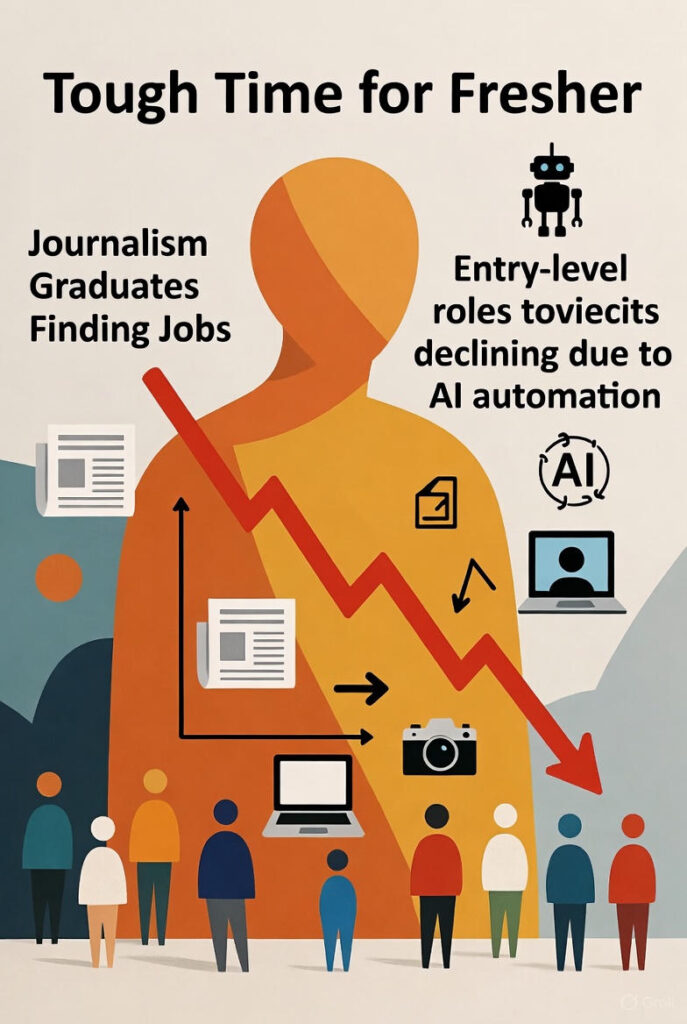
Tough Time for Journalism Graduates
Journalism graduates entering the job market face a tougher landscape than previous generations. Traditional entry-level roles—such as junior reporters, fact-checkers, research assistants, copy editors, and basic content producers—are declining sharply due to AI automation of routine tasks like transcription, headline generation, data summarization, basic drafting, and simple investigative pattern-spotting. Reports show sharp drops in entry-level media hires, with AI-exposed jobs seeing relative employment declines for young workers (ages 22–25).
A Stanford University study found a 13% relative decline in employment for 22-25-year-olds in high-AI-exposure roles, including media, where tasks like research and basic reporting are highly automatable. Anthropic CEO Dario Amodei has warned that half of entry-level white-collar jobs, including in newsrooms, could vanish within five years. Newsrooms increasingly rely on AI for efficiency, reducing the need for large cohorts of novices amid traffic and revenue pressures (e.g., from AI search summaries).
Yet this disruption is creating opportunities in hybrid journalism, where human skills combine with AI tools. The field is shifting toward augmentation: AI handles repetitive work, freeing journalists for high-value tasks like source cultivation, ethical judgment, investigative depth, narrative crafting, and audience trust-building. Organizations like the Reuters Institute, Nieman Lab, and Poynter emphasize that proactive adaptation—treating AI as a collaborator—is essential for survival and growth.
Here’s a targeted, actionable roadmap to prepare and position yourself effectively:
Build Serious AI Fluency as a Daily Habit AI literacy is now a baseline expectation. Experiment extensively with tools like ChatGPT, Claude, Gemini, Grok, Perplexity, and journalism-specific platforms. Use them for research acceleration, data querying, translation, interview transcription, brainstorming angles, or generating initial story outlines—but always verify outputs rigorously to catch hallucinations, biases, and attribution issues. Master prompt engineering tailored to journalism: craft precise, context-rich prompts (e.g., “Analyze this dataset for patterns relevant to local election funding, cite sources, flag potential biases”).
Take free/short courses from JournalismAI Academy, Reuters Institute resources, Poynter, or Coursera/DeepLearning.AI focused on AI for media. Integrate AI into your workflow now to build habits.
Strengthen Irreplaceable Human Skills AI struggles with nuance, empathy, ethics, originality, and real-world verification—lean into these. Hone investigative and source-building expertise through deep reporting, network cultivation, on-the-ground interviews, and manual claim verification. Sharpen critical thinking and verification skills, including fact-checking, bias detection, and AI output auditing—key for emerging roles like content validators or deepfake detectors. Excel at storytelling and audience engagement through compelling narrative craft, multimedia production, emotional intelligence, and community trust-building. Study AI ethics and governance in journalism (algorithmic bias, transparency, disclosure policies) to prepare for oversight or policy roles.
Create Tangible Proof and Gain Experience Aggressively Entry-level scarcity means you must build your own opportunities. Develop a strong portfolio with AI-assisted projects: produce investigative pieces using AI for data analysis + human verification, create interactive explainers, or launch an AI-augmented newsletter—document your process transparently. Pursue fellowships, internships, apprenticeships, or AI-focused programs (Hearst, Texas Tribune, JournalismAI/ICFJ). Freelance, pitch to outlets, contribute to hyperlocal newsletters, or join collaborative investigations (e.g., Bellingcat-style using AI tools). Network relentlessly via LinkedIn/X, attend events like JournalismAI Festival, and request informational interviews—many roles emerge through referrals. Consider adjacent paths (content strategy for nonprofits, corporate comms, tech-media hybrids) to build experience before pivoting.
Target Resilient & Emerging Roles Focus on growth areas where journalism majors have an edge: data/AI-augmented journalists for pattern detection in investigative work; AI ethics/review specialists for auditing outputs and ensuring transparency; multimedia/storytelling producers for interactive, personalized content; specialized beats covering AI/tech, climate, misinformation, or global south issues; and product/innovation roles in experimenting newsrooms (BBC Verify, NYT initiatives). Job boards already show hundreds of hybrid “AI journalism” postings.
Adopt the Right Mindset for Long-Term Resilience The market is tough—youth unemployment in relevant fields remains elevated, and competition is fierce—but journalism’s core values (truth-seeking, accountability) remain irreplaceable. View AI as an amplifier, not a competitor: use it to handle drudgery so you focus on what machines cannot replicate. Stay curious, experimental, and transparent about AI use to build audience trust. Commit to lifelong upskilling (1–2 new tools/skills per quarter). Start small today—pick one tool, complete an AI-assisted project this week, share it, get feedback, and iterate. The future rewards adaptable, ethical storytellers who embrace human-AI collaboration.
Sharp drops in entry-level media hires, with broader trends showing AI-exposed jobs seeing relative employment declines for young workers (ages 22–25). Newsrooms are increasingly relying on AI for efficiency, reducing the need for large cohorts of novices while traffic and revenue pressures (e.g., from AI search summaries) force further cuts.
However, this disruption creates opportunities in hybrid journalism, where human skills combine with AI tools. The field is shifting toward augmentation: AI handles repetitive work, freeing journalists for high-value tasks like source cultivation, ethical judgment, investigative depth, narrative crafting, and audience trust-building. Organizations like the Reuters Institute, Nieman Lab, and Poynter emphasize that proactive adaptation—treating AI as a collaborator—is essential for survival and growth.
How to Adapt to AI in Journalism: The Roadmap to Stay Relevant
Here’s targeted, actionable advice for journalism graduates to prepare and position themselves effectively:
From Threat to Tool: How to Master AI and Secure the Future
AI fluency is now a baseline expectation, not a nice-to-have. Many newsrooms expect new hires to use generative AI from day one.
Experiment extensively with tools like ChatGPT, Claude, Gemini, Grok, Perplexity, and journalism-specific platforms (e.g., those from Associated Press or BBC experiments). Use them for research acceleration, data querying, translation, interview transcription, or brainstorming angles—but always verify outputs rigorously.
Learn prompt engineering tailored to journalism: Craft detailed, context-rich prompts that produce accurate, unbiased drafts or summaries. Practice turning vague ideas into structured outputs (e.g., “Analyze this dataset for patterns relevant to local election funding, cite sources, flag potential biases”).
Understand limitations: Hallucinations, biases, source attribution issues, and ethical risks. Take free/short courses from JournalismAI Academy, Reuters Institute resources, Poynter, or platforms like Coursera/DeepLearning.AI focused on AI for media.
Build habits: Integrate AI into your workflow now (e.g., use it to summarize long documents or generate initial story outlines, then refine manually).
Strengthen Irreplaceable Human Skills
AI struggles with nuance, empathy, ethics, originality, and real-world verification—lean into these.
Investigative & source-building expertise — Develop deep reporting skills: Cultivate networks, conduct on-the-ground interviews, verify claims manually. AI can assist data analysis, but human judgment spots context and ethics.
Critical thinking & verification — Hone fact-checking, bias detection, and output auditing. Roles like AI content validators or deepfake detectors are emerging.
Storytelling & audience engagement — Excel at narrative crafting, multimedia production, and personalized outreach. Focus on emotional intelligence for community building and trust restoration.
Ethics & governance — Study AI ethics in journalism (bias in algorithms, transparency in AI use). This positions you for roles in editorial oversight or policy.
Gain Real-World Experience Aggressively
Entry-level scarcity means you must create your own opportunities.
Seek fellowships, internships, or apprenticeships: Apply to programs like Hearst Journalism Fellowship, Texas Tribune fellowships, or AI-focused ones from JournalismAI/ICFJ. Even short/remote gigs count.
Freelance & contribute: Pitch to outlets, write for hyperlocal newsletters, or join collaborative projects (e.g., Bellingcat-style investigations using AI tools).
Network relentlessly: Use LinkedIn/X to connect with journalists/editors; attend events (virtual or in-person) like JournalismAI Festival; request informational interviews. Many roles come through referrals.
Consider alternative paths: Start in adjacent fields (content strategy for nonprofits, corporate comms with news focus, or tech-media hybrids) to build experience, then pivot.
Target Resilient & Emerging Roles
Focus on growth areas where journalism majors have an edge:
Data/AI-augmented journalists — Investigative roles using AI for pattern detection (e.g., environmental or sanctions stories).
AI ethics/review specialists — Auditing AI outputs, ensuring transparency, or developing disclosure policies.
Multimedia/storytelling producers — Creating interactive, personalized content; roles in audience engagement or creator-style journalism.
Specialized beats — Covering AI/tech itself, climate, misinformation, or global south issues where human insight is crucial.
Product/innovation roles — In newsrooms experimenting with AI (e.g., BBC Verify, NYT initiatives).
Job boards show hundreds of “AI journalism” or hybrid postings, from reporter to strategist.
Final Mindset & Outlook
The market is tough—youth unemployment in relevant fields is elevated, and competition is fierce—but journalism’s core value (truth-seeking, accountability) remains irreplaceable.
Graduates who view AI as an amplifier, not a threat, and who build hybrid portfolios will stand out. Start small: Pick one tool today, complete an AI-assisted project this week, share it, and iterate. The industry needs adaptable, ethical storytellers more than ever—position yourself as one.

The Indian Case: A Transitional and Uneven Landscape
In India, AI’s integration into newsrooms mirrors the global trend but with distinct regional nuances, remaining in a transitional phase -accelerating among leading digital and large-scale publishers while lagging in traditional, regional, and vernacular outlets.
Most regional, print-heavy, and vernacular-language newsrooms (which dominate India’s vast media landscape of over 100,000 publications) have minimal to no core AI integration. Barriers include high tool/infrastructure costs, limited digital/AI literacy among staff, unreliable high-speed connectivity in many areas, and ethical hesitancy over bias, misinformation, deepfakes, and job impacts on entry-level roles. While individual journalists may use free tools like ChatGPT for personal research, organizational embedding remains rare outside urban/digital-first setups.
Consumer enthusiasm is exceptionally high, with Indians leading global averages in AI use for news consumption, yet institutional adoption in production workflows is uneven and often cautious. Top players like Times Internet, The Hindu, Dailyhunt, Manorama Online, Mathrubhumi, The Quint, Amar Ujala, Eenadu, and Deccan Herald are actively deploying AI for tasks such as headline generation, transcription, data analysis, multilingual adaptation, audience personalization, and cost reductions (e.g., up to 50% savings in data processing at Dailyhunt).
Government initiatives such as the IndiaAI Mission, BharatGen, and Bhashini are indirectly supporting adoption through Indic-language models, while programs like Google’s AI Skills Academy aim to upskill newsrooms. Job impacts echo global concerns, with AI potentially automating entry-level roles but creating opportunities in hybrid workflows; experts predict broader scaling in 2026 as tools mature, urging a focus on human-AI collaboration to maintain journalistic integrity in India’s diverse and polarized media landscape.

Gear Up Now to Thrive in the Era of Human-AI Collaboration
The AI era in journalism isn’t the end of the craft—it’s the beginning of its most powerful chapter. While automation quietly reshapes entry-level paths and demands new fluency, it simultaneously hands ambitious storytellers tools once unimaginable: instant data insights, multilingual reach, rapid prototyping, and the freedom to focus on what machines can never master—ethical courage, human empathy, relentless curiosity, and the art of connecting truth to people.
The journalists who will define the next decade aren’t those who resist change; they are the ones who embrace AI as an ally, sharpen their irreplaceable human edge, build hybrid skills with intention, and step boldly into newsrooms that need adaptable, principled voices more than ever. Your future isn’t being taken—it’s waiting to be claimed. Start today: one tool, one project, one transparent workflow at a time. The story of tomorrow needs you in it.
About the Author
Rohit Dhuliya is a filmmaker and writer known for insightful documentaries and commentary on contemporary issues. His films have screened at festivals including Mumbai International Film Festival, Swedish International Film Festival, Signs Film Festival (Kerala), Monadnock International Film Festival (USA), and Global Peace Film Festival (USA). Wounds of Change won the Rising Star Award at the Canada International Film Festival and screened at the University of Heidelberg. His recent film Gandhi Rediscovered received the Short Documentary Award at the Portland International Film Festival, the Golden Sparrow Film Festival, and an official selection at Monadnock.

