


The Himalayas — known as the “Third Pole” — are losing ice at an alarming rate due to climate change. Glaciers that feed the Ganga, Brahmaputra, Indus and other major rivers are retreating rapidly, triggering glacial lake outburst floods (GLOFs), seasonal water shortages, and accelerating the sinking of the Ganga-Brahmaputra Delta. This detailed report explains the science, risks to billions in South Asia, and why urgent global action is needed.

By Deepali Dhuliya
The Himalayas, often dubbed the “Third Pole,” harbor the world’s largest reservoir of ice outside the polar regions, with over 15,000 glaciers spanning the Hindu Kush Himalaya (HKH) region. This frozen expanse not only shapes the dramatic topography of Asia’s highest mountains but also sustains vital hydrological systems.
These glaciers feed ten major river basins, including the Ganga, Brahmaputra, Indus, and Yangtze, providing freshwater to approximately two billion people across 10 countries in South, Southeast, and East Asia. The seasonal melt from these ice masses regulates river flows, supports irrigation for agriculture, powers hydropower plants, and maintains ecosystems teeming with biodiversity.
The escalating climate change is unleashing a cascade of threats: accelerated melting, hazardous glacial lake formations, disrupted water cycles, and downstream vulnerabilities like the sinking Ganga-Brahmaputra Delta. This backgrounder explores these interconnected risks, drawing on peer-reviewed studies and institutional reports to underscore the urgency for global action.
Rapid Glacier Melt Due to Climate Change
Human-induced climate change, primarily through greenhouse gas emissions, is supercharging the retreat of Himalayan glaciers. Satellite observations and ground measurements reveal that ice loss in the HKH has surged dramatically in recent decades.
A landmark 2023 report by the International Centre for Integrated Mountain Development (ICIMOD) found that glaciers in the region disappeared 65% faster between 2011 and 2020 compared to the previous decade, equating to an annual mass loss of about 8.2 gigatons of ice. This acceleration mirrors broader global trends but is amplified in the mountains, where temperatures are rising 1.5 to 2 times faster than the planetary average.
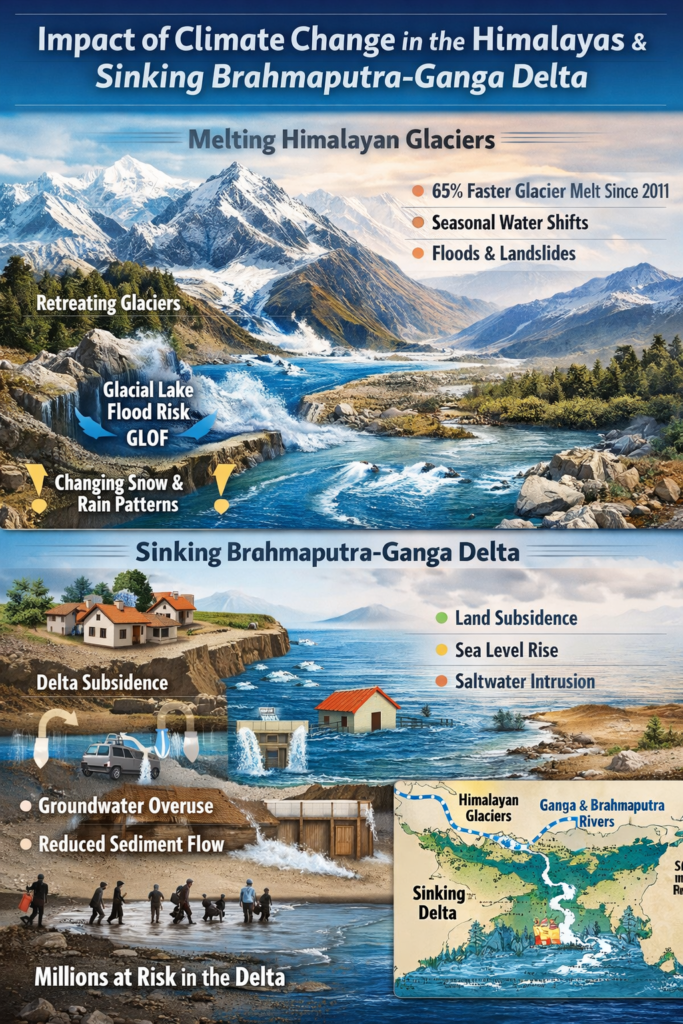
The Third Pole is melting faster than ever — and the consequences are cascading downstream. Himalayan glaciers are vanishing at a rate of 65% faster than a decade ago, feeding dangerous glacial lakes that threaten millions with sudden, devastating floods. At the same time, shifting snow and rain patterns are already disrupting the seasonal water supply that nearly two billion people depend on
Projections paint an even grimmer picture. Under a 1.5°C global warming scenario—aligned with the Paris Agreement’s aspirational limit—the HKH could lose 30% of its glacier volume by 2100, while a 2°C rise would see up to 50% vanish.
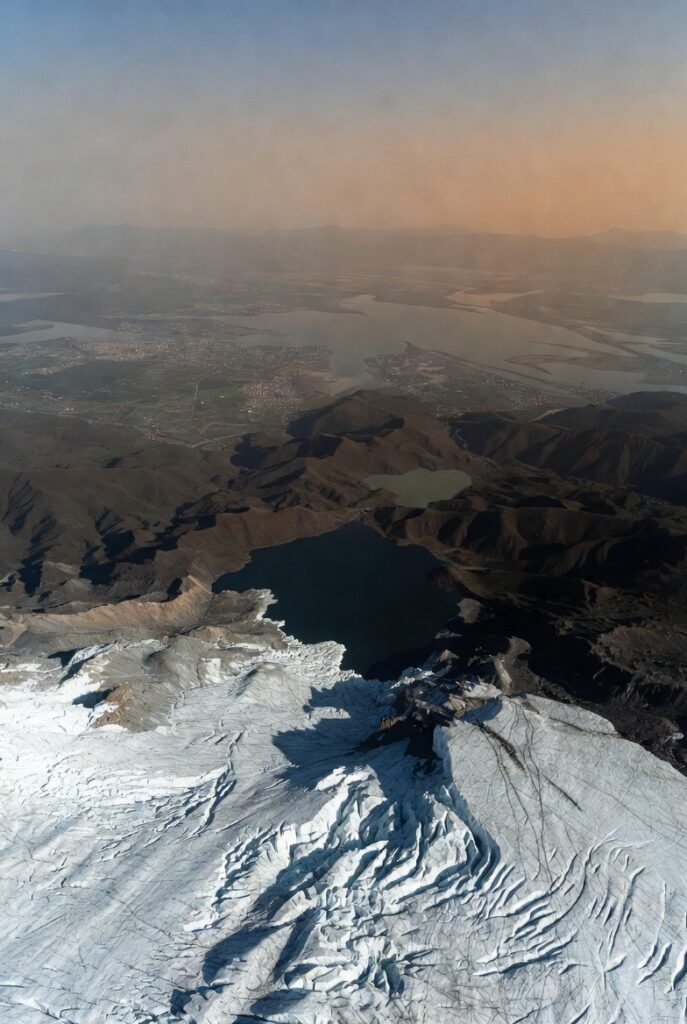
The Intergovernmental Panel on Climate Change (IPCC) corroborates this in its Special Report on the Ocean and Cryosphere, warning that even limiting warming to 1.5°C would commit the region to irreversible ice loss, with peak water runoff—when melt exceeds accumulation—potentially arriving decades earlier than previously anticipated. At higher emissions pathways, up to 75% of ice could be gone by century’s end, severely curtailing dry-season flows in dependent rivers.
Beyond rising air temperatures, which have climbed 0.2–0.3°C per decade in the HKH since the 1970s, shifting precipitation regimes exacerbate the melt. Increased atmospheric moisture leads to more rain than snow at higher elevations, a phenomenon termed “snow drought.”
This reduces the reflective snowpack that insulates glaciers, exposing them to direct solar heating and hastening ablation. A 2025 study in Nature highlighted that such droughts have intensified, with snowfall projected to decline 18.9–32.8% by mid-century, further tipping the balance toward net ice loss. These dynamics not only diminish glacier mass but also destabilize the fragile cryosphere, setting the stage for downstream perils.
Expansion of Glacial Lakes and Rising Hazards
As glaciers recede, meltwater pools in bedrock depressions and behind unstable moraines—debris dams left by retreating ice—forming thousands of supraglacial and proglacial lakes. Recent inventories reveal a stark proliferation: the High Mountain Asia (HMA) region now hosts 31,698 glacial lakes covering 2,240 square kilometers, marking a 5.5% area increase since 2016. In the
Indian Himalayas alone, the Indian Space Research Organisation (ISRO) documented 2,431 lakes larger than 10 hectares in 2016–2017, with 676 (28%) expanding significantly since 1984, and 89% of those growing more than twice their original size over 38 years.
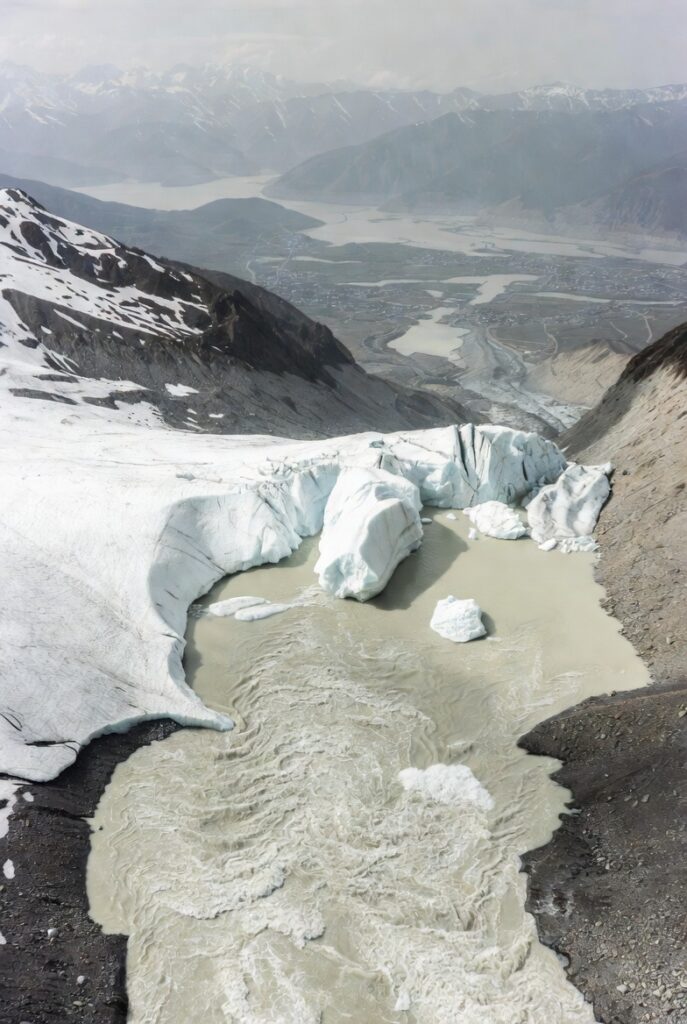
These lakes pose acute risks of glacial lake outburst floods (GLOFs), where sudden breaches unleash torrents of water, ice, and sediment. Historical events, like the 2021 Chamoli disaster in Uttarakhand, India, underscore the devastation: a rock-ice avalanche triggered a flash flood that killed over 200 and damaged hydropower infrastructure.
The eastern Himalayas emerge as a GLOF hotspot, with hazard levels three times higher than elsewhere, threatening over 9.3 million people downstream in HMA from 2,211 high-risk lakes. Transboundary vulnerabilities amplify the danger; 85% of high-risk basins straddle borders like China-Nepal, complicating early warning systems.
From mountain peaks to coastal deltas, climate change is rewriting Asia’s water story. While Himalayan ice melts and glacial lakes swell, the Ganga-Brahmaputra Delta is sinking faster than sea levels are rising — a deadly combination of reduced sediment, groundwater extraction, and global warming that puts 230 million lives and vast farmland at risk of permanent flooding and salinity.
Climate projections indicate GLOF frequency could double by 2100 under moderate warming, as lake volumes swell 20–50%. Small lakes, often overlooked, contribute disproportionately; a 2025 NASA study found they can generate floods rivaling larger ones due to rapid filling from accelerated melt. With populations swelling in valley settlements—drawn by hydropower and tourism—the human toll could escalate, demanding integrated monitoring via satellites like NASA’s GRACE and community-based alerts.
Seasonal Shifts and Water Availability
Glacier melt modulates the hydrograph of Asia’s lifelines, contributing 20–40% of dry-season flow in rivers like the Indus and Ganga. Yet, warming is skewing this rhythm. Earlier snowmelt—now advancing by 10–15 days since the 1980s—shifts peak discharges from summer to spring, heightening monsoon-season floods while parching post-monsoon periods.
In the Brahmaputra, which blends meltwater with heavy rains, this desynchronization could boost flood peaks by 20% but slash dry-season reliability by 30% by 2050.
For agrarian societies, these shifts imperil food security. The Indo-Gangetic Plain, fed by Himalayan runoff, produces 15% of global rice; erratic flows threaten yields for 600 million farmers. Hydropower, generating 20% of regional electricity, faces output volatility: excess spring melt overwhelms dams, while deficits strain reservoirs.
In long-term, as glaciers dwindle, perennial rivers may transition to seasonal ones, exacerbating droughts in basins serving 1.9 billion. Adaptation hinges on diversified water storage and transboundary pacts, like the Indus Waters Treaty, to buffer these hydrological upheavals.
Temperature Rise and Reduced Snow Cover
The HKH’s “elevation-dependent warming” amplifies global trends: mid-altitudes (3,000–5,000 meters) heat up 2–3 times faster, eroding snow cover by 13% from 2001–2021, or 751 square kilometers annually. The 2024–2025 winter set a 23-year low, with snow persistence 24% below normal, dipping to 61% coverage. This bare ground absorbs more heat, fueling albedo feedback that accelerates melt.
Altered Precipitation Patterns
Western Disturbances (WDs)—extratropical cyclones delivering winter precipitation—have mutated under climate stress. IIT Roorkee research shows WDs now intrude pre-monsoon, boosting rainfall 20% in northwest India and Pakistan while slashing snowfall in upper Himalayas.
A 2026 study in Geophysical Research Letters documents seasonal shifts: WDs peak earlier, with structural weakening reducing snow efficiency by 15–25%. This rain-snow swap erodes recharge, intensifying “snow droughts” across 70% of the HKH.
Increased Extremes: Floods and Droughts
Short-term melt surges inflate river volumes 10–20%, priming flash floods; long-term depletion forecasts 40% dry-season shortfalls by 2100. The IPCC projects extremes to intensify, with compound events—like 2023’s Pakistan floods—recurring thrice as often.
Feedback Loops: Darkening Ice and More Melt
Black carbon (BC) from South Asian biomass burning and industry darkens ice, slashing albedo by 5–10% and hastening melt by 4°C equivalent. Dust storms transport BC aloft, depositing it via monsoons; a 2025 study links this to 20–30% of observed retreat. Curbing emissions could slow loss by 20–30%, per World Bank models.
Broader Ecological and Socioeconomic Impacts
Upward treeline shifts displace alpine species; landslides, up 15% since 2000, bury villages. Pastoralists lose grazing lands, while tourism—employing millions—faces infrastructure erosion. Biodiversity hotspots like the Eastern Himalayas risk 30% species loss.
Climate change is melting Himalayan glaciers 65% faster than a decade ago, threatening freshwater for nearly 2 billion people. From expanding glacial lakes and deadly GLOFs to shifting river flows and the sinking Ganga-Brahmaputra Delta, the Third Pole crisis is already reshaping Asia’s mountains, rivers and lowlands.
Why the Brahmaputra–Ganga Delta Is Sinking
The Ganga-Brahmaputra Delta (GBD), Earth’s largest at 105,000 square kilometers, subsides 1–4 centimeters annually—outpacing sea-level rise in hotspots. Natural compaction of Holocene sediments accounts for 50%, but anthropogenic factors dominate: groundwater extraction (1–2 cm/year in Dhaka) compacts aquifers; dams like Farakka trap 70% of sediment flux, starving replenishment. Urban loads in Kolkata exacerbate sinking to 2 cm/year.
Sea-Level Rise Adds Pressure
Global melt and thermal expansion elevate seas 3.7 mm/year; in the GBD, relative rise hits 15–20 mm/year due to subsidence, projecting 30 cm submersion by 2050. IPCC models forecast 0.5–1 meter by 2100 under RCP4.5.
Consequences for Millions of People
Home to 230 million, the GBD faces inundation of 17% land by 2050, displacing 20 million. Salinity encroaches 100 km inland, halving rice yields; fisheries collapse from mangrove die-off. Cyclones like Amphan (2020) amplify surges, killing thousands.
From Mountains to Plains: A Water Story
Himalayan melt bolsters GBD sediment delivery, historically offsetting subsidence. Dams now halve this, while altered flows—up 10% wet-season, down 20% dry—erode stability. GLOFs could trigger deltaic breaches, linking highland hazards to lowland floods.
What This Means for Asia
Water insecurity looms for billions: 40% flow cuts threaten agriculture feeding 60% of India’s poor. Disasters may claim 100,000 lives/decade; economies lose $50 billion yearly to floods. Mitigation—emissions cuts, BC reductions—and adaptation—delta restoration, alerts—are imperative. IIT Roorkee and ICIMOD advocate basin-wide modeling for resilience. Without action, the Third Pole’s thaw will drown Asia’s future.
The Third Pole’s Warning: Asia’s Climate Crisis Is Accelerating Faster Than Policy
The Third Pole is not melting in isolation—it is sounding an alarm for all of Asia. Rapid glacier retreat, expanding glacial lakes, erratic river flows, and a sinking Ganga–Brahmaputra delta together signal a crisis moving faster than policy responses. Addressing it requires more than incremental adaptation: it demands coordinated, transformative action.
Governments across South and Southeast Asia must strengthen transboundary river governance, curb black carbon and greenhouse-gas emissions, reform dam and groundwater policies to restore sediment flows, and invest in early-warning systems and nature-based flood protection.
The international community must back this effort with climate finance, technology transfer, and emissions cuts consistent with limiting warming to 1.5°C. The science is clear—without decisive action now, the Third Pole’s destabilisation will become irreversible, exposing hundreds of millions to worsening floods, droughts, displacement, and food insecurity.
About the Author
Deepali Dhuliya is a communication scholar with a degree in journalism from the University of Delhi. Her work focuses on human resource management and climate change & sustainability. She has worked at Infosys, H&M, and Zomato, where she was involved in designing and managing sustainability programmes. Her work bridges communication, organisational practice, and environmental responsibility, with a strong focus on translating sustainability goals into actionable strategies.

