


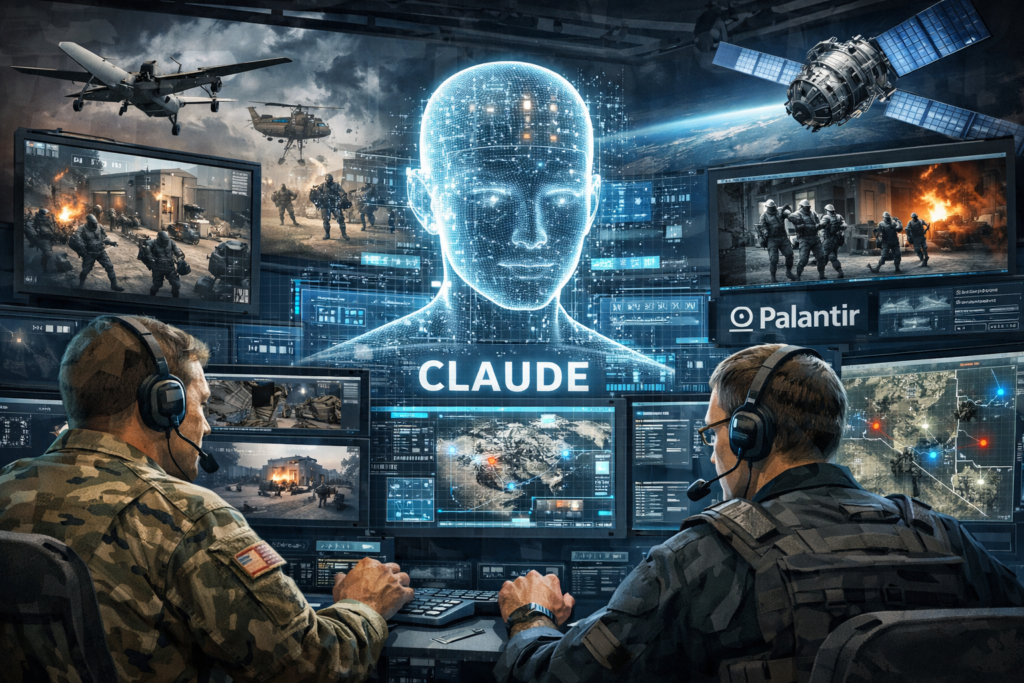
As artificial intelligence moves from labs to live battlefields, a new chapter in modern warfare is unfolding. Frontier AI systems like Anthropic’s Claude, integrated through Palantir Technologies into classified U.S. military platforms, are no longer just analytical tools—they are emerging as real-time intelligence partners, capable of processing vast streams of data amid the fog and chaos of high-risk operations.
By Newswriters News Desk
In the early hours of January 3, U.S. special operations forces launched a high-risk raid deep into Caracas, Venezuela, capturing then-President Nicolás Maduro and his wife, Cilia Flores, in a swift and audacious operation that marked a dramatic escalation in Washington’s long campaign against the Maduro regime.
What has elevated this already controversial action to a landmark in the evolution of modern warfare is the revelation, first reported by The Wall Street Journal and Axios in mid-February 2026, that Anthropic’s frontier AI model, Claude, played a direct role in supporting the operation.
Deployed through Anthropic’s partnership with Palantir Technologies on classified U.S. military platforms, Claude assisted in processing real-time intelligence during the active phase of the raid—potentially analyzing vast data streams, satellite imagery, or tactical feeds to inform decisions amid the chaos.
his alleged deployment stands in stark contradiction to the company’s own stated policy, which prohibits the use of its AI systems for military purposes. While firms like Anthropic publicly frame their models as safety-first tools meant to avoid enabling violence or lethal decision-making, the reported integration of such systems into classified military platforms exposes a growing disconnect between ethical guidelines and real-world use.
By operating through intermediaries and partnerships, AI companies can maintain formal distance while their technology nonetheless becomes embedded in active military decision-making. The result is a form of ethical outsourcing—where responsibility is blurred, accountability diluted, and policy commitments weakened by strategic and geopolitical pressures. It underscores a hard truth: as AI becomes a decisive asset in warfare, corporate self-regulation may collapse under the weight of state power and national security demands.
While the precise functions remain classified and unconfirmed in detail (with the military historically employing AI for similar intelligence synthesis tasks), this marks the first publicly documented instance of Anthropic’s technology being integrated into a live, kinetic overseas military operation.
This development has ignited fierce debate over the intersection of cutting-edge AI and lethal force. Anthropic’s own usage policies strictly prohibit deploying Claude to “facilitate violence, develop weapons, or conduct surveillance,” yet the company’s spokesperson offered only a carefully worded non-confirmation: “We cannot comment on whether Claude, or any other AI model, was used for any specific operation, classified or otherwise. Any use of Claude—whether in the private sector or across government—is required to comply with our Usage Policies.”
The timing amplifies the tension. Anthropic has positioned itself as the AI industry’s leading voice on safety, with CEO Dario Amodei issuing repeated warnings about existential risks from unconstrained systems.
The episode comes amid internal turbulence—including the abrupt resignation of safeguards research lead Mrinank Sharma with a stark warning that “the world is in peril”—and a $20 million investment in pro-regulation advocacy. Meanwhile, negotiations with the Pentagon over a potential $200 million contract have stalled, as Defense officials push for fewer restrictions on high-stakes applications like targeting and surveillance, clashing with Anthropic’s red lines.
The Maduro raid thus crystallizes a deeper dilemma: As AI becomes indispensable to military superiority in an era of great-power rivalry, can voluntary corporate safeguards hold against the imperatives of national security? For Anthropic, the stakes are existential—balancing principled restraint against the pull of government contracts and the reality that rivals like OpenAI, Google, and xAI already supply less-restricted models to the Pentagon. For the broader world, it signals that the adolescence of powerful AI has already moved from theoretical debates to the battlefield, where the line between augmentation and autonomy grows perilously thin.

