

If universities fail to adapt to a rapidly changing world, higher education risks splintering into a deeply unequal system—elite institutions catering to the global privileged, while mass institutions are reduced to credential factories offering narrow, short-term training. As independent research gives way to corporate and military priorities, the public purpose of knowledge erodes. The cost would be borne not just by universities, but by democratic societies that lose one of their last spaces for critical thought, debate, and intellectual independence.
By Subhash Dhuliya
As universities confront accelerating technological change, political scrutiny, and social disruption, their purpose is being fundamentally re-examined. This analysis reflects on how higher education can adapt to a rapidly transforming world while preserving its deeper mission—as a space for knowledge, ethical reflection, and democratic thought—at a moment when its relevance and legitimacy are under unprecedented challenge.
For more than a millennium, universities have survived wars, revolutions, plagues, and technological upheavals. From medieval monasteries to modern research powerhouses, they have continually reinvented themselves while preserving a core commitment to knowledge, inquiry, and public good. Today, however, universities across the world face one of their most profound moments of reckoning.
Globalisation, political polarisation, rapid technological change, social inequality, climate crisis, and the rise of artificial intelligence are collectively reshaping higher education—questioning its relevance, eroding trust, straining funding, and challenging academic freedom and institutional purpose.
The future of universities will depend not on whether they resist change, but on how thoughtfully they evolve.
Universities Under Pressure
This instrumental approach has altered the social contract between the university and the state. Higher education is increasingly treated as a private investment rather than a public good, shifting costs onto students while weakening long-term institutional capacity. As funding shrinks, universities are pushed towards market-driven programmes, short-term research agendas, and corporate partnerships that may compromise academic independence.
The pressure to “deliver results” quickly also undermines disciplines whose value cannot be easily quantified—such as the humanities and fundamental sciences. The value of the humanities and fundamental sciences cannot be reduced to immediate employability metrics. These disciplines cultivate critical thinking, ethical reasoning, scientific curiosity, and intellectual depth—capacities that shape societies over decades, not quarterly job reports.
Measuring them solely by short-term labour market outcomes misunderstands their role in sustaining democracy, advancing knowledge, and preparing citizens to navigate complexity and uncertainty.
A “good university” in the 21st century is one that combines excellence with inclusion, innovation with integrity, and global outlook with local responsibility. It protects academic freedom while remaining socially accountable. It uses technology wisely, nurtures human potential, and dares to ask uncomfortable questions
Students, burdened by rising fees and uncertain job markets, ask whether degrees still justify their cost. Employers question whether graduates possess relevant skills.
A persistent question confronting universities is whether their primary role is to advance research and higher learning through the transmission of knowledge, or to function as training centres supplying job-ready skills. Employers frequently complain that graduates lack “industry-relevant” competencies, fuelling pressure on universities to redesign curricula around immediate workplace needs.
Yet this framing risks creating a false dichotomy. Universities are not meant to replicate vocational institutes, nor can they ignore the realities of changing labour markets. Their distinctive contribution lies in equipping students with deep disciplinary understanding, analytical thinking, adaptability, and the capacity to learn continuously—qualities that enable individuals to acquire specific skills over time, rather than be trained narrowly for jobs that may soon disappear.
Education develops understanding, judgment, and the capacity to think critically across contexts, while training focuses on acquiring specific skills for defined tasks or jobs. Education prepares individuals for a lifetime of learning and adaptation; training prepares them for immediate performance. Both are important, but confusing one for the other diminishes the broader purpose of universities.
Apart from this conceptual contradiction, trust has eroded in many contexts. Society is divided over whether universities are neutral spaces of learning or ideological battlegrounds. In some countries, universities are accused of being elitist and detached from social realities; in others, they are seen as politically biased or culturally alienated. Academic freedom is under strain as authoritarian regimes, populist governments, and even market forces attempt to shape curricula, research agendas, and campus speech. The result is an institution caught between public expectation and political suspicion.
Yet the crisis is not merely external. Universities themselves often struggle with rigid bureaucracies, slow decision-making, outdated pedagogies, and reward systems that privilege publication counts over real-world impact. The traditional university model—campus-based, degree-centric, discipline-siloed—no longer maps neatly onto a world defined by lifelong learning, interdisciplinary problems, and digital connectivity.
Compounding this mismatch is the challenge that many faculty members struggle to remain fully abreast of rapid changes in knowledge production, technology, and professional practice. Heavy teaching loads, administrative responsibilities, limited institutional support for continuous upskilling, and incentive structures that reward narrow specialisation over renewal often slow adaptation. As a result, curricula risk lagging behind evolving realities, reinforcing the perception that universities are out of sync with a fast-changing world rather than actively shaping it.
Universities help shape citizens, not just employees; they nurture values such as integrity, curiosity, tolerance, and critical inquiry, not merely technical skills. In doing so, they sustain the ethical foundations of democratic societies and the cultural imagination needed to confront complex global challenges
Universities and Global Challenges
Paradoxically, just as universities face questions about relevance, the world needs them more than ever. Climate change, pandemics, widening inequality, violent conflict, democratic backsliding, and the ethical dilemmas of AI cannot be solved by technology or markets alone. They demand deep research, ethical reflection, historical understanding, and cross-disciplinary collaboration—precisely the strengths universities are meant to offer.
Universities are among the few institutions capable of integrating science with social science, technology with ethics, and innovation with long-term thinking. They can generate climate solutions while interrogating their social costs, develop AI systems while questioning their moral implications, and analyse inequality while educating future leaders to address it.
However, to play this role effectively, universities must move beyond ivory-tower isolation. They must engage more directly with communities, policymakers, industries, and civil society—without becoming captive to any single interest. The challenge is to remain independent yet engaged, critical yet constructive.
Tradition Versus Disruption
At the heart of the debate lies a deep tension between tradition and disruption. Universities are custodians of accumulated knowledge, academic norms, and cultural memory. Their rituals, degrees, peer review systems, and tenure structures exist to protect intellectual rigour and autonomy. At the same time, digital platforms, online learning, micro-credentials, corporate training programmes, and AI tutors are disrupting how knowledge is produced and consumed.
If universities cling too tightly to tradition, they risk irrelevance. If they embrace disruption uncritically, they risk losing their soul.
The future lies not in choosing between the two, but in integrating them. Universities must preserve slow thinking in a fast world, depth in an age of information overload, and human judgment in an era of automation—while still experimenting with new formats, technologies, and partnerships.
Universities must innovate with purpose, ensuring that efficiency, speed, and technological adoption do not come at the cost of intellectual depth, academic freedom, and human values.
What If Universities Fail or Succeed?
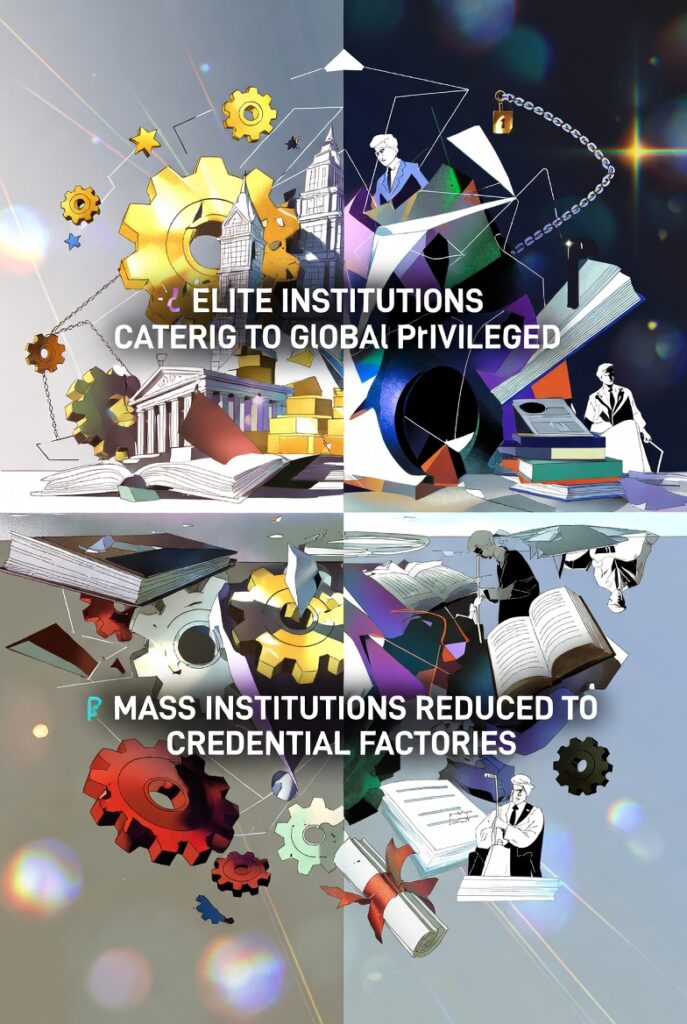
If universities fail to evolve, the consequences will be significant. Higher education could fragment into a two-tier system: elite institutions serving the global privileged, and mass-market credential factories offering narrow vocational training. Research may shift increasingly into corporate or military domains, driven by profit or power rather than public interest. Democratic societies would lose one of their most important spaces for independent thought, debate, and critique.
If universities do evolve successfully, however, they could become even more central to social progress. They could act as hubs of lifelong learning, engines of inclusive innovation, and trusted spaces for dialogue in polarised societies. The difference between these futures depends on choices being made now—about governance, culture, technology, and values.
The University of the Future
The university of the future is unlikely to be defined by grand campuses alone. It will be hybrid—combining physical spaces with digital platforms, local engagement with global networks. Governance models will need reform, with greater transparency, participation, and accountability. Leadership will require not just administrative efficiency, but moral clarity and intellectual vision.
Academic culture must also change. Interdisciplinary work should be rewarded, teaching valued alongside research, and public engagement recognised as a core scholarly responsibility. Universities will need to move away from rigid hierarchies and embrace collaborative, team-based knowledge creation.
AI-Empowered, But Human-Centred
Artificial intelligence will profoundly reshape universities—but it need not dehumanise them. AI can assist in personalised learning, research synthesis, data analysis, and administrative efficiency. Used well, it can free faculty and students from routine tasks and allow more time for mentoring, creativity, and critical thinking.
The danger lies in treating AI as a substitute for human judgment rather than a tool to enhance it. Universities must lead in setting ethical standards for AI use—addressing bias, surveillance, intellectual property, and the meaning of authorship and originality. An AI-empowered university should be more humane, not less.
The Future of Teaching, Research, and Knowledge
Teaching will increasingly shift from passive lectures to active, problem-based learning. Students will need not just information, but the ability to think critically, collaborate across cultures, and navigate uncertainty. Research will become more collaborative and mission-driven, addressing complex societal challenges while maintaining basic, curiosity-driven inquiry.
Knowledge creation itself is changing. Universities must recognise multiple forms of knowledge—including indigenous, local, and experiential knowledge—while upholding standards of evidence and reasoning. In doing so, they can broaden whose voices count in the production of truth

Universities as Moral and Civic Institutions
Above all, universities must resist being reduced to mere service providers selling degrees in an increasingly competitive education marketplace. They are moral, civic, and cultural institutions with responsibilities that extend far beyond market demand or employability statistics.
Universities help shape citizens, not just employees; they nurture values such as integrity, curiosity, tolerance, and critical inquiry, not merely technical skills. In doing so, they sustain the ethical foundations of democratic societies and the cultural imagination needed to confront complex global challenges.
The future of universities is not predetermined; it will be forged through deliberate political choices, visionary leadership, and an engaged society demanding both excellence and integrity. How universities respond will determine not only the trajectory of higher education but also the resilience of knowledge, the vitality of democratic life, and the ethical foundations of our global community. In navigating the tension between tradition and innovation, between skills and values, universities have the opportunity to reaffirm their timeless role as beacons of inquiry, civic responsibility, and human flourishing.
References & Further Readings
Books
- Kerr, Clark (2001).
The Uses of the University (5th ed.).
Cambridge, MA: Harvard University Press.
(Classic work on the evolving purposes of the modern university.) - Delbanco, Andrew (2012).
College: What It Was, Is, and Should Be.
Princeton, NJ: Princeton University Press. - Collini, Stefan (2012).
What Are Universities For?
London: Penguin Books. - Bourdieu, Pierre & Passeron, Jean-Claude (1990).
Reproduction in Education, Society and Culture.
London: Sage Publications.
(Originally published in French in 1970.) - Barnett, Ronald (2011).
Being a University.
London: Routledge. - Marginson, Simon (2016).
The Dream Is Over: The Crisis of Clark Kerr’s California Idea of Higher Education.
Berkeley: University of California Press. - Caplan, Bryan (2018).
The Case Against Education: Why the Education System Is a Waste of Time and Money.
Princeton, NJ: Princeton University Press. - Smith, Michael D. (2019).
The Abundant University: Remaking Higher Education for a Digital World.
Baltimore: Johns Hopkins University Press. - Nussbaum, Martha C. (2010).
Not for Profit: Why Democracy Needs the Humanities.
Princeton, NJ: Princeton University Press.
Journal Articles & Reports
- Marginson, Simon (2011).
“Higher Education and Public Good.”
Higher Education Quarterly, Vol. 65, No. 4. - Altbach, Philip G., Reisberg, Liz & Rumbley, Laura E. (2019).
Trends in Global Higher Education: Tracking an Academic Revolution.
Rotterdam: Sense Publishers. - Giroux, Henry A. (2014).
“Neoliberalism’s War on Higher Education.”
Haymarket Books (Essay collection). - Biesta, Gert (2015).
“Good Education in an Age of Measurement.”
Educational Assessment, Evaluation and Accountability, Springer. - Zuboff, Shoshana (2019).
The Age of Surveillance Capitalism (relevant chapters on universities and data).
New York: PublicAffairs.
Web & Institutional Resources
- UNESCO (2022).
Reimagining Our Futures Together: A New Social Contract for Education.
Paris: UNESCO Publishing. - World Economic Forum (2023).
The Future of Jobs Report.
Geneva: WEF. - OECD (2023).
Education at a Glance.
Paris: OECD Publishing. - Government of India (2020).
National Education Policy 2020.
New Delhi: Ministry of Education. - Higher Education Policy Institute (HEPI) (2024).
Artificial Intelligence and the Future of Higher Education.
Oxford: HEPI.
Prof. Subhash Dhuliya is a distinguished academician, researcher, and educational administrator. He served as Vice Chancellor of Uttarakhand Open University and Professor at IGNOU, IIMC, and CURAJ. Earlier, he worked as Assistant Editor and Editorial Writer with the Times Group- Sunday Times and Navbharat Times, and as Chief Sub-Editor at Amrit Prabhat (Amrita Baza Patrika Group). He has edited IIMC’s research journals Communicator and Sanchar Madhyam, founded Newswriters.in, and served as a UNESCO consultant for journalism education in the Maldives.
Acknowledgement:
The ideas, analysis and conclusions expressed in this article are solely those of the author. AI tools were used for background research and editorial support.
PROMOTIONAL CONTENT