


By Rohit Dhuliya
The Homogenization of American Life: Corporate Overreach in Commerce and Culture
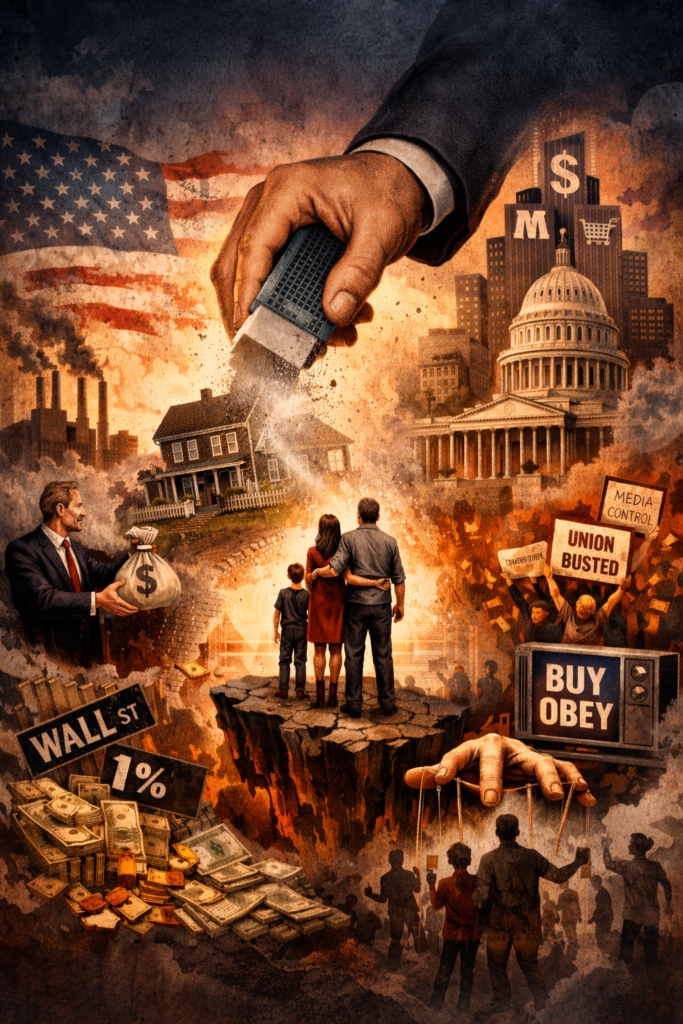
In today’s America, the classic promise of hard work leading to prosperity, homeownership, upward mobility, and a secure middle-class life feels increasingly out of reach for millions. The culprit? Unbridled corporate power that has reshaped society in ways that prioritize shareholder profits over people, communities, and shared opportunity.
Big corporations—through relentless consolidation, wage suppression, political influence, and cultural dominance—are systematically dismantling the foundations of the American Dream. Wages have stagnated for decades even as worker productivity skyrockets, with corporate profits and executive pay soaring to historic highs. Unions, once a counterbalance to corporate greed, have been eroded to historic lows, leaving workers vulnerable to exploitation, longer hours, fewer benefits, and precarious gig-economy jobs.
Politically, corporations wield outsized influence via massive lobbying, campaign donations, and the “revolving door” between boardrooms and government. Landmark decisions like corporate “personhood” and unlimited campaign spending have turned democracy into a pay-to-play system, where policies favor tax cuts for the wealthy, deregulation, and corporate welfare over investments in education, healthcare, infrastructure, and social mobility.
On the ground, the physical and cultural landscape tells the story: Main Street America has been overrun by identical fast-food chains and big-box giants like Walmart and Amazon, wiping out local businesses, draining community wealth, and replacing unique regional character with homogenized consumerism. Entertainment monopolies flood the airwaves and screens with formulaic, sensationalized content—violent media, reality TV, and hyper-commercialized distractions—that numbs critical thinking, erodes moral values, and promotes materialism over civic engagement.
The result is a society of growing inequality, declining social mobility, environmental neglect, and widespread disillusionment. Recent surveys show most Americans feel economic conditions are hurting them, with many abandoning dreams of homeownership, family stability, or retirement security. Private equity firms and mega-corporations extract value from industries like healthcare, retail, and housing, often leaving behind job losses, debt-laden communities, and shuttered institutions.
This isn’t inevitable market evolution—it’s the outcome of decades of policy choices that let corporate interests dominate. The American Dream isn’t dead yet, but it’s fading fast under corporate stranglehold. Reclaiming it requires confronting this power: stronger antitrust enforcement, campaign finance reform, worker protections, and a renewed focus on people over profits. Before the dream fully vanishes, America must decide whether corporations serve the nation—or the nation serves corporations.
The homogenization of American life refers to the gradual erosion of regional diversity, local traditions, and individual agency, replaced by standardized, mass-produced experiences driven by corporate interests. This phenomenon manifests in two interconnected arenas: the commercial landscape, where fast-food chains and big-box retailers dominate, and the entertainment industry, where consolidated media empires churn out content that prioritizes shock value over substance. Together, these forces foster rampant consumerism while undermining moral values, community ties, and cultural uniqueness. Far from a natural evolution, this shift is a byproduct of economic strategies that prioritize profit over people, leading to a society where sameness breeds conformity and ethical decay.
Commercial Homogenization: The Death of Main Street
At the heart of this homogenization is the proliferation of fast-food chains like McDonald’s, Burger King, and Starbucks, alongside big-box retailers such as Walmart, Target, and Amazon’s physical outposts. These entities have transformed America’s urban and rural landscapes, turning once-vibrant Main Streets into ghost towns of shuttered mom-and-pop shops. Historically, small businesses defined local character—think family-owned diners serving regional specialties or independent hardware stores stocked with community-specific goods. Today, these are supplanted by identical franchises and warehouses, creating a “placeless” America where every town looks eerily similar.
Economically, the impact is devastating. Studies show that big-box stores often lead to net job losses rather than gains. For instance, a comprehensive analysis of Walmart’s expansion from 1977 to 2002 across U.S. counties revealed an average net loss of 150 retail jobs per store opening, as local competitors close. Smaller retailers can’t match the pricing power derived from global supply chains and economies of scale, resulting in closures that ripple through communities.
In one study, within 15 months of a Walmart opening, up to 14 existing retail establishments shut down, with only about 3.5 new ones emerging. This isn’t just about jobs; it’s about wealth extraction. National chains siphon profits to distant headquarters, reducing local economic circulation. Locally owned businesses recirculate up to three times more money in the community compared to chains, which often bank and procure externally. A 2023 report on dollar stores highlights how they push out grocers, limiting access to fresh food and fostering “food deserts” in small towns.
Culturally, this fosters consumerism as a default lifestyle. Big-box stores promote endless consumption through low prices, planned obsolescence, and impulse-buy layouts, encouraging Americans to define identity through purchases rather than community or craftsmanship.
The erasure of local character is palpable: historic downtowns give way to sprawling parking lots and uniform architecture, diminishing civic pride and social cohesion. Environmental costs compound this—big-box developments consume open space, increase traffic, and contribute to urban sprawl. Critics argue this creates a “Ponzi scheme” of temporary tax boosts followed by infrastructure burdens that localities can’t sustain. In rural areas, the effect is acute; chains homogenize tastes, replacing regional cuisines with processed uniformity, while urban neighborhoods lose ethnic markets to generic supercenters.
Defenders claim these stores provide affordability and convenience, especially in underserved areas. Yet, evidence suggests they exacerbate inequality: wages at chains are lower (often below living standards), benefits scarcer, and unionization rarer than at independents. A 2014 study linked Walmart’s presence to higher obesity and crime rates, alongside reduced per-acre tax revenues compared to mixed-use developments. Over time, this homogenization breeds a consumerist ethos where value is measured in bargains, not sustainability or community investment.
Entertainment Monopolies: Degenerate Content and Moral Erosion
Parallel to commercial dominance, media consolidation amplifies cultural homogenization. Today, a handful of conglomerates—Disney, Warner Bros. Discovery, Paramount, and tech giants like Netflix and Amazon—control vast swaths of entertainment, from films to streaming. This began accelerating post-1996 Telecommunications Act, leading to mergers that reduced independent voices. By 2025, three companies own 40% of local TV stations, influencing content toward national uniformity over local nuance. Outcomes include homogenized programming: formulaic blockbusters, reboots, and reality TV dominate, sidelining diverse storytelling.
Critics decry the “degenerate” content pumped out—violent video games, sensational reality TV, and hyper-sexualized media—as eroding moral values. Violent games like Grand Theft Auto or Call of Duty glorify aggression, with meta-analyses linking exposure to increased real-world aggression, especially in youth. A 2018 review found small but reliable boosts in physical aggression among adolescents.
Mechanisms include desensitization and moral disengagement, where players justify virtual violence, potentially spilling into hostility. Reality TV, from shows like Keeping Up with the Kardashians to Survivor, promotes voyeurism, superficiality, and conflict as entertainment, normalizing deceit and materialism. Hyper-sexualized media, prevalent in games and ads, objectifies women, fostering sexism. Studies show brief exposure to sexualized avatars increases hostile sexism and acceptance of harassment. A meta-analysis tied such content to body dissatisfaction and misogyny, though effects vary by methodology.
This content erodes morals by prioritizing shock over ethics: violence desensitizes empathy, reality TV rewards narcissism, and sexualization commodifies bodies. Consolidated media favors profitable sensationalism—algorithms push extreme content to maximize engagement—leading to societal ills like reduced prosocial behavior and heightened aggression. Critics argue this creates a feedback loop: homogenized entertainment reinforces consumerist values, where happiness is tied to trends rather than virtue.
Skeptics counter that links to violence are overstated; the APA notes insufficient evidence for causal ties to severe acts, emphasizing multifactorial causes like poverty. Some studies find no harm from sexualization, suggesting objectification theory may not fully apply to interactive media. Yet, broader consolidation reduces viewpoint diversity, potentially biasing narratives toward corporate-friendly themes.
Societal Impacts and the Path Forward
Collectively, these forces create a homogenized America: commerce strips local identity, fostering debt-fueled consumerism; entertainment dulls moral compasses, promoting vice as virtue. Outcomes include rising inequality, cultural apathy, and ethical relativism—evident in increased societal violence, family fragmentation, and environmental neglect.
To counter this, revitalizing local economies through policies supporting independents, and diversifying media via antitrust measures, could restore vibrancy. Ultimately, homogenization isn’t inevitable; it’s a choice shaped by unchecked corporate power, one that demands reclamation for a more authentic American dream.
About the Author
Rohit Dhuliya is a filmmaker and writer known for insightful documentaries and commentary on contemporary issues. His films have screened at festivals including Mumbai International Film Festival, Swedish International Film Festival, Signs Film Festival (Kerala), Monadnock International Film Festival (USA), and Global Peace Film Festival (USA). Wounds of Change won the Rising Star Award at the Canada International Film Festival and screened at the University of Heidelberg. His recent film Gandhi Rediscovered received the Short Documentary Award at the Portland International Film Festival, the Golden Sparrow Film Festival, and an official selection at Monadnock.

