


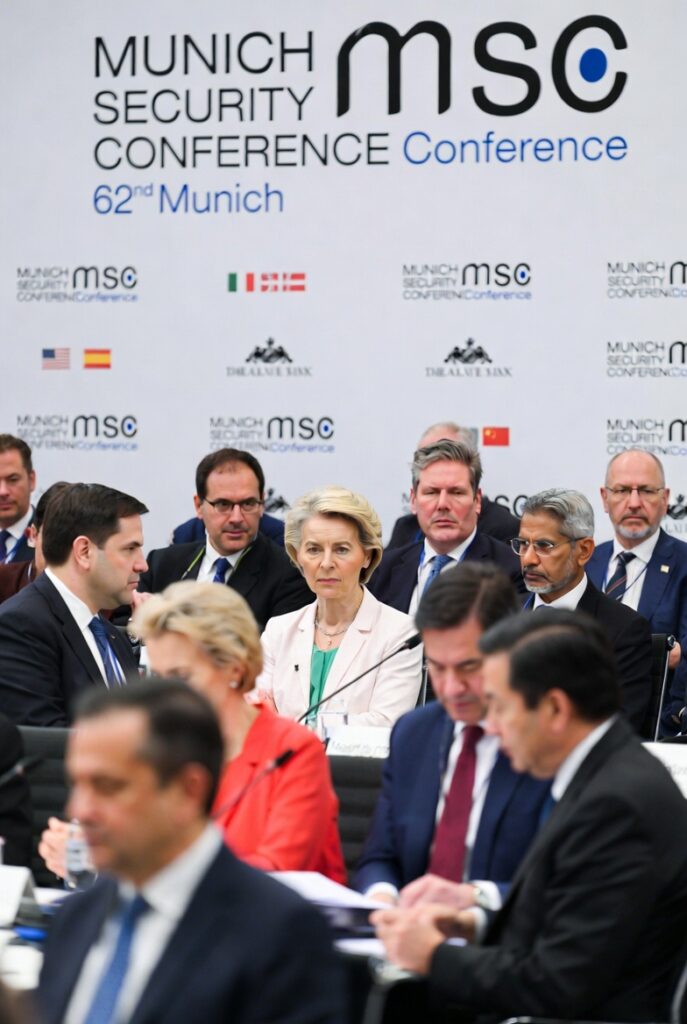
The 62nd Munich Security Conference (Feb 13–15, 2026) unfolded under the shadow of the Munich Security Report Under Destruction, which warned of “wrecking-ball politics” dismantling the post-1945 order. Nearly 50 heads of state and government addressed transatlantic strains, Europe’s drive for strategic autonomy, and multipolar shifts. U.S. Secretary of State Marco Rubio reaffirmed Western unity while pressing for burden-sharing, European Commission President Ursula von der Leyen called defense independence “obligatory,” UK Prime Minister Keir Starmer pledged Arctic deployments, India’s S. Jaishankar stressed strategic autonomy, and China’s Wang Yi positioned Beijing as a guardian of multilateralism. Amid Ukraine’s war, Arctic tensions, and regime-change protests, the gathering highlighted incremental resilience efforts but exposed deepening Western divisions and the accelerating rise of multipolarity.
By Newswriters News Desk
The 62nd Munich Security Conference (MSC), held from February 13 to 15, 2026, at Munich’s Hotel Bayerischer Hof and Rosewood Munich, brought together nearly 50 heads of state and government, hundreds of policymakers, military leaders, and experts from over 100 countries.
Framed by the annual Munich Security Report titled Under Destruction, the event dissected a fraying global order characterized by “wrecking-ball politics” that dismantle rather than reform institutions, amid eroding multilateralism, regional conflicts, and technological disruptions.
MSC Chairman Wolfgang Ischinger upheld the “Munich Rule” of eye-level dialogue, fostering candid exchanges in a volatile landscape. Dominated by German Chancellor Friedrich Merz’s European delegation and transatlantic recalibrations under the second Trump administration, the conference tested unity on Ukraine, Arctic security, and Europe’s strategic autonomy.
The report’s core thesis highlighted deliberate deconstruction of norms—from trade to non-proliferation—driven by populist forces exploiting economic and migration grievances. Day 1 panels probed transatlantic bonds strained by U.S. isolationism and Europe’s defense gaps, while “Competing Visions of the Global Order” featured Global South perspectives advocating multipolarity.
Ukraine remained central, with Zelenskyy virtually demanding a NATO membership timeline as a deterrent. Middle East and Arctic flashpoints surfaced in sideline talks, alongside
AI-enabled warfare and cyber vulnerabilities. Societal issues like migration and deindustrialization fueled debates, with Rubio critiquing mass migration’s destabilizing effects.
U.S. Secretary of State Marco Rubio’s February 14 keynote offered reassurances, invoking shared Western civilization while critiquing post-Cold War delusions on globalization, energy, and migration. He positioned Trump’s approach as burden-sharing for a “just” Ukraine settlement and managed rivalry with China. EU figures like Kaja Kallas welcomed the tone shift from prior criticisms, though some viewed it as condescending.
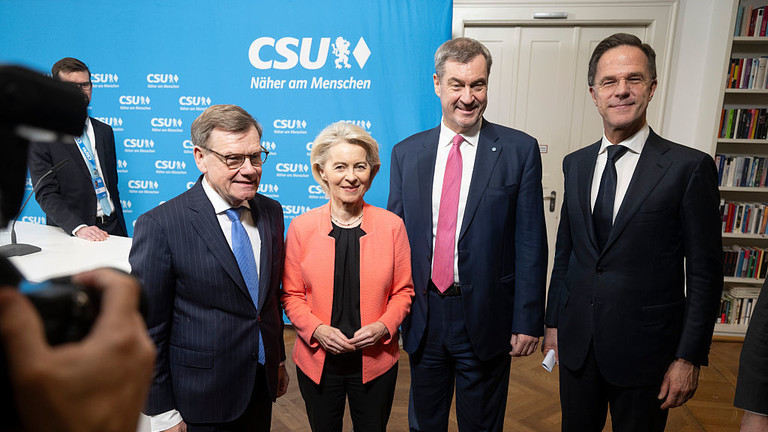
Johann Wadephul, Ursula von der Leyen, Markus Soeder, and Mark Rutte at the Munich Security Conference, Germany, February 13, 2026. © Getty Images / Marijan Murat/picture alliance
European Commission President Ursula von der Leyen countered with “Europe’s Path to Independence,” declaring mutual defense obligatory and urging autonomy in defense, energy, and tech for a “new Western century.” UK Prime Minister Keir Starmer announced Arctic deployments of HMS Prince of Wales and commandos, signaling readiness amid Russian and Chinese ambitions.
A key dimension emerged from addresses by India’s External Affairs Minister S. Jaishankar and China’s Foreign Minister Wang Yi, illustrating divergent yet complementary multipolar visions.
Jaishankar, in the panel “Navigating Uncertainty: India and Germany in a World in Disarray” with German Foreign Minister Johann Wadephul, reaffirmed India’s deep-rooted strategic autonomy—transcending political divides—enabling independent choices like sustained Russian energy ties despite U.S. pressures.
He highlighted dynamic foreign policy, IMEC corridor progress for connectivity, UN@80 reforms including Security Council expansion, Quad unity, maritime security, and pragmatic coalition-building to navigate transitions without rigid alignments.
Wang Yi, in his keynote “Joining Hands to Set the Ship of History on the Right Course” during the “Conversation with China,” defended multilateralism and the UN Charter against disruptions, portraying China as a stable partner to Europe (“partners, not rivals”) while cautioning against decoupling, unilateralism, and Taiwan-related provocations—accusing Japan of “angry ambitions.”
He stressed peaceful Ukraine resolutions, China’s indispensability in talks (“if it is not on the table, it is on the menu”), and U.S.-China ties hinging on Washington’s pragmatism. Their interventions highlighted fault lines: India’s autonomous Global South focus versus China’s assertive multilateral defense, both challenging Western narratives in the “under destruction” context.
Sideline highlights included massive protests for Iranian regime change, Syrian stabilization talks involving Kurdish leaders, and informal pledges on AI governance and Arctic patrols—though no major binding outcomes emerged, reflecting the MSC’s signaling role.
The conference exposed Western divisions more than external threats, with Rubio’s transactionalism risking fatigue and Europe’s autonomy vision facing fiscal hurdles. Globally, it signaled multipolarity’s rise, China’s influence in supply chains and diplomacy, and Ukraine’s test of resolve. As Ischinger concluded, “Yesterday is over”—urging bold action amid debris, with 2027’s gathering poised to reveal whether seeds of resilience take root or fissures deepen.

