


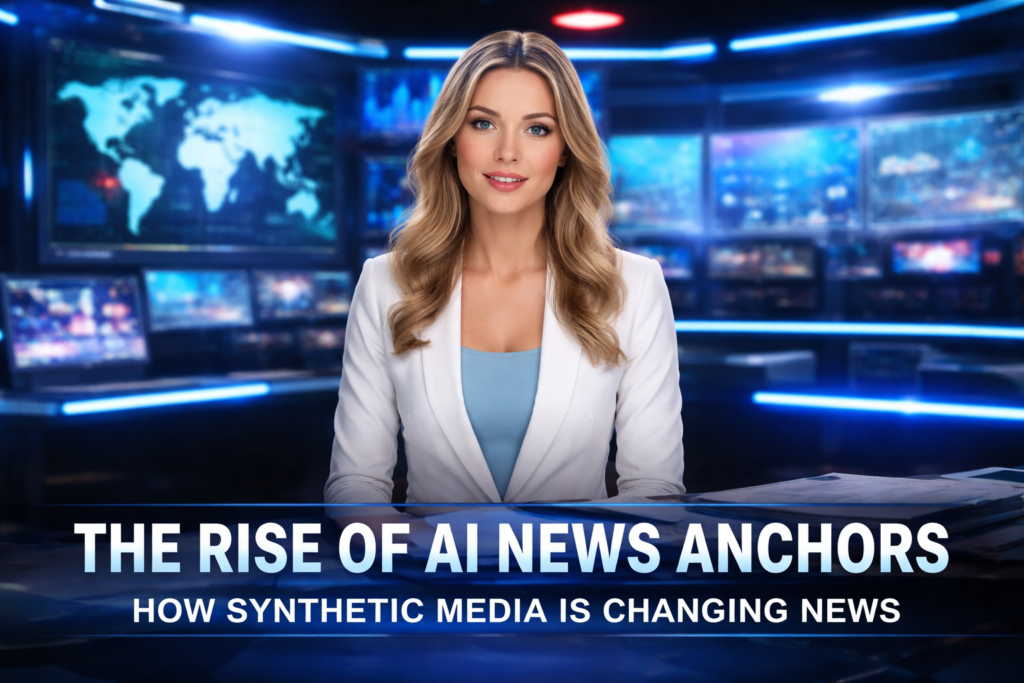
Artificial intelligence is rapidly reshaping the global information ecosystem. One of the most striking developments is the rise of AI-generated news presenters, often called synthetic anchors or digital avatars. These lifelike presenters can deliver news, analysis, and commentary without ever appearing in a physical studio.
As platforms such as YouTube and X (Twitter) become flooded with automated video content produced using tools like Synthesia and HeyGen, journalists and researchers are beginning to examine the implications for media credibility, information warfare, and the future of public trust in digital news.
By Muneshwar
The rapid development of artificial intelligence in the past few years has begun to transform the global information ecosystem in ways that were scarcely imaginable a decade ago. Among the most striking developments is the emergence of AI-generated news presenters, often referred to as AI avatars or synthetic anchors.
These digital presenters resemble human news hosts but are created using artificial intelligence systems capable of generating lifelike speech, facial expressions, and video presentations. The phenomenon has expanded rapidly since 2023, raising important questions about media production, information credibility, and the future of journalism.
The proliferation of AI news presenters represents a broader transformation often described as synthetic media—content that is partially or entirely generated by artificial intelligence. This new form of media production is not merely a technological novelty; it has significant implications for journalism, digital communication, and geopolitical information campaigns.
The Technological Foundations of AI News Presenters
The emergence of AI-generated presenters became possible due to advances in machine learning, natural language processing, and generative video technology. Platforms such as Synthesia, HeyGen, and D-ID have developed tools that allow users to create realistic video presenters without traditional filming.
How AI-Generated News Presenters Are Created
The creation of videos featuring AI-generated presenters typically follows a structured multi-stage workflow that combines human input with automated media-generation technologies. Although the final output may resemble a professionally produced studio broadcast, the entire process can often be completed within minutes using specialized AI platforms.
1. Script Development
The process begins with the preparation of a script. In most cases, a human creator—such as a journalist, content producer, or researcher—writes the script that the presenter will deliver. Increasingly, however, scripts themselves may be generated or refined with the help of generative AI tools that assist in drafting summaries, commentary, or explanatory narratives. The script determines not only the content of the video but also its tone, pacing, and informational structure.
2. Text-to-Speech Conversion
Once the script is finalized, it is uploaded to an AI video-generation platform. The system converts the text into spoken narration using synthetic voice technology, commonly known as text-to-speech (TTS). Modern TTS systems rely on advanced neural networks capable of producing voices that sound natural and expressive, often allowing users to select from multiple accents, speaking styles, and languages. Some platforms also allow the creation of custom voices that mimic a particular speaking style or vocal identity.
3. AI Avatar Generation
The next step involves pairing the narration with a digital presenter, often referred to as an AI avatar. These avatars are computer-generated human figures designed to simulate realistic facial movements, eye contact, and body language. When the synthetic voice narrates the script, the system automatically synchronizes lip movements and facial expressions with the spoken words. This synchronization—sometimes called lip-sync animation—creates the illusion that the avatar is actually speaking the text.
4. Visual Composition and Background Design
Many platforms allow creators to choose or design a virtual studio environment in which the avatar appears. Backgrounds may include newsroom sets, abstract digital graphics, or animated data displays. Additional visual elements such as charts, headlines, subtitles, or images can also be inserted to make the video resemble a conventional news broadcast or explanatory presentation.
5. Rendering and Video Production
After these elements are assembled—the script, voice narration, avatar, and visual background—the system renders the final video. Rendering involves processing all components together into a single synchronized video file. Because the entire workflow is automated, the rendering stage typically takes only a few minutes.
6. Distribution and Publishing
The finished video can then be exported and uploaded directly to digital platforms such as YouTube, TikTok, or X (Twitter). Some AI platforms even integrate publishing tools that allow creators to distribute content automatically across multiple social-media channels.
From Studio Production to Automated Media
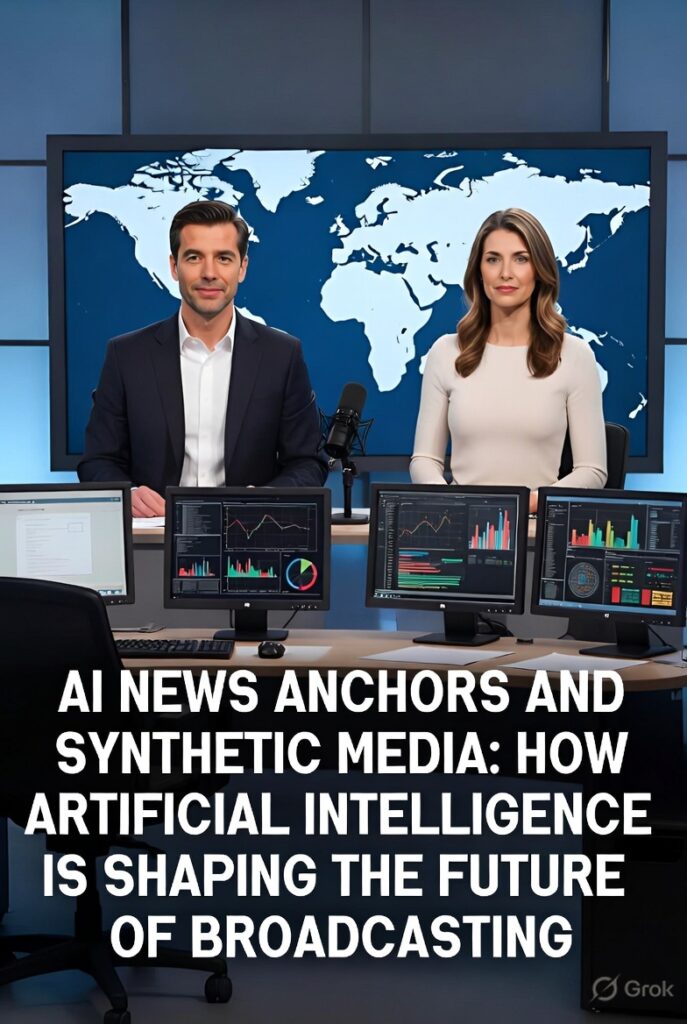
Traditionally, producing a news-style video required a studio, camera equipment, lighting, professional presenters, and post-production editing. AI-generated presenters drastically reduce these requirements. With only a script and access to an AI video platform, creators can generate professional-looking videos at very low cost and in a fraction of the time previously required.
This transformation is one reason why AI-generated anchors and synthetic presenters have rapidly appeared across digital media. While the technology offers new possibilities for content creation, it also raises important questions about transparency, credibility, and the evolving relationship between human journalists and automated media systems.
AI Platforms Used to Create Synthetic Presenters
Several specialized platforms have emerged that enable creators to produce videos featuring AI-generated presenters. These platforms combine text-to-speech systems, facial animation technologies, and video-rendering tools into a single automated workflow. Among the most widely used services is Synthesia, which allows users to select from dozens of digital avatars capable of delivering scripted content in multiple languages.
Another popular platform is HeyGen, known for its realistic avatars and customizable voice options. These tools enable creators to upload a script, choose an avatar and background, and generate a finished video within minutes.
A similar technology is offered by D-ID, which focuses on animating still images into speaking faces using advanced facial-mapping algorithms. In this approach, a static photograph or digital portrait can be transformed into a talking presenter that appears to deliver the scripted narration. Some systems even allow users to create custom avatars modeled on real people, further enhancing the realism of the presentation.
What distinguishes these platforms is their reliance on deep-learning models trained on large datasets of human speech, facial expressions, and video recordings. These models enable the system to synchronize lip movements with speech, generate subtle facial expressions, and simulate natural eye contact with viewers. As a result, the final video can closely resemble a traditional studio broadcast—even though no camera, studio, or human presenter was involved in the recording process.
For content creators, marketers, educators, and media organizations, these tools significantly reduce the cost and complexity of video production. At the same time, the technology raises important questions about transparency and authenticity. When viewers encounter a highly realistic digital presenter, it may not always be clear whether the individual on screen is a real journalist or a synthetic avatar generated by artificial intelligence.
This ambiguity is one reason why AI-generated presenters are becoming a subject of growing discussion in debates about the future of journalism, digital media ethics, and information credibility.
What makes these tools particularly powerful is their accessibility. They require little technical expertise and are available through subscription-based services. As a result, individuals, companies, and institutions can now produce professional-looking video content without studios, cameras, or human presenters.
The Economics of Synthetic News Production
One of the main drivers behind the rapid spread of AI presenters is the dramatic reduction in production costs. Traditional video journalism requires substantial resources: professional presenters, studio equipment, lighting, cameras, editors, and production staff. These costs can run into thousands of dollars for a single segment.
AI avatars dramatically change this equation. A single content creator can produce multiple videos per day using automated systems. The cost per video may be only a few dollars or less, depending on the platform used. This cost advantage has encouraged many online content producers to experiment with AI-generated presenters.
In the age of algorithm-driven platforms, such as YouTube, TikTok, and X (Twitter), frequent content production is essential for visibility and audience engagement. AI avatars allow creators to generate a steady stream of content without the logistical constraints of traditional video production. This has made them particularly attractive for channels focused on news summaries, educational explainers, and commentary on current events.
Corporate and Educational Applications
It would be misleading to view AI presenters solely through the lens of misinformation or manipulation. Many organizations use them for legitimate and practical purposes. Corporations employ AI avatars to create training videos, internal communications, and marketing presentations. Universities and online education platforms also use synthetic presenters to deliver lectures or instructional modules.
The advantage in these contexts lies in consistency and scalability. An AI presenter can deliver identical messages across multiple languages, maintain consistent branding, and update content quickly when information changes. This makes synthetic presenters useful for organizations operating in global environments where rapid communication is essential.
Synthetic Media and Information Warfare
Despite these legitimate applications, the rise of AI-generated news anchors has also attracted attention from researchers studying information warfare and digital propaganda. Synthetic presenters can potentially be used to create large volumes of persuasive content that resembles traditional news broadcasts.
One widely discussed example is the AI-generated persona known as Wolf News, which appeared in videos promoting geopolitical narratives aligned with Chinese state interests. Investigations by cybersecurity researchers revealed that the presenter was entirely synthetic, created using AI video technology. The videos were distributed across multiple platforms, giving them the appearance of independent news commentary.
The strategic value of such synthetic presenters lies in their scalability and anonymity. A single organization can produce hundreds of videos across multiple languages and platforms while maintaining the illusion of diverse voices. Unlike traditional propaganda outlets, which often carry recognizable institutional identities, AI presenters can appear as independent commentators or analysts.
This phenomenon represents a new phase in the evolution of information warfare, where artificial intelligence is used to amplify narratives and shape public perception.
Challenges for Media Credibility
The emergence of synthetic presenters poses significant challenges for the credibility of online information. Historically, viewers relied on visual cues to assess authenticity. Seeing a person speak on camera created a sense of trust because the audience assumed the presenter was a real individual accountable for the information being delivered.
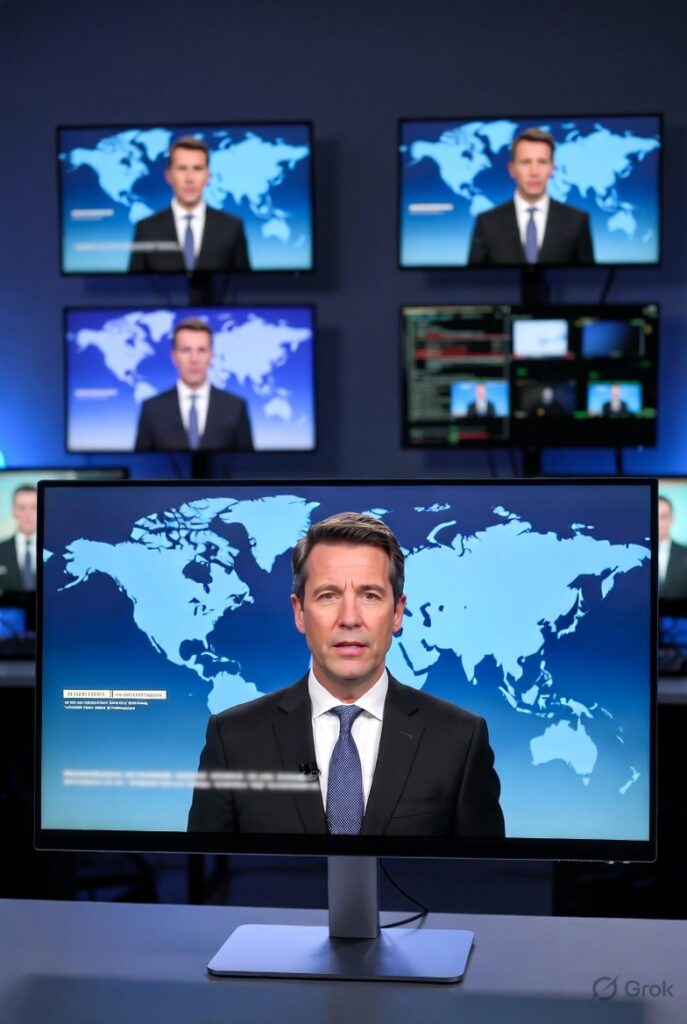
AI-generated anchors undermine this assumption. Advances in video synthesis now make it possible to create highly realistic human faces that speak convincingly. As these technologies improve, distinguishing between real and synthetic presenters may become increasingly difficult for ordinary viewers.
This challenge is particularly significant for journalism. News organizations have long relied on the authority and credibility of identifiable reporters and anchors. When anonymous or synthetic presenters begin to resemble professional journalists, the boundary between legitimate reporting and automated content becomes blurred.
Detecting AI Presenters
Researchers studying synthetic media have developed methods for identifying AI-generated presenters. These methods typically focus on subtle visual and audio cues. AI avatars often display limited facial micro-expressions, uniform lighting conditions, and highly consistent speech patterns. Their body movements may also appear restricted compared with those of human presenters.
Five Quick Tests to Identify an AI News Anchor
As AI-generated presenters become increasingly realistic, distinguishing them from human news anchors can be challenging. However, a few quick observational checks can help viewers identify whether a presenter may be synthetic.
1. Observe Facial Expressions Carefully
Human faces constantly produce subtle micro-expressions—tiny movements of the eyebrows, cheeks, and lips that occur naturally during speech. AI presenters often display smoother and more limited facial movement. If the presenter’s expressions appear unusually consistent or slightly rigid throughout the video, the host may be computer-generated.
2. Watch the Eyes and Blinking Patterns
Natural eye behavior includes irregular blinking, small shifts in gaze, and occasional glances away from the camera. Synthetic presenters sometimes maintain fixed eye contact with the camera and blink at regular intervals. This can create an impression of slightly mechanical eye behavior.
3. Listen to the Voice Quality
AI-generated voices are now highly realistic, but they often maintain a very even tone and rhythm. A synthetic voice may lack natural breathing pauses, spontaneous emphasis, or emotional variation. If the narration sounds perfectly paced without minor imperfections typical of human speech, it could indicate text-to-speech narration.
4. Check Body Movement and Gestures
Real presenters usually gesture with their hands, shift posture slightly, or move their shoulders while speaking. AI avatars often display limited movement—typically restricted to head motion and simple gestures. Repetitive or minimal body language can be a sign of synthetic generation.
5. Verify the Presenter’s Identity
Finally, conduct a quick credibility check. Look for the presenter’s professional profile, previous media work, or affiliations with recognized organizations. If the presenter exists only on a single video channel without any verifiable background, the host may be a pseudonymous figure or an AI-generated avatar created using platforms such as Synthesia or HeyGen.
Together, these simple tests can help viewers evaluate whether a news presenter is likely to be a real journalist or a synthetic digital host. In an era of rapidly evolving artificial intelligence, developing such media literacy skills is becoming essential for navigating the modern information landscape.
However, these indicators are becoming less reliable as technology improves. Modern AI systems are increasingly capable of replicating natural facial movements and emotional expressions. As a result, detection methods may need to rely more on contextual analysis, such as verifying the identity of the presenter or examining the origin of the content.
Ethical and Regulatory Questions
The rise of AI-generated presenters has sparked debates about ethics and regulation in digital media. One major issue concerns transparency. Should creators be required to disclose when a video presenter is synthetic? Some experts argue that clear labeling is necessary to maintain public trust.
Another concern involves the potential misuse of synthetic media for misinformation campaigns. Governments and international organizations are beginning to explore regulatory frameworks for AI-generated content. However, creating effective regulations is difficult because the technology evolves rapidly and is widely accessible.
At the same time, excessive regulation could stifle innovation in fields such as education, marketing, and entertainment where AI avatars provide genuine benefits.
Implications for Journalism
For journalists and media professionals, the rise of synthetic presenters highlights the need to rethink the relationship between technology and credibility.
Artificial intelligence is already transforming newsroom operations through automated transcription, data analysis, and content generation. AI presenters represent the next stage of this transformation.
Rather than replacing journalists entirely, synthetic media may lead to hybrid models of production in which human reporters create the content while AI systems handle presentation and distribution. This approach could allow news organizations to deliver information more efficiently while preserving editorial oversight.
However, the proliferation of AI-generated content also increases competition for audience attention. Independent creators using automated tools can produce large volumes of commentary and analysis, potentially overshadowing traditional journalism.
The Future of Synthetic News
Looking ahead, the role of AI presenters in media ecosystems is likely to expand. Advances in generative AI are making synthetic faces more realistic and voices more expressive. Future systems may allow viewers to interact with AI presenters in real time, asking questions and receiving personalized explanations of news events.
At the same time, public awareness of synthetic media is growing. As audiences become more familiar with AI-generated content, they may develop new forms of media literacy that help them evaluate credibility in digital environments.
Ultimately, the impact of AI presenters will depend on how societies balance technological innovation with ethical responsibility. Transparency, accountability, and media literacy will play crucial roles in ensuring that synthetic media enhances communication rather than undermines trust.
Conclusion
The rise of AI-generated news presenters marks a significant turning point in the evolution of digital media. Enabled by advances in generative AI and supported by the economic incentives of online platforms, synthetic anchors have become an increasingly visible feature of the information landscape. They offer powerful tools for communication, education, and marketing, but they also introduce new challenges related to credibility, transparency, and information warfare.
As artificial intelligence continues to reshape the media environment, the distinction between human and synthetic communication will become increasingly blurred.
For journalists, researchers, and policymakers, understanding this transformation is essential. The future of trustworthy information may depend not only on technological innovation but also on the ability of societies to adapt ethical norms and institutional safeguards to an age of synthetic media.
The emergence of AI-generated news presenters marks a significant shift in the media landscape, blurring the traditional boundaries between human journalism and automated content creation. While synthetic anchors offer efficiency and scalability in video production, they also raise important questions about transparency, authenticity, and public trust in digital information.
As these technologies continue to evolve, the responsibility will increasingly fall on media organizations, technology platforms, and audiences to promote greater transparency and strengthen media literacy.
In an era of synthetic media, the ability to critically evaluate both the message and the messenger will be essential for safeguarding the credibility of journalism.
About the Author
Muneshwar is a communication scholar and researcher specializing in media, technology, and artificial intelligence. His work explores how emerging technologies are reshaping journalism, broadcasting, and audience trust in the digital age. Through analytical and research-based writing, he examines the ethical challenges, questions of authenticity, and broader societal implications of AI-driven innovations for media professionals and the public.

