


By Newswriters News Desk
In early 2026, President Donald J. Trump launched the Board of Peace (BoP), an international organization aimed at promoting peacekeeping efforts worldwide, with an initial focus on reconstructing Gaza following a fragile ceasefire in the region.
Established through United Nations Security Council Resolution 2803 in 2025, the Board represents a U.S.-led coalition operating outside the traditional UN framework. Trump, who serves as the Board’s lifelong chairman, has described it as a “consequential international body” with unlimited potential to end conflicts and foster development.
The Board’s creation stems from Trump’s 20-point Comprehensive Plan to end the Gaza conflict, which was endorsed by the UN and emphasizes strategic oversight, resource mobilization, and accountability for post-war reconstruction. The charter was formally signed by Trump and 25 other leaders at the World Economic Forum in Davos on January 22, 2026.
The Board of Peace emerged amid ongoing tensions in Gaza, where a U.S.-brokered ceasefire between Israel and Hamas has held precariously since late 2025. Trump’s plan includes measures for demilitarization, economic redevelopment, and governance reforms in the region. The Board is tasked with overseeing these processes, starting with Gaza but with ambitions to address global conflicts.
Unlike the UN, the Board operates as a selective “coalition of the willing,” where membership requires an invitation from the chairman. Countries can secure permanent membership by contributing $1 billion within the first year, while non-paying members serve three-year terms. This model has drawn comparisons to private enterprises, emphasizing efficiency over broad inclusivity.
Structure and Leadership
The Board’s governance is centralized under Trump as chairman, granting him authority to invite or exclude members, break ties, and veto resolutions. A founding Executive Board supports operations, comprising experienced figures in diplomacy and economics:
Structure and Leadership
The Board’s governance is centralized under Trump as chairman, granting him authority to invite or exclude members, break ties, and veto resolutions. A founding Executive Board supports operations, comprising experienced figures in diplomacy and economics:
| Role | Name | Background |
| Chairman | Donald J. Trump | U.S. President |
| Member | Marco Rubio | U.S. Secretary of State |
| Member | Jared Kushner | Advisor to Trump |
| Member | Steve Witkoff | U.S. Special Envoy |
| Member | Tony Blair | Former UK Prime Minister |
| Member | Marc Rowan | Apollo CEO |
| Member | Ajay Banga | World Bank President |
| Member | Robert Gabriel | U.S. National Security Advisor |
Additionally, a Gaza Executive Board includes representatives like Turkish Minister Hakan Fidan and Qatari official Ali Al-Thawadi. Nikolay Mladenov serves as High Representative for Gaza.
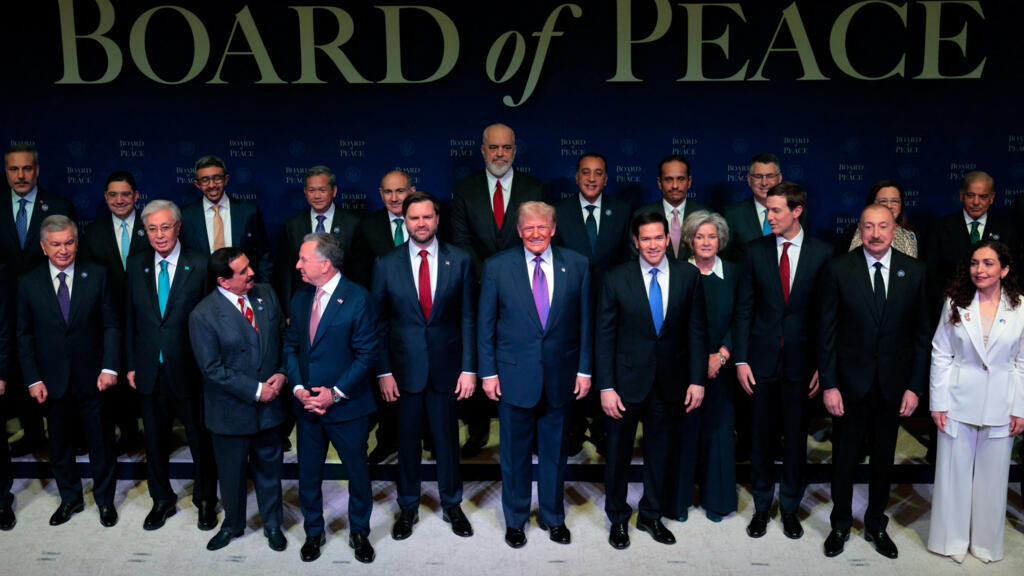
As of February 2026, the Board has invited 50 countries, with around 35 expressing interest. Membership spans regions but notably excludes many Western allies. Key members include:
Asia/Middle East: Armenia, Azerbaijan, Bahrain, Cambodia, Indonesia, Israel, Jordan, Kazakhstan, Kuwait, Mongolia, Pakistan, Qatar, Saudi Arabia, Turkey, United Arab Emirates, Uzbekistan, Vietnam.
Europe: Albania, Belarus, Bulgaria, Hungary, Kosovo.
Africa: Egypt, Morocco.
Americas: Argentina, El Salvador, Paraguay.
Notable acceptances include Argentine President Javier Milei and Albanian Prime Minister Edi Rama. Invitations were extended to figures like Israeli Prime Minister Benjamin Netanyahu (accepted) and Russian President Vladimir Putin (status pending), despite international arrest warrants for alleged war crimes.
Major powers declining include the UK, Canada, France, Germany, Australia, China, India, and Japan, citing concerns over the Board’s structure and potential to undermine the UN.
The Inaugural Meeting and Financial Pledges
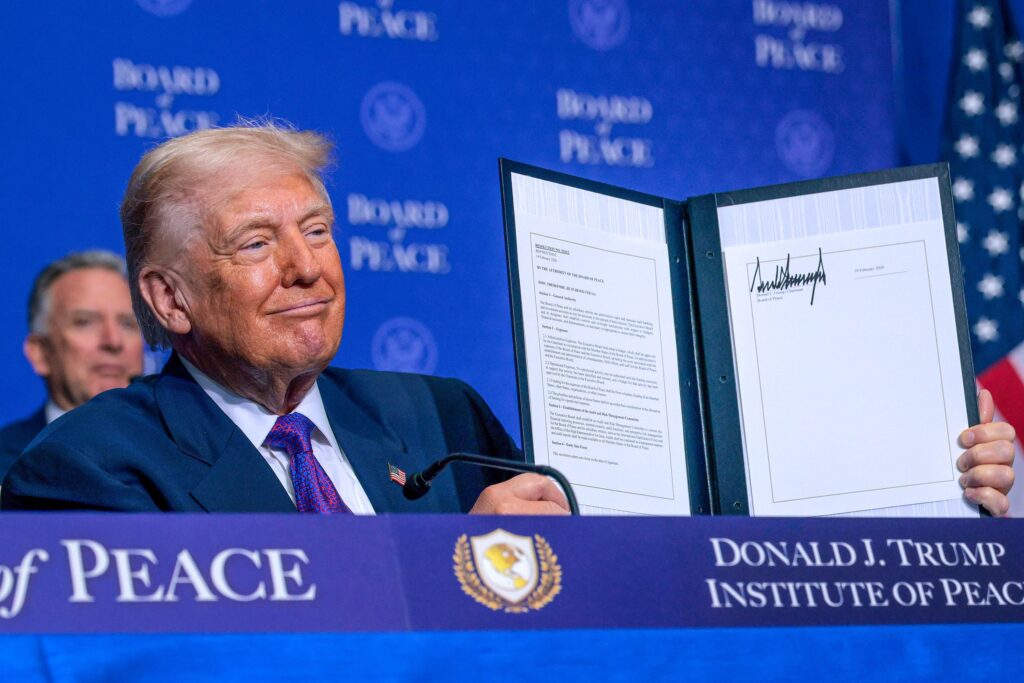
The Board’s first meeting occurred on February 19, 2026, at the newly renamed Donald J. Trump Institute of Peace in Washington, D.C. Attended by representatives from over two dozen countries, the session focused on Gaza’s next reconstruction phase.
Trump announced a U.S. commitment of $10 billion to the initiative, emphasizing that this amount pales compared to war costs. Member nations pledged an additional $7 billion for Gaza relief. Discussions also touched on broader partnerships, such as a recent collaboration with FIFA for Gaza regeneration.
Criticisms and Public Reactions
The Board has elicited mixed responses. Supporters, including Trump advisor Alex Bruesewitz, praise it as a vehicle for ending destruction and promoting peace. However, critics argue it resembles a “pay-to-play” scheme, potentially allowing wealthy nations undue influence over global affairs. Some draw parallels to Soviet-era propaganda bodies, questioning its sincerity.
On social media, opinions vary. Users like @111publishing have accused it of enabling the “pillage” of Palestinian lands, while others mock associations with figures like Milei amid unrelated controversies. Late-night host Stephen Colbert has also critiqued the initiative. Concerns persist that the Board could sideline the UN and exclude key stakeholders.
Future Outlook
With Gaza as its proving ground, the Board of Peace aims to expand its scope to other conflict zones. Its success will depend on securing broader international buy-in and delivering tangible results in reconstruction. As Trump stated at the meeting, the Board seeks to prove itself as history’s most impactful peacekeeping entity. However, its unconventional structure and selective membership may continue to fuel debates about its legitimacy and effectiveness in a multipolar world.

