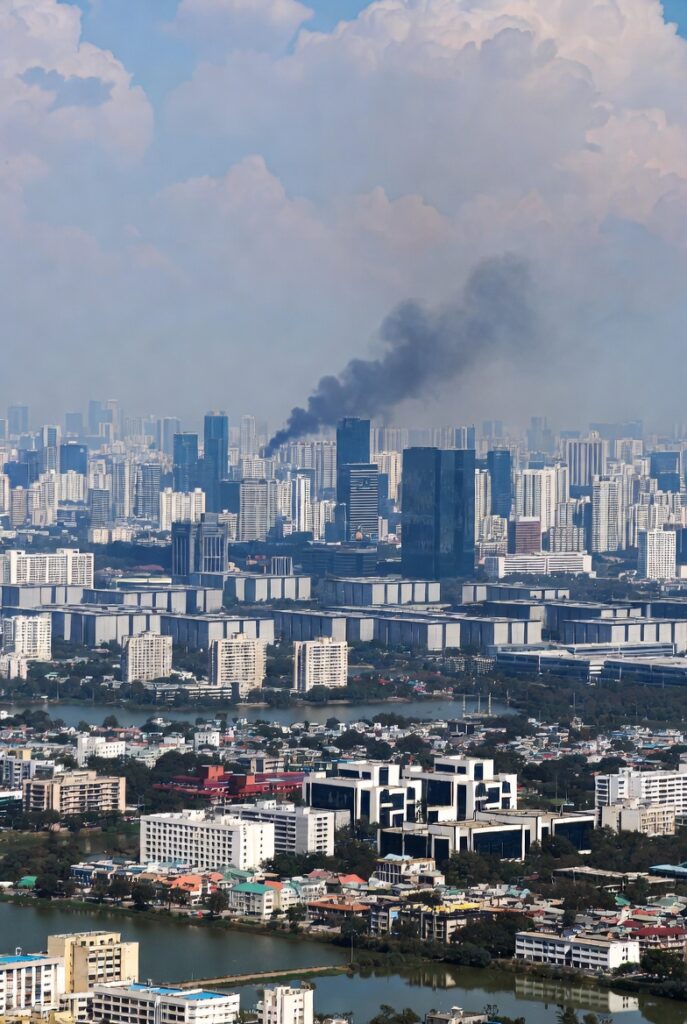


India’s vast digital population has turned the country into the world’s most coveted AI playground. With nearly a billion internet users spending hours online every day, global tech firms are racing to tap Indian data to train and refine their models. The boom promises jobs, innovation, and global relevance—but it also raises a critical question: will AI make India a technology powerhouse, or reduce it to a global server farm consuming land, water, and energy while the real value flows elsewhere?

By Newswriters News Desk
India stands at the crossroads of a digital revolution, propelled by the relentless advance of artificial intelligence (AI). With over 900 million internet users—a figure that has surged beyond initial estimates due to widespread smartphone adoption and affordable data plans—India boasts one of the world’s largest and most engaged online populations. Users spend an average of nearly seven hours daily online, generating a torrent of data through social media, streaming, digital payments, and AI interactions.
This digital bounty has ignited a fierce competition among global AI giants like Google, Microsoft, Amazon, and Meta, alongside domestic players such as Reliance and Adani, to establish a foothold in India. Investments are pouring in: Google has committed $15 billion over five years to build an AI hub in Visakhapatnam, Microsoft announced $17.5 billion for cloud and AI infrastructure from 2026 to 2029, and Adani pledged a staggering $100 billion by 2035 for renewable-powered AI data centers. Amazon, too, plans $35 billion by 2030 to expand AI-driven operations. These moves underscore India’s allure as a data powerhouse, but they also spotlight a critical dilemma: Is this influx an economic boon or a drain on India’s finite land and water resources?
This analysis delves into the dynamics of this “digital gold rush,” refining the narrative to emphasize the mounting pressures on India’s land and water amid rapid AI infrastructure growth. Drawing on recent projections and statistics, it examines the opportunities for job creation, innovation, and global positioning, while scrutinizing the risks of resource depletion. By 2026, India’s data center capacity is projected to reach 1.7-2 GW, potentially doubling to 4-8 GW by 2030. This expansion, while promising technological advancement, could exacerbate environmental strains in a nation already grappling with urbanization, climate change, and resource scarcity. The challenge lies in balancing ambition with sustainability to ensure India emerges as an AI leader rather than a mere supplier of resources.
Why India Appeals to AI Companies
India’s attractiveness stems from a unique confluence of factors. Its massive scale—combining a population of 1.4 billion with low-cost internet and over 80% smartphone penetration—offers AI firms unparalleled access to users.
A successful AI product here can amass tens of millions of adopters rapidly, providing real-time data for model refinement. The depth of engagement is equally compelling: Prolonged online sessions yield rich datasets from multilingual voice commands, image uploads, and behavioral patterns, essential for training robust AI systems.
India’s diversity enhances data quality. With 22 official languages and myriad dialects, accents, and socio-economic contexts, Indian data trains AI to handle global variability, making models more adaptable for international markets.
Cost efficiencies further sweeten the deal: Cheaper land, labor, and government incentives like subsidies for green data centers make India a viable alternative to high-cost regions like the US or Europe. As global AI demand surges, India’s fast-growing data center industry—valued at $8.94 billion in 2025 and projected to hit $31.36 billion by 2035 at a 13.37% CAGR—positions it as a strategic hub.
AI Companies’ Strategies in India
AI firms are not merely marketing products; they are weaving themselves into India’s digital fabric. Free or subsidized tools for students, developers, and SMEs drive adoption and data flow. Partnerships with local entities for cloud services and infrastructure are rampant, as seen in Adani’s collaborations with Google and Flipkart. Localization efforts adapt AI to Indian languages, while lobbying seeks favorable data policies.
At the core are data centers: Massive facilities for storage and computation. In 2025, India added 387 MW of capacity, pushing totals to 1,520 MW, with 1.03 GW under construction and 1.29 GW planned. Projects like Microsoft’s Hyderabad region, set for mid-2026 launch with three availability zones, and CtrlS’s 12 MW AI-ready center in Bhopal illustrate this boom. Total investments could reach $200 billion, per government estimates, transforming India into a compute powerhouse.

The Upside: Economic and Strategic Gains
Managed astutely, this surge yields substantial benefits. Job creation is paramount: Data centers generate roles in construction, maintenance, cybersecurity, and operations, potentially supporting tens of thousands directly and indirectly. For instance, Adani’s $100 billion plan is expected to catalyze $250 billion in AI ecosystem value, including server manufacturing.
AI adoption boosts productivity across sectors—education via personalized learning, healthcare through diagnostics, agriculture with predictive analytics, and logistics via optimization. Indian startups gain from advanced tools, fostering innovation.
Strategically, India mirrors its 1990s software hub success, enhancing global leverage. Infrastructure upgrades, like improved power grids and fiber networks, benefit domestic entities. Public services improve too: AI aids governance, multilingual translation, and urban management.
The Downside: Strains on Land Resources
Yet, the rush risks turning India into a “global server farm,” where local resources fuel foreign profits. Land pressure is acute. A hyperscale data center spans 10-50 acres, often near urban or industrial zones for connectivity. With dozens planned, total land use could exceed thousands of acres nationwide. By 2026, capacity hits 1.7 GW, requiring significant parcels. Mumbai and Chennai dominate, accounting for 70% of capacity, straining metro land.
Concentration exacerbates issues: Prime locations near water or power sources compete with agriculture, housing, and ecosystems. In Kolkata, 195 acres are earmarked, displacing other uses. As primary markets saturate—vacancy at 1.6% in 2025—expansion shifts to Tier-2 cities like Bhopal or Visakhapatnam, but this spreads pressure without alleviating urban strain.
Land economics tighten: Contiguous, low-risk parcels are scarce, inflating costs and delaying projects. Without zoning reforms, data centers could displace vital developments, intensifying India’s land scarcity amid a population boom.
Intensifying Water Resource Pressures
Water consumption poses an even graver threat. Data centers rely on water for cooling, with a medium-large facility using 1-5 million liters daily—akin to a town of 10,000-50,000 people. In India, 2025 consumption stands at 150 billion liters annually, projected to double to 358 billion by 2030. A 1 MW center uses 26 million liters yearly; scaled to 30 MW, it’s 780 million.
This burdens water-stressed India, with only 4% of global water for 18% of the population. Over 60-80% of data centers face high stress this decade. Hubs like Hyderabad (projected 909 million liter daily shortage) and Pune (recent shortages sparking protests) host expansions by Amazon and Microsoft. Bengaluru’s boom deepens crises: A 20 MW facility needs 1.37 million liters daily.
AI intensifies this: High-density workloads demand liquid cooling, consuming vast water despite efficiencies. Indirect use via power generation adds more—data centers account for 0.5% of national electricity and ~150 billion liters water in 2025. Climate change worsens shortages; “water-neutral” claims often fail locally. Rural areas suffer: In Maharashtra villages, data centers drain aquifers, affecting farmers. Without intervention, this could spark conflicts, undermining India’s water security.
Additional Risks: Electricity, Carbon, and Sovereignty
Electricity demands compound issues: AI training consumes massive power, pressuring grids. Demand could rise to 57 TWh by 2030 from 13 TWh in 2024, tripling data centers’ electricity share to 2.6%. Fossil fuel reliance hikes emissions, hindering climate goals unless renewables scale.
Data sovereignty looms large: Indian data, a national asset, risks exportation, with core IP abroad. Privacy concerns mount without robust safeguards.
Pathways Forward: Policy Imperatives
To mitigate risks, India must act decisively. Enact AI-specific regulations addressing resource use and accountability. Price water and electricity to reflect scarcity, discouraging waste. Incentivize local value: Favor firms building Indian models, employing researchers, and sharing IP. Mandate transparency on resource consumption and data usage. Prioritize public safeguards, ensuring AI bolsters services.
Promote sustainable tech: Dry cooling, recycled water, and renewables. Streamline permits via single-window systems while enforcing environmental audits. Diversify to less-stressed regions, integrating with national water policies.
Conclusion
India’s digital gold rush offers transformative potential, positioning it as an AI powerhouse with economic ripple effects. Yet, unchecked expansion threatens to drain land and water, turning opportunity into liability.
With projections of billions in liters consumed and thousands of acres repurposed, the pressures are undeniable. Policy choices today—balancing growth with resource stewardship—will determine if India thrives as an innovator or merely sustains global AI at its own expense. The digital future must serve Indian interests, ensuring equitable, sustainable progress.