


In modern conflicts, the struggle for narrative is often as decisive as the struggle on the battlefield. Coverage of tensions involving Iran reveals how media framing can shape global perceptions of war, responsibility, and legitimacy. Western news outlets frequently present the conflict through narratives of security threat, nuclear anxiety, and geopolitical confrontation, reinforcing political interpretations aligned with strategic interests.
The perspectives emerging from the Global South tend to emphasize regional stability, economic consequences, and diplomatic balance. This analysis examines how the Iran conflict is constructed through political framing in Western media and how alternative viewpoints complicate the dominant narrative.
By Subhash Dhuliya
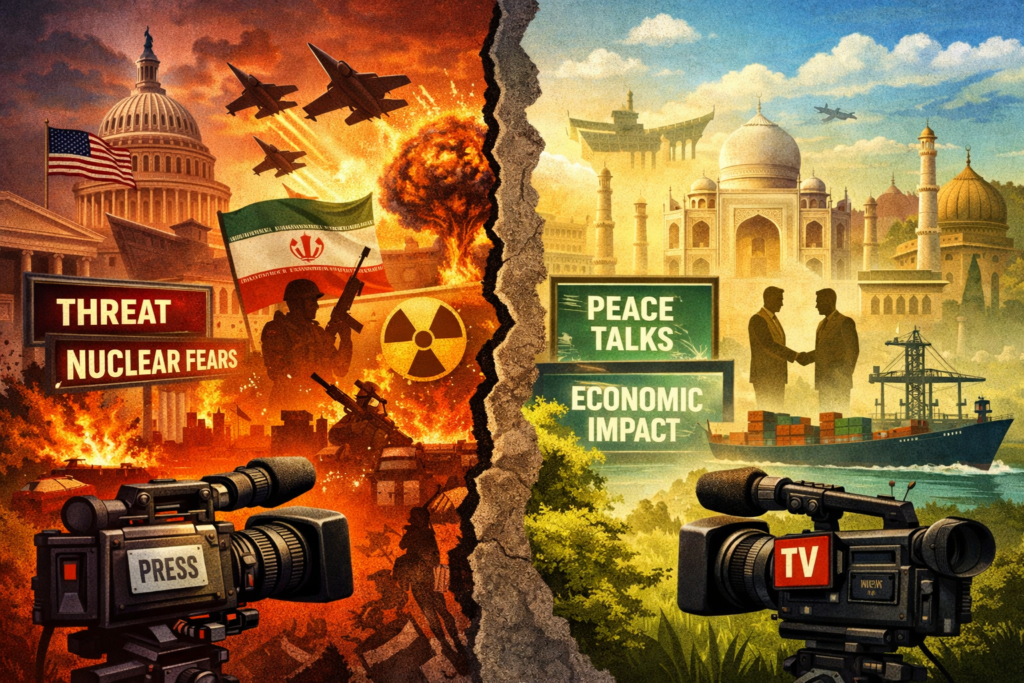
As tensions around Iran intensify, the battle for public perception is unfolding not only in diplomacy and military strategy but also in the global media arena. Western news coverage often frames the conflict through narratives of security threats, nuclear anxiety, and ideological confrontation, shaping how audiences interpret Iran’s role in regional politics.
The media in the Global South—including India—approach the issue through a more pragmatic lens that emphasizes geopolitical balance, economic interests, and regional stability. This analysis explores how political framing in Western media influences the narrative of the Iran conflict and contrasts it with perspectives emerging from the Global South.
Wars are fought not only on battlefields but also in the realm of narratives
Modern conflicts unfold within complex media ecosystems where journalism, political messaging, and strategic communication intersect. The confrontation involving Iran—whether framed as tensions with the United States, Israel, or broader regional conflicts—has been accompanied by intense media coverage in Western outlets such as CNN, BBC, The New York Times, and The Washington Post.
The way these conflicts are presented is rarely neutral. Media scholars have long argued that news organizations frame conflicts through particular narratives that reflect political priorities, institutional biases, and geopolitical alignments.
The coverage of Iran provides a particularly revealing case. Since the 1979 Islamic Revolution, Iran has been positioned as a central adversary within Western political discourse. Consequently, Western media narratives often situate Iran within frames emphasizing threat, aggression, ideological extremism, or instability. These narratives shape public perceptions of the conflict and influence policy debates. Through the use of specific language, selective sourcing, and narrative structures, Western media often construct the Iran conflict through political frames that align with broader
Western strategic perspectives.
This essay analyzes how Western media politically frame the Iran war and related conflicts, examining the dominant narrative structures that shape public understanding. It focuses on five key frames: the threat frame, the responsibility frame, the victim-aggressor narrative, the nuclear anxiety frame, and the moral legitimacy frame.
1. The “Iran as Threat” Frame
One of the most persistent frames in Western media coverage portrays Iran as a primary threat to regional stability and international security. News reports frequently emphasize Iran’s military capabilities, missile programs, and influence across the Middle East. Within this narrative structure, Iran appears not merely as a participant in geopolitical tensions but as a destabilizing actor whose actions require containment or deterrence.
Research analyzing Western television coverage indicates that outlets such as CNN often highlight themes linking Iran to violence or instability, reinforcing the perception that the country represents a security challenge to the region. In such reporting, Iran’s actions are frequently contextualized within narratives about terrorism, proxy warfare, or threats to allies such as Israel and Gulf states.
This framing has several political implications. First, it simplifies complex geopolitical conflicts by focusing on a single actor as the central source of instability. Second, it legitimizes policy responses such as sanctions, military deterrence, or strategic alliances against Iran. Finally, it aligns media narratives with the foreign policy discourse of Western governments, particularly the United States.
From a media-studies perspective, this framing reflects the agenda-setting function of journalism. By repeatedly highlighting Iran’s military actions or strategic ambitions, news outlets encourage audiences to interpret regional tensions primarily through the lens of Iranian aggression. Over time, this narrative becomes normalized, shaping how audiences interpret subsequent developments.
2. The Responsibility Frame: Assigning Blame
A second major element of political framing concerns the attribution of responsibility. In conflict reporting, journalists often identify which actor is responsible for escalation or violence. Studies of international media coverage show that Western outlets frequently employ the “responsibility frame,” which attributes the causes of conflict to a specific actor.
In coverage of Iran-related conflicts, this responsibility frame often places Iran at the center of escalation narratives. For example, retaliatory actions by Iran may be framed as “unprecedented attacks” or “major escalations,” while preceding actions by other actors may receive less emphasis. This asymmetry can subtly shape audience perceptions of causality.
The political significance of such framing is considerable. If audiences believe that Iran is primarily responsible for initiating or escalating conflict, they are more likely to support punitive measures such as sanctions or military strikes. Conversely, if the conflict is presented as a cycle of retaliation involving multiple actors, public support for unilateral action may diminish.
This dynamic demonstrates how journalistic framing influences the perceived legitimacy of political decisions. Even when reports remain factually accurate, the order in which events are presented and the actors emphasized can significantly affect audience interpretation.
3. Victim–Aggressor Narratives
A third political frame concerns the construction of victim and aggressor identities. Media coverage of war frequently divides actors into morally distinct categories: those who attack and those who defend themselves. In Western media narratives about Iran, this dichotomy often positions Iran as the aggressor and its adversaries as defensive actors.
This narrative structure is not unique to the Iran conflict; it is a common feature of wartime reporting. However, its political implications are particularly significant in the Middle Eastern context. By presenting one side primarily as a victim of aggression, media coverage can reinforce public sympathy for certain actors while marginalizing the perspectives of others.
In many reports, Iranian military actions are framed in active language emphasizing threat and intent, whereas actions by Western allies may be framed as responses to security concerns. Such linguistic choices shape how audiences interpret responsibility and legitimacy.
The victim–aggressor frame also interacts with broader cultural narratives. Western political discourse frequently emphasizes the protection of democratic allies and the containment of authoritarian regimes. When media narratives align with these ideological categories, they reinforce existing political worldviews.
4. Nuclear Anxiety and Security Narratives
Another major framing element in Western media coverage of Iran concerns nuclear proliferation. Iran’s nuclear program has been a central issue in international diplomacy for decades, and Western news outlets often highlight concerns that Iran could develop nuclear weapons.
This nuclear anxiety frame plays a crucial role in shaping public perceptions of the Iran conflict. Reports frequently emphasize intelligence assessments, diplomatic negotiations, and potential military responses related to Iran’s nuclear capabilities. By foregrounding this issue, media coverage situates the conflict within a broader narrative about global security and the risks of nuclear proliferation.
The political implications are clear. If Iran is perceived primarily through the lens of nuclear threat, policy debates become centered on deterrence, sanctions, or military options. Other aspects of Iranian society—such as economic development, domestic politics, or regional diplomacy—receive comparatively less attention.
Critics argue that this focus can oversimplify complex political dynamics. By concentrating on the nuclear issue, media narratives may reduce Iran’s role in regional politics to a single security dimension. Nevertheless, from a strategic communication perspective, the nuclear frame remains highly influential because it resonates strongly with public fears about global security.
5. Moral Legitimacy and Ideological Framing
Western media coverage of Iran often incorporates a broader ideological narrative concerning democracy, authoritarianism, and human rights. Iran’s political system is frequently contrasted with liberal democratic values, and reports about the conflict may reference issues such as domestic repression, civil liberties, or ideological extremism.
This moral legitimacy frame serves a dual function. On one level, it contextualizes the conflict within debates about governance and political values. On another level, it reinforces the idea that Western political systems represent a normative standard against which other regimes are judged.
Media scholars note that such ideological framing is common in international reporting. By linking geopolitical conflicts to broader moral narratives, journalists create stories that resonate with audiences and reinforce shared political values. However, critics argue that this approach can also introduce bias by privileging certain perspectives while marginalizing others.
In the case of Iran, ideological framing may contribute to what some analysts describe as a long-standing narrative of Iran as a political “other” within Western discourse. Since the Islamic Revolution, Iran has often been portrayed as fundamentally opposed to Western political models. This perception influences both political rhetoric and media coverage.
6. Structural Influences on Media Framing
Understanding political framing requires examining not only individual journalists but also the structural factors that shape media institutions. Western news organizations operate within political, economic, and cultural environments that influence how stories are selected and presented.
One influential theoretical framework is the propaganda model, which argues that media narratives often reflect the interests of political and economic elites. According to this model, factors such as ownership structures, advertising pressures, reliance on official sources, and ideological assumptions can shape news coverage.
In the context of the Iran conflict, Western media outlets often rely heavily on government officials, military analysts, and policy experts as sources. These sources frequently reflect the perspectives of Western governments or allied institutions. As a result, their interpretations of events can dominate the narrative.
Additionally, geopolitical alliances influence how conflicts are framed. Western media organizations are embedded within societies whose governments maintain strategic relationships with countries such as Israel and Gulf states. These relationships inevitably shape the political context within which journalism operates.
7. War Journalism versus Peace Journalism
Another useful framework for analyzing media coverage is the distinction between war journalism and peace journalism, proposed by media scholar Johan Galtung. War journalism focuses on conflict, violence, and military strategy, often highlighting the actions of political elites and military actors. Peace journalism, by contrast, emphasizes context, underlying causes, and the perspectives of multiple stakeholders.
Studies of media coverage of Middle Eastern conflicts suggest that Western outlets frequently adopt a war journalism approach, prioritizing dramatic events and military developments over broader contextual analysis.
In the case of Iran, this tendency can lead to coverage that emphasizes missile strikes, military threats, and strategic escalation while providing limited attention to diplomatic initiatives or historical grievances. While such reporting reflects the news value of dramatic events, it may also reinforce perceptions of the conflict as inevitable or intractable.
8. The Political Impact of Media Framing
The political framing of the Iran war has significant consequences for both domestic and international politics. Public opinion in Western countries often shapes the range of policy options available to political leaders. When media narratives emphasize threat, aggression, and ideological opposition, they may increase public support for confrontational policies.
The media framing influences international perceptions of legitimacy. Governments often seek to justify their actions in the court of global public opinion, and media narratives play a crucial role in shaping these debates.
In conflicts involving Iran, competing media narratives also emerge from different geopolitical regions. Middle Eastern, Russian, or Asian media outlets may present alternative interpretations that challenge Western narratives. This multiplicity of perspectives illustrates how information itself becomes part of the geopolitical contest.
Beyond the Battlefield: How Media Narratives Shape the Politics
The political framing of the Iran war in Western media demonstrates the powerful role of journalism in shaping public understanding of international conflicts. Through narrative structures emphasizing threat, responsibility, victimhood, nuclear anxiety, and ideological difference, Western media outlets construct a particular interpretation of the Iran conflict that aligns with broader geopolitical narratives.
While these frames often emerge from legitimate journalistic practices—such as reliance on official sources and the need to simplify complex events—they also reflect deeper structural influences within the media ecosystem. The result is a set of narratives that can reinforce political assumptions and shape public perceptions of international affairs.
Understanding media framing is essential for critically engaging with news coverage of conflicts such as those involving Iran. By examining how narratives are constructed and whose perspectives are prioritized, audiences can better assess the political dimensions of war reporting and the role of media in shaping global discourse.
Media Framing in the Global South: The Case of India
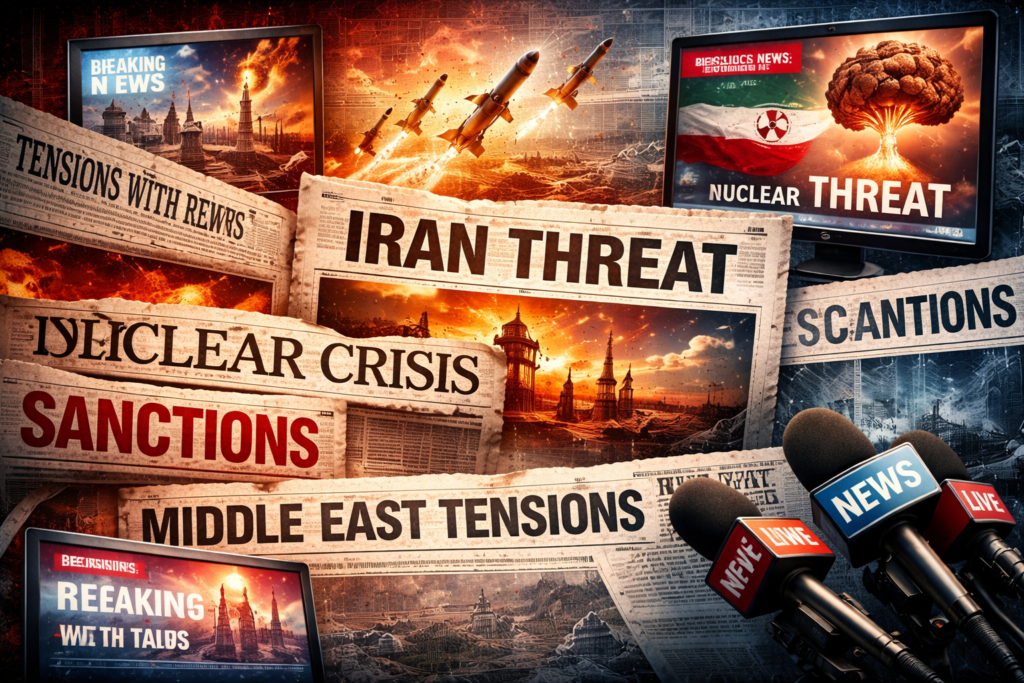
While Western media narratives play a dominant role in shaping global discourse on Iran, coverage in the Global South often reflects different political priorities, strategic interests, and historical experiences. India provides an instructive example of how a major Global South country navigates media framing of the Iran conflict.
Indian news outlets operate within a complex geopolitical environment: India maintains strategic partnerships with the United States and Israel while simultaneously sustaining long-standing diplomatic and economic ties with Iran, particularly in the energy sector and regional connectivity projects such as the development of the Chabahar port.
Unlike many Western media narratives that frequently emphasize Iran primarily as a security threat, Indian media coverage tends to frame developments in terms of regional stability, economic implications, and diplomatic balancing.
Major Indian newspapers such as The Hindu and The Indian Express often provide contextual reporting that highlights the geopolitical complexities of the region, including the impact of sanctions, oil supply disruptions, and the strategic calculations of regional actors. While security concerns remain an important theme, the framing is often less overtly ideological than in some Western outlets.
Television networks such as NDTV and CNN-News18 tend to present the conflict through a mixture of international reporting and domestic strategic analysis. Coverage frequently focuses on the implications for India’s foreign policy, including energy security, maritime trade routes in the Persian Gulf, and the safety of Indian expatriates working in the region. This approach reflects India’s practical concerns as a major importer of Middle Eastern energy and as a country with significant diaspora populations across the Gulf.
At the same time, Indian media discourse often reflects the broader tradition of strategic autonomy in Indian foreign policy thinking. Rather than fully adopting Western narratives about Iran, many Indian analysts emphasize the need for diplomatic engagement and regional stability.
Opinion columns and strategic commentaries frequently highlight the risks of escalation, warning that conflict in the Gulf could disrupt global energy markets and destabilize an already volatile region. This perspective aligns with India’s long-standing position that geopolitical crises should ideally be addressed through negotiation and multilateral diplomacy.
However, the Indian media landscape is far from uniform. Some television debates and digital platforms increasingly mirror the polarized and high-decibel style of Western cable news, where geopolitical conflicts are sometimes framed through simplified narratives of allies and adversaries.
In such contexts, Iran may still be portrayed as a destabilizing actor, particularly in discussions linked to regional security and Israel–Iran tensions. Yet even within these narratives, the emphasis often shifts quickly to the implications for India’s national interests rather than broader ideological conflicts.
Reliance on Western Agencies
Another notable aspect of Indian coverage is the reliance on international news agencies such as Reuters and Agence France-Presse. Because many Indian newsrooms depend on global wire services for real-time international reporting, Western narrative frames can indirectly influence coverage in the Global South. However, Indian editors and commentators often supplement these reports with domestic analysis that reflects India’s strategic priorities.
Overall, the Indian media framing of the Iran conflict illustrates the hybrid nature of Global South journalism. While Western narratives remain influential due to the dominance of global news agencies and international media networks, national interests and regional perspectives significantly shape how conflicts are interpreted. As a result, the Iranian issue in Indian media discourse is often framed less as an ideological confrontation and more as a complex geopolitical problem with economic, strategic, and diplomatic implications for the broader region.
The War Beyond the Battlefield: Competing Narratives
The Iran conflict illustrates that wars today are fought not only with missiles and military alliances but also through competing narratives in the global information space. Western media framing—through themes of threat, responsibility, nuclear risk, and ideological difference—plays a significant role in shaping public understanding and policy debates.
These narratives do not exist in isolation. Media perspectives from the Global South and other regions introduce different priorities, highlighting diplomacy, economic interdependence, and the dangers of escalation. Recognizing these competing frames is essential for understanding how international conflicts are interpreted and contested, reminding audiences that the battle for perception is often as consequential as the conflict itself.
About the Author: Prof. Subhash Dhuliya is a distinguished academician, researcher, and educational administrator with over four decades of experience in media academics and as a practicing journalist. He served as Vice Chancellor of Uttarakhand Open University and Professor at IGNOU, IIMC, and CURAJ. He worked as Assistant Editor and Editorial Writer at Navbharat Times, Sunday Times of India, and Times Television, and as Chief Sub-Editor at Amrit Prabhat. He has been editor of IIMC’s research journals, Communicator, and Sanchar Madhyam, and founded Newswriters.in. Prof. Dhuliya has designed journalism courses, served as a UNESCO Consultant for Journalism Education in the Maldives, and led training for journalists from Nepal and Afghanistan.
Acknowledgement: The conceptual framework and ideas in this article are solely those of the author. AI tools were used for background research and polishing.

