


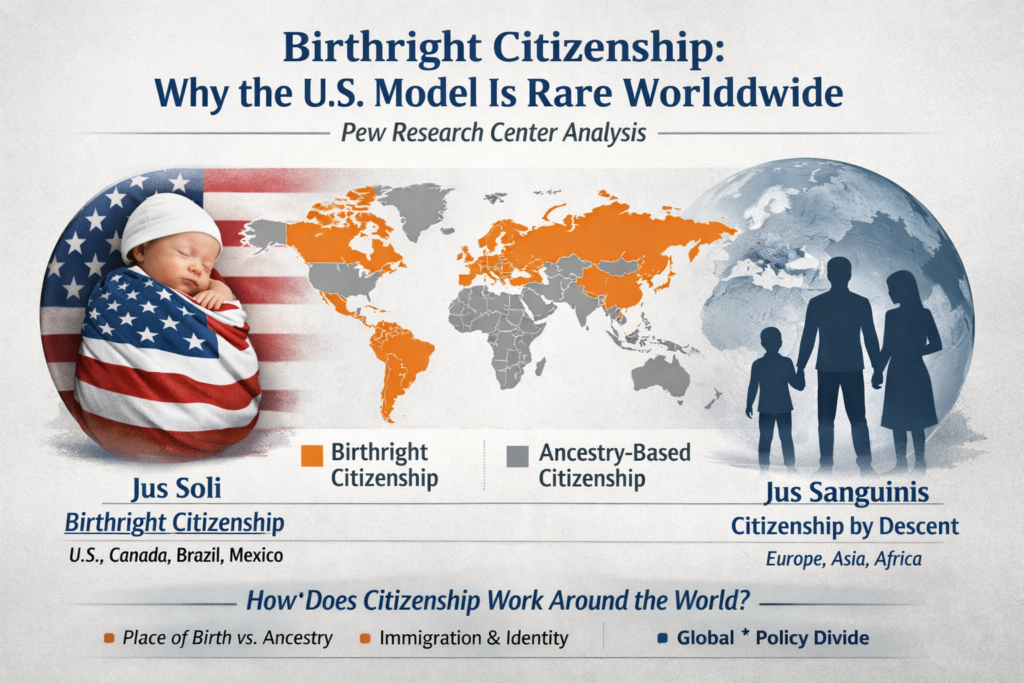
A new analysis by the Pew Research Center reveals that unconditional birthright citizenship—long a cornerstone of U.S. law—is uncommon across the globe. While countries in the Americas largely follow the jus soli principle, most nations in Europe, Asia, and Africa rely on ancestry-based citizenship laws, reshaping the global debate on immigration, identity, and belonging.
By Newswriters News Desk
The principle of granting citizenship based on place of birth—commonly known as jus soli or birthright citizenship—has long been a defining feature of the United States. Rooted in the 14th Amendment to the Constitution, it guarantees citizenship to nearly all individuals born on U.S. soil, regardless of their parents’ legal status. However, recent analysis by the Pew Research Center underscores a striking global reality: this model is far from the norm.
At a time when the issue is being debated in U.S. courts and politics, Pew’s findings provide a broader comparative perspective. They reveal that while birthright citizenship remains central to American identity, it is relatively rare across much of the world.
A Western Hemisphere Exception
According to Pew’s research, unconditional birthright citizenship is largely concentrated in the Americas. Countries such as the United States, Canada, Mexico, Brazil, and Argentina continue to grant citizenship automatically to most people born within their borders.
Globally, however, only a minority of nations follow this model. Estimates suggest that roughly 30 to 40 countries offer some form of unconditional birthright citizenship, and most of these are located in North and South America.
This geographic concentration reflects historical and demographic factors. Many countries in the Americas adopted inclusive citizenship policies to encourage immigration and nation-building. In contrast, much of Europe, Asia, and Africa developed citizenship laws rooted in ancestry, ethnicity, or descent.
Jus Soli vs. Jus Sanguinis
The global divergence in citizenship policies can be understood through two legal principles:
- Jus soli (right of the soil): Citizenship is granted based on birthplace.
- Jus sanguinis (right of blood): Citizenship is determined by the nationality of one’s parents.
While the United States is a prominent example of jus soli, most countries rely primarily on jus sanguinis.
Under jus sanguinis systems, being born in a country does not automatically confer citizenship unless at least one parent is a citizen or meets specific residency requirements. This approach is common in Europe, Asia, and parts of Africa.
Europe’s Restrictive Shift
Pew’s analysis highlights that many developed countries that once had elements of birthright citizenship have moved away from it over time.
Countries such as the United Kingdom, Ireland, Australia, and New Zealand have either abolished or restricted automatic citizenship by birth.
For instance:
- The UK ended unconditional birthright citizenship in 1983.
- Ireland amended its laws in 2004 following a referendum.
- Australia now grants citizenship at birth only if at least one parent is a citizen or permanent resident.
Even in countries that retain limited forms of jus soli, additional conditions often apply. Germany, for example, allows children born in the country to acquire citizenship only if a parent has lived there legally for several years.
Asia and Africa: Citizenship by Descent Dominates
Across Asia and Africa, unconditional birthright citizenship is even less common. Most countries in these regions follow descent-based systems, often tied to historical, ethnic, or political considerations.
In countries like India, citizenship laws have evolved to become more restrictive over time. Initially, India allowed a broader form of birth-based citizenship after independence, but amendments now require at least one parent to be an Indian citizen—and in some cases, neither parent can be an undocumented migrant.
This shift reflects broader concerns about migration, national identity, and demographic balance—issues that have influenced policy debates worldwide.
Why the U.S. Stands Out
The United States’ commitment to birthright citizenship is rooted in its constitutional framework and historical experience. The 14th Amendment, adopted in 1868 after the Civil War, was designed to guarantee citizenship to formerly enslaved people and ensure equality before the law.
Over time, this principle has come to symbolize inclusivity and opportunity, reinforcing the idea of the U.S. as a nation of immigrants.
However, Pew’s findings suggest that this model is an exception rather than the rule. While widely recognized, it is not widely replicated.
Contemporary Debate and Policy Tensions
The global rarity of U.S.-style birthright citizenship has become a focal point in contemporary political debates. Critics argue that the policy may encourage irregular migration or “birth tourism,” while supporters maintain that it promotes social cohesion and prevents the creation of stateless populations.
Recent developments in the United States—including legal challenges to efforts aimed at restricting birthright citizenship—have brought renewed attention to the issue.
Public opinion remains divided. Pew research indicates that Americans are split on whether children born to undocumented immigrants should automatically receive citizenship, reflecting broader partisan and ideological divides.
Global Implications
The contrast between the U.S. and the rest of the world highlights deeper questions about citizenship, identity, and belonging.
Countries that rely on jus sanguinis often emphasize cultural continuity and national heritage. In contrast, jus soli systems prioritize territorial belonging and civic identity.
Each approach has implications:
- Jus soli can foster inclusion and reduce statelessness.
- Jus sanguinis can strengthen national cohesion but may exclude long-term residents and their descendants.
As migration continues to shape societies worldwide, these competing models are likely to remain central to policy debates.
Conclusion
The Pew Research Center’s analysis makes one point clear: unconditional birthright citizenship, as practiced in the United States, is relatively uncommon on a global scale. While it remains a cornerstone of American law and identity, most countries rely on ancestry-based systems or impose conditions on citizenship at birth.
This divergence reflects differing historical trajectories, political priorities, and social values. As debates over immigration and citizenship intensify, understanding these global patterns becomes essential—not only for policymakers but also for citizens navigating an increasingly interconnected world.
In this context, the U.S. model stands out as both distinctive and contested, embodying ideals of inclusivity while prompting ongoing debate about its future.

