


India’s cultural diplomacy has become a powerful tool of global engagement, leveraging its rich civilizational heritage, diaspora networks, and digital outreach to shape international perception. From the global recognition of yoga to the worldwide reach of Indian cinema and streaming platforms, India has expanded its soft power footprint significantly. However, challenges such as domestic socio-political tensions, institutional fragmentation, selective cultural representation, and digital-era misinformation are increasingly impacting its effectiveness. This analysis examines the current state of India’s cultural diplomacy, the factors constraining it, and the opportunities that could redefine its global role in the coming decades.
By Muneshwar Prasad
India’s cultural diplomacy has evolved into a multilayered and increasingly strategic instrument of foreign policy, blending civilizational depth with contemporary soft power projection. Rooted in millennia-old traditions yet recalibrated for a globalized world, it occupies a unique space between heritage promotion, geopolitical signaling, and economic engagement.
The present state of India’s cultural diplomacy reflects both institutional consolidation and adaptive innovation; however, its effectiveness is increasingly shaped—and sometimes constrained—by a range of internal and external negative factors.
At the institutional level, India’s cultural diplomacy is anchored by bodies such as the Indian Council for Cultural Relations and the Ministry of External Affairs. These institutions have expanded the scope of cultural engagement beyond classical arts to include yoga, cuisine, cinema, and digital media. One of the most visible successes has been the global recognition of the International Day of Yoga, which exemplifies how India has transformed a traditional practice into a universal cultural offering. Similarly, Indian cinema, amplified through platforms like Netflix and Amazon Prime Video, has enhanced India’s cultural visibility across continents.
Yet, beneath these achievements lie structural and perceptual challenges that increasingly shape the global reception of India’s cultural diplomacy.
A primary negative factor is the tension between projected cultural narratives and domestic socio-political realities. Cultural diplomacy often emphasizes India’s pluralism, inclusivity, and “unity in diversity.”
However, international media coverage and global civil society discussions sometimes highlight issues such as religious polarization, constraints on freedom of expression, or cultural homogenization. When there is a perceived gap between narrative and reality, the credibility of cultural diplomacy weakens. In a hyper-connected global environment, domestic developments are no longer insulated; they directly influence how cultural messaging is interpreted abroad.
A second constraint is the politicization of culture. Cultural symbols, historical narratives, and even artistic expressions are increasingly drawn into ideological debates within India. When these contested narratives are projected internationally, they risk appearing exclusionary rather than universal. Cultural diplomacy functions most effectively when it is perceived as open and dialogic; when it becomes prescriptive or majoritarian in tone, it may alienate diverse global audiences, particularly in multicultural societies.
Third, institutional fragmentation continues to limit effectiveness. Cultural diplomacy is dispersed across multiple agencies—central ministries, state governments, cultural organizations, and private actors—often without a unified strategic framework. While institutions like ICCR play a central role, coordination gaps can lead to duplication of efforts, inconsistent messaging, and underutilization of resources. Compared to countries that maintain highly centralized cultural diplomacy institutions, India’s approach can appear diffuse and less strategically aligned.
Funding constraints further exacerbate this issue. India’s investment in cultural infrastructure abroad—cultural centers, language institutes, and long-term exchange programs—remains modest relative to its global ambitions. This limits the scale and continuity of engagement, especially in regions where sustained cultural presence is essential for influence. Without consistent funding, many initiatives remain event-based rather than institutionally embedded.
Even as India projects an image of pluralism and civilizational depth through platforms like the International Day of Yoga and global cultural exchanges led by the Indian Council for Cultural Relations, contradictions between domestic realities and international messaging increasingly shape global perceptions. In a digitally connected world, cultural diplomacy is no longer insulated from internal debates, making credibility as crucial as visibility.
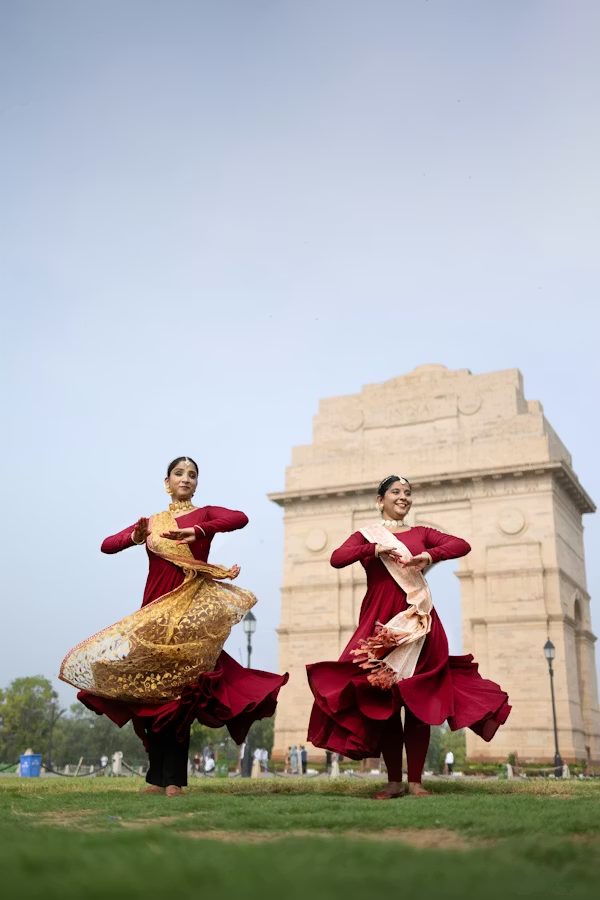
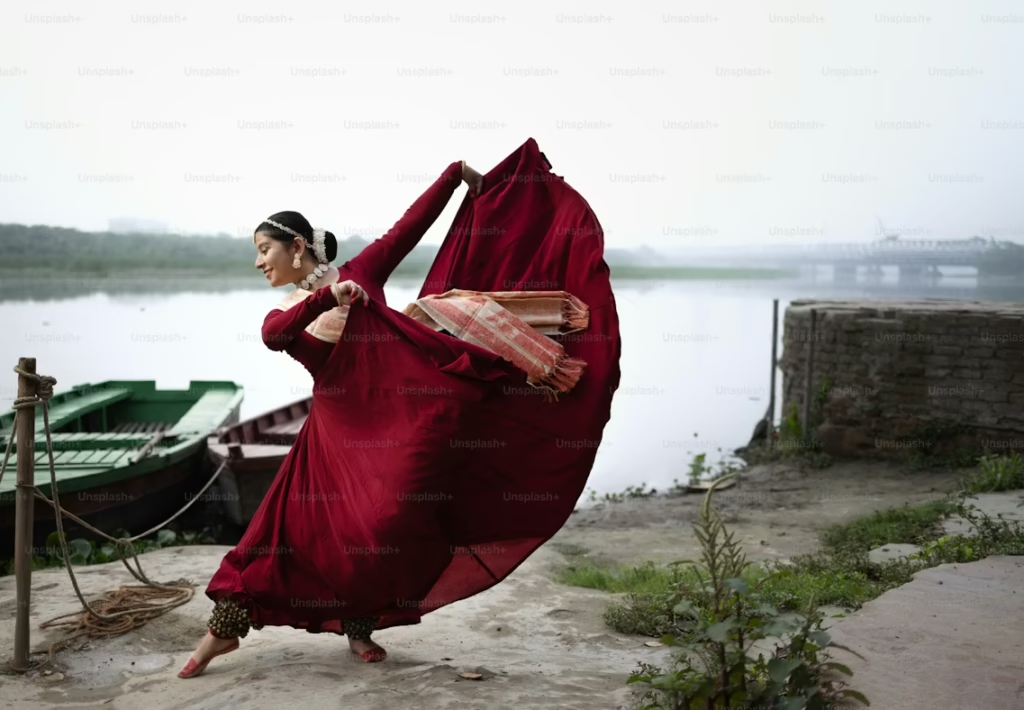
Another significant challenge lies in the selective representation of culture. India’s cultural diplomacy has traditionally foregrounded classical traditions—yoga, spirituality, classical dance, and heritage monuments. While these are valuable, an over-reliance on them can create a static or monolithic image of Indian culture. Contemporary cultural expressions—independent cinema, digital art, regional cultures, youth subcultures—remain underrepresented. This limits India’s ability to connect with younger, global audiences who engage more with dynamic and evolving cultural forms.
The role of the diaspora, often seen as a strength, also presents complexities. Events such as Pravasi Bharatiya Divas highlight India’s engagement with its global community. However, diaspora groups are not homogeneous; they carry diverse political, religious, and cultural identities. In some cases, diaspora activism can amplify domestic ideological conflicts in international spaces, complicating India’s cultural messaging and diplomatic positioning.
Digital media, while expanding reach, introduces another layer of challenge. The same platforms that enable India to project its culture globally also circulate misinformation, stereotypes, and polarized narratives. Social media controversies, online campaigns, and viral content can quickly shape global perceptions—often beyond the control of official institutions. The decentralization of cultural representation, while लोकतांत्रिक (democratic), reduces the state’s ability to curate a coherent narrative.
Geopolitical competition also impacts India’s cultural diplomacy. Countries such as China, South Korea, and Turkey have invested heavily in cultural exports—through language institutes, entertainment industries, and state-supported media. South Korea’s “Hallyu” wave, for instance, demonstrates how coordinated cultural policy can translate into global influence. In comparison, India’s efforts, though rich in content, often lack the same level of strategic packaging and sustained global branding.
Additionally, bureaucratic inertia and procedural delays can hinder cultural initiatives. Artists, scholars, and cultural practitioners sometimes face logistical challenges in international collaborations, including funding approvals, travel clearances, and institutional support. Such constraints discourage innovation and limit the agility required in contemporary cultural diplomacy.
There is also the issue of language. While Hindi and Sanskrit are often emphasized in cultural outreach, India’s linguistic diversity is far greater. The underrepresentation of regional languages and literatures restricts the depth of cultural engagement. Promoting multilingualism could significantly enhance India’s cultural diplomacy by showcasing its internal diversity more authentically.
Finally, the commodification of culture presents a subtle but important challenge. As cultural elements are packaged for global consumption—whether yoga, cuisine, or spirituality—they risk being simplified or commercialized in ways that dilute their complexity. This can lead to a tension between authenticity and marketability, affecting the integrity of cultural representation.
The future of India’s cultural diplomacy will depend not only on its heritage assets but on its ability to innovate, diversify, and engage. As Indian cinema expands through platforms like Netflix and Amazon Prime Video, and diaspora platforms such as Pravasi Bharatiya Divas continue to build transnational networks, the challenge lies in aligning cultural storytelling with contemporary global sensibilities while maintaining authenticity and inclusivity.
Despite these negative factors, the potential of India’s cultural diplomacy remains substantial. Addressing these challenges requires a more integrated and reflexive approach. Strengthening institutional coordination, increasing investment, and embracing a broader spectrum of cultural expressions are essential steps. Equally important is ensuring that domestic cultural policies align with the values projected internationally.
India’s future cultural diplomacy must move beyond showcasing heritage to fostering dialogue, collaboration, and co-creation. By engaging with global audiences not just as recipients but as partners, India can build a more resilient and credible cultural presence. The challenge is not merely to project culture, but to sustain trust in the narratives it seeks to share.
India’s cultural diplomacy stands at a critical juncture where its strengths are undeniable but its limitations are increasingly visible. The interplay between internal dynamics and external perceptions will determine its trajectory. If India can reconcile these tensions and adapt to a rapidly changing global cultural landscape, it has the potential to emerge as one of the most influential cultural powers of the 21st century.
In the final analysis, India’s cultural diplomacy will be judged not by the scale of its cultural projection but by the credibility, coherence, and inclusivity of its narrative. Institutions like the Indian Council for Cultural Relations and global platforms such as the International Day of Yoga have already established a strong foundation, but sustaining influence in a fragmented, hyper-digital world requires deeper alignment between domestic realities and international messaging.
The real test lies in whether India can move beyond symbolic showcases to foster genuine cultural dialogue—embracing diversity, encouraging creative innovation, and building trust across borders. If it succeeds, India’s cultural diplomacy will not merely project soft power; it will shape global cultural conversations in enduring and meaningful ways.
About the Author
Muneshwar Prasad is a communication scholar and researcher specializing in journalism and communication studies. He has extensive experience as both a journalist and a media academic, bringing together professional practice and scholarly insight.
Photo: Aditya Saxena/ Unsplash

The Sun Temple at Konark, Odisha: 13th-century UNESCO World Heritage Site

