


PHOTO: The Week
Newswriters News Desk
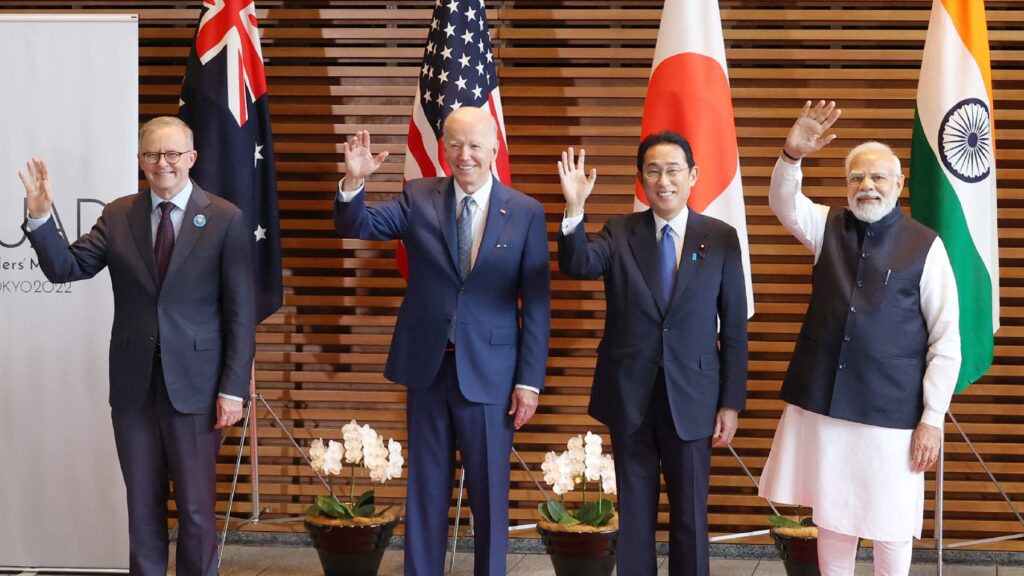
The Quadrilateral Security Dialogue (Quad), once hailed as a cornerstone of Indo-Pacific stability, is teetering on the edge of irrelevance as the United States under President Donald Trump’s second term signals waning commitment to the grouping. With Trump reportedly opting out of the upcoming leaders’ summit in India—slated for November—and imposing steep tariffs on key partner India, analysts warn that the alliance of the U.S., India, Japan, and Australia risks devolving from a dynamic multilateral forum into a hollow diplomatic shell. Born out of shared concerns over China’s rising assertiveness, the Quad’s trajectory now hinges on whether the other three members can sustain its momentum amid America’s “America First” pivot.
The Quad, resuscitated by Trump himself in 2017 after a decade of dormancy, flourished under his successor Joe Biden with annual summits, expanded initiatives on vaccines, climate resilience, and maritime security, and 10 foreign ministers’ meetings in five years—the latest in Washington on July 1, 2025. Yet, Trump’s return has introduced stark reversals. His administration’s 50% tariffs on Indian goods—among the highest imposed globally—coupled with public barbs accusing New Delhi of “losing” to China through oil deals with Russia, have strained the U.S.-India bilateral ties that underpin the Quad. Further eroding support.
Trump’s appointee Robert F. Kennedy Jr. as Health Secretary has gutted vaccine and pandemic programs, dismantling Quad-backed efforts like the “Cancer Moonshot” for cervical cancer reduction in the Indo-Pacific and the “Pandemic Fund.” Climate commitments from the Wilmington Declaration, including clean energy and resilience projects, face rollback as Trump exits the Paris Accord anew and prioritizes fossil fuels with his “Drill baby, drill” mantra.
These moves reflect a broader transactional U.S. approach that clashes with the Quad’s multilateral ethos, potentially sidelining nontraditional security pillars like infrastructure and disaster relief in favor of narrow, China-focused signaling. The July 2025 foreign ministers’ statement notably omitted these areas, signaling a retreat from the proactive vision that defined Biden-era progress. Critics fear this disinterest could undo gains, such as the Quad Critical Minerals Initiative for supply chain diversification and enhanced maritime domain awareness, leaving the region more vulnerable to Chinese coercion.
In response, Quad partners are forging ahead with bilateral and trilateral efforts to fill the void. On October 3, India and Australia inked three defense pacts in Canberra, focusing on classified information sharing, mutual submarine search-and-rescue operations, and joint staff talks—moves explicitly aimed at bolstering interoperability amid U.S. pullback.
Indian Defence Minister Rajnath Singh, meeting his Australian counterpart Richard Marles, emphasized deepening ties in cyber defense, maritime security, and regional challenges, while reaffirming the Quad’s role in a “free, open, stable, and prosperous Indo-Pacific.” Marles echoed this, identifying China as the “biggest security anxiety” for both nations and highlighting upcoming Malabar naval exercises. India is also advancing pacts with Japan and outreach to South Korea and the Philippines, signaling a hedging strategy against U.S. unreliability.
Prime Minister Narendra Modi sought to downplay tensions, posting on X that U.S.-India ties remain “very positive and forward-looking,” while Trump assured reporters of his personal friendship with Modi and a “special relationship” between the nations. Japan and Australia, long-time Quad stalwarts, may revive the Australia-Japan-India trilateral (AJI) format to maintain counter-China coordination, adapting the grouping’s flexible, minilateral structure to deliver tangible outcomes like the forthcoming Quad Ports of the Future Partnership in India. As one analyst noted, “The Quad’s survival depends not on Washington alone, but on the other members’ willingness to innovate and sustain shared interests.”
At this crossroads, the Quad—evolving toward a “Quad 3.0” with harder security edges—could either harden into a resilient bulwark against regional threats or fade into dormancy, much like its 2008-2017 hiatus. With China’s ambitions unchecked and Indo-Pacific flashpoints multiplying, from the South China Sea to the Taiwan Strait, the stakes are existential. If the non-U.S. trio can steer the ship, the Quad may yet prove its worth as a “global force for good”; otherwise, it risks becoming another casualty of great-power retrenchment.

