


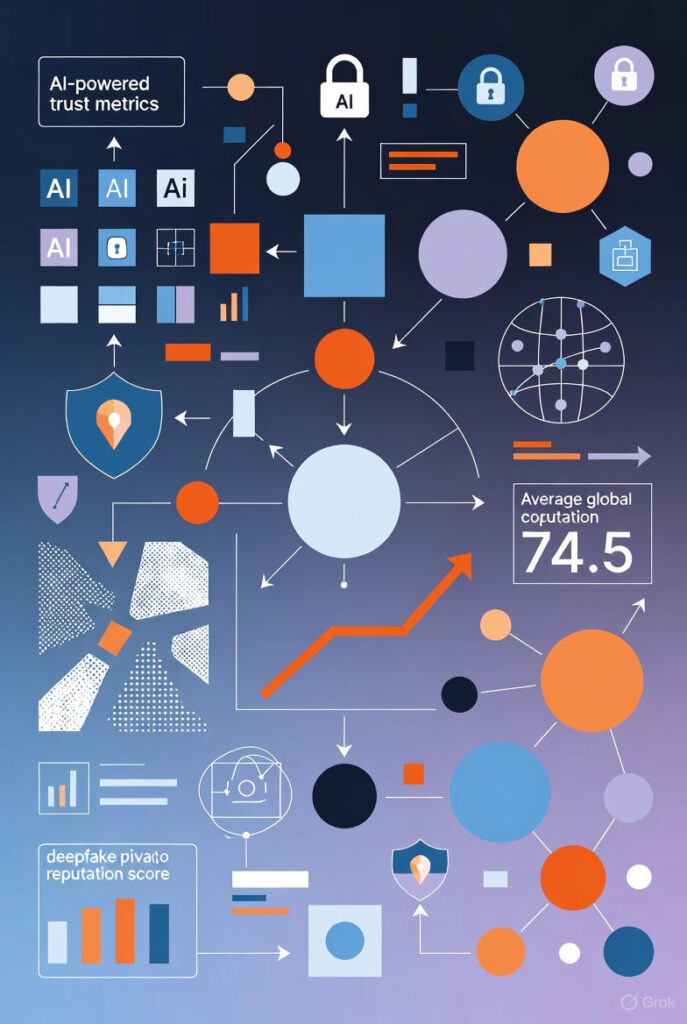
The reputation economy has solidified as a core value driver, where AI-powered trust metrics—review aggregation, sentiment analysis, blockchain endorsements, and predictive scoring—serve as a parallel currency often eclipsing traditional money in securing opportunities, partnerships, talent, and markets. Global corporate reputation averages 74.5 (per the 2025 RepTrak® report), while the online reputation management software market is projected near $14 billion this year.
Strong digital footprints yield clear gains: top firms see valuation premiums up to 25%, consumer trust in positive reviews hovers around 75-85% (often rivaling personal recommendations), and nations like Switzerland and Canada lead 2025 international reputation rankings. Yet risks mount—deepfakes, algorithmic bias, and privacy regulations—making proactive, transparent reputation stewardship essential for thriving in tomorrow’s trust-driven world.
By Newswriters News Desk
Trust as the New Currency in the Digital Age
In an era dominated by digital interactions, the concept of the “reputation economy” has emerged as a pivotal force shaping economic and social landscapes. This system posits that reputation—built through online reviews, ratings, social media endorsements, and data-driven trust metrics—serves as a form of currency that influences opportunities, transactions, and relationships.
Unlike traditional economies reliant on financial capital, the reputation economy thrives on intangible assets like trustworthiness and perceived value, amplified by platforms that democratize feedback. As global connectivity grows, this paradigm shift redefines how individuals and businesses operate, turning every online action into a potential asset or liability.
The origins of the reputation economy can be traced back to the rise of the sharing economy in the early 2010s, where platforms like Airbnb and Uber disrupted traditional markets by relying on peer-to-peer trust rather than institutional guarantees.
In these models, users rate each other after transactions, creating a self-regulating ecosystem that minimizes risks through collective vigilance. For instance, Airbnb allows hosts to rent out their homes to strangers, with reputation scores determining booking success and pricing power. Similarly, Uber’s mutual rating system ensures accountability, where low-rated drivers or passengers face restrictions or bans.
This evolution stems from broader economic challenges, including sluggish growth, high unemployment, and barriers to capital access in both developed and emerging markets. As traditional structures falter, individuals leverage idle assets—cars, skills, or even homes—to generate income, with reputation acting as the gatekeeper.
Beyond sharing platforms, the reputation economy permeates e-commerce and social influence. On sites like Amazon and eBay, products with high review counts and positive ratings see significantly higher sales; studies show that items with over 50 reviews can yield up to 4.2 times more revenue.
Brands like Everlane exemplify this by embracing transparency in pricing and supply chains, fostering consumer loyalty and earning high reputation scores that translate into market advantage.
Patagonia, meanwhile, builds its repute through environmental activism, appealing to eco-conscious millennials who prioritize purpose over price. Social media amplifies this dynamic, where influencers convert followers into financial capital through sponsored content and endorsements. A strong online presence, bolstered by user-generated content and peer recommendations, enhances credibility and drives purchasing decisions.
Key factors driving success in this economy include corporate purpose, employer attractiveness, and data privacy management. Companies like Spotify demonstrate this by engaging customers personally on social platforms, responding to queries with tailored song recommendations, which boosts their reputation score to 79.7 out of 100.
Trust is the cornerstone: 70% of consumers trust online reviews, and 62% consult them before buying. For businesses, a stellar reputation not only increases sales but also attracts top talent—57% of workers prefer companies with excellent reputations—and enhances investor appeal, where intangible assets like reputation account for 81% of market value.
However, the reputation economy is not without pitfalls. Manipulation through fake reviews or bots can undermine authenticity, while biases in algorithms may perpetuate inequalities, disadvantaging newcomers or marginalized groups.
Privacy concerns arise as personal data fuels reputation algorithms, raising ethical questions about surveillance and consent. The integration of artificial intelligence exacerbates this, enabling “silent judgments” based on vast data sets, from credit scores to social media behavior. Platforms like China’s social credit system illustrate dystopian extremes, where reputation scores dictate access to services.
The reputation economy is poised for further transformation. Blockchain technology promises decentralized, tamper-proof reputation systems, while cryptocurrencies like Bitcoin facilitate trust in unregulated spaces. As billions in emerging markets come online via smartphones, global exchanges will expand, potentially disrupting traditional banking in a “Napster moment” for finance. Yet, without regulation, this could fuel a massive black market. Policymakers must balance innovation with safeguards to harness its potential for sustainable growth.
The reputation economy represents a profound shift toward a trust-based world, where digital footprints determine destiny. By optimizing online presence—through authentic engagement, ethical practices, and responsive feedback—individuals and organizations can thrive. As this system evolves, it challenges us to redefine value, emphasizing that in the digital age, reputation isn’t just an asset; it’s the ultimate currency.
The reputation economy stands as a profound evolution of capitalism, where intangible trust has become the most liquid and powerful asset. No longer confined to sharing platforms or e-commerce stars, it permeates every layer of economic life—from gig workers whose scores dictate job access, to corporations whose RepTrak rankings influence investor confidence and talent attraction, to nations whose global standing shapes trade and diplomacy.
While challenges like AI-enabled manipulation, privacy erosion, and unequal access persist, the opportunities for those who prioritize ethical transparency, authentic engagement, and proactive risk mitigation are immense. Ultimately, in this era, reputation is no mere byproduct of success; it is the foundation upon which all future prosperity is built. Those who master it will lead; those who neglect it risk fading into irrelevance.

