


Born out of a secular liberation struggle, Bangladesh is facing one of the gravest crises of its political identity. The collapse of Sheikh Hasina’s long rule has exposed deep democratic erosion, enabling the resurgence of Islamist forces and intensifying anti-India sentiment. This in-depth analysis examines how authoritarian governance, regional miscalculations, and global power dynamics converged to destabilize Bangladesh—and what it means for India and South Asia.
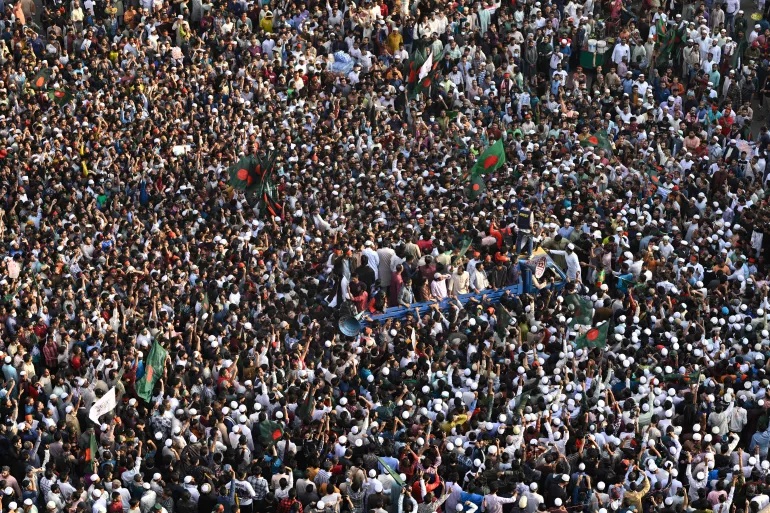
Protesters shout slogans and block an intersection following overnight attacks and vandalism after the death of a prominent activist, who was shot by an assailant a week ago, in Dhaka, Bangladesh [Mahmud Hossain Opu/AP Photo]
By Newswriters News Desk
Bangladesh, forged in the crucible of the 1971 Liberation War, emerged as a beacon of secularism and pluralism in South Asia. Its birth was a rejection of Pakistan’s religious and cultural imposition on the Bengali people, emphasizing nationalism, democracy, socialism, and secularism in its 1972 Constitution. Yet, over five decades later, the nation is grappling with profound political upheaval.
Islamist movements are gaining momentum, anti-India sentiments are intensifying, and the secular democratic framework faces existential threats. This transformation has been accelerated by the authoritarian drift under Sheikh Hasina’s prolonged rule, which eroded institutional trust and created a vacuum exploited by radical forces.
External influences, including shifting U.S. policies and India’s strategic miscalculations, have further complicated the landscape. As of late 2025, with an interim government under Muhammad Yunus navigating ongoing instability, Bangladesh stands at a pivotal juncture.
Historical Foundations: Secularism and National Identity in Bangladesh: The Liberation War and Secular Constitution
The 1971 Liberation War was not merely a struggle for political independence but a profound assertion of Bengali cultural identity against Pakistan’s theocratic tendencies. Led by Sheikh Mujibur Rahman, the war resulted in Bangladesh’s sovereignty, with India playing a crucial supportive role through military intervention and humanitarian aid. The 1972 Constitution enshrined four foundational pillars: nationalism, socialism, democracy, and secularism. This secular ethos was groundbreaking in a region where religion often intersects with politics, aiming to safeguard religious minorities and promote equality for all citizens regardless of faith.
However, secularism in Bangladesh has always been contested terrain. While the Constitution prohibited religion-based political parties initially, religious identity permeated social life, with Islam serving as a cultural and communal anchor for the majority population. Political Islam, rooted in organizations like Jamaat-e-Islami (JI), which collaborated with Pakistani forces during the war, maintained underground networks. Over time, pragmatic political shifts diluted secularism. For instance, the 1977 Fifth Amendment under military ruler Ziaur Rahman introduced “Bismillah-ir-Rahman-ir-Rahim” into the Constitution and replaced “secularism” with “absolute trust and faith in Almighty Allah,” signaling a gradual Islamization of state identity.
Post-Independence Political Instability and Islamism
The assassination of Sheikh Mujib in 1975 marked the onset of turbulent decades. Military regimes under Ziaur Rahman and later Hussain Muhammad Ershad courted Islamist groups to legitimize their rule, rehabilitating war criminals and allowing JI to re-enter politics. This era saw alliances between mainstream parties and Islamists, embedding religious rhetoric in national discourse.
The Bangladesh Nationalist Party (BNP), founded by Zia, often partnered with JI in coalitions, amplifying Islamist influence in education, media, and civil society.
By the 1990s, democracy was nominally restored, but instability persisted through alternating BNP and Awami League (AL) governments. Islamist militancy surfaced periodically, such as the 2005 bombings by Jamaat-ul-Mujahideen Bangladesh (JMB). These undercurrents highlighted the fragility of secularism, setting the stage for contemporary resurgences. The interplay of nationalism and religion created a dual identity: a secular state apparatus overlaying a deeply religious society, prone to exploitation during crises.
For years, Sheikh Hasina’s government projected stability, economic growth, and a strong stance against extremism. Yet beneath this façade, democratic institutions hollowed out, opposition politics was crushed, and dissent increasingly criminalized. This concentration of power generated public alienation, creating the very political vacuum that Islamist groups and anti-establishment forces would later exploit.
Sheikh Hasina’s Rule: Secular Rhetoric Amid Authoritarian Consolidation: Consolidation of Power and Democratic Backsliding
Sheikh Hasina, daughter of Mujib, returned to power in 2009 after a period of caretaker government. Her Awami League’s tenure, spanning over 15 years until 2024, was marked by economic growth—Bangladesh’s GDP surged, poverty declined, and infrastructure boomed. However, this progress masked deepening authoritarianism. Elections in 2014, 2018, and 2023 were marred by allegations of rigging, voter suppression, and opposition boycotts, drawing criticism from international observers like the European Union and Human Rights Watch.
Hasina’s government centralized power, weakening checks and balances. The judiciary faced executive interference, with controversial appointments and rulings favoring the regime. Media freedom plummeted; the Digital Security Act (later Cyber Security Act) was weaponized to silence dissent, leading to arrests of journalists and activists. Civil society organizations were co-opted or harassed, fostering a climate of fear. Security forces, notably the Rapid Action Battalion (RAB), were implicated in extrajudicial killings, enforced disappearances, and torture—practices justified as counter-terrorism but criticized as tools of political control.
This democratic erosion bred public disillusionment, particularly among the youth, who comprised over 60% of the population. Economic successes, while impressive, were uneven, exacerbating inequalities and corruption perceptions.
Suppressing Political Competitors
Hasina’s strategy targeted key rivals. The BNP, led by Khaleda Zia, was crippled through corruption charges and imprisonment of leaders. JI was banned in 2023 for its “anti-secular” stance and alleged militancy, following war crimes tribunals that executed several of its leaders for 1971 atrocities. While these actions appealed to secular nationalists, they eliminated pluralism, pushing opposition underground and radicalizing fringes.
Critics argue this suppression created a “one-party state,” where loyalty to Hasina eclipsed merit. The absence of viable alternatives amplified grievances, culminating in the 2024 protests.
The Anti-Quota and Anti-Authoritarian Protests
What began in July 2024 as student-led demonstrations against a reinstated quota system for public jobs—favoring freedom fighters’ descendants—escalated into a nationwide anti-government movement. Protesters decried not just quotas but systemic corruption, unemployment, and autocracy. Slogans like “Down with Hasina” reflected broader frustrations with a regime seen as unresponsive to the aspirations of a young, educated populace.
The government’s response was draconian: internet blackouts, curfews, and lethal force by security personnel resulted in over 600 deaths, per independent estimates. This violence, including attacks on protesters with helicopters and live ammunition, backfired, uniting diverse groups—students, laborers, and even some AL supporters—in a “Monsoon Revolution.”
Collapse of Hasina’s Rule and Interim Government
By August 5, 2024, mass mobilizations forced Hasina’s resignation and flight to India. The military refused to suppress the uprising fully, leading to her ouster. Muhammad Yunus, a Nobel Peace Prize winner for microfinance, was appointed chief adviser of an interim government to restore order and prepare for elections.
This transition exposed constitutional voids: the 1972 framework lacked clear provisions for such scenarios, leading to debates over legitimacy. As of December 2025, the interim administration continues amid delays in elections, now eyed for 2026, and a proposed referendum on reforms. Yunus’s government has faced accusations of inefficiency and bias, with ongoing unrest.
Resurgence of Islamist and Anti-India Forces: Revival of Islamist Political Actors
The 2024 vacuum revitalized suppressed groups. JI, unbanned by court order, has re-emerged, participating in politics and advocating Sharia-influenced policies. Other Islamist outfits, like Hefazat-e-Islam, have mobilized on issues like blasphemy and education reform, gaining traction among disillusioned youth facing economic woes.
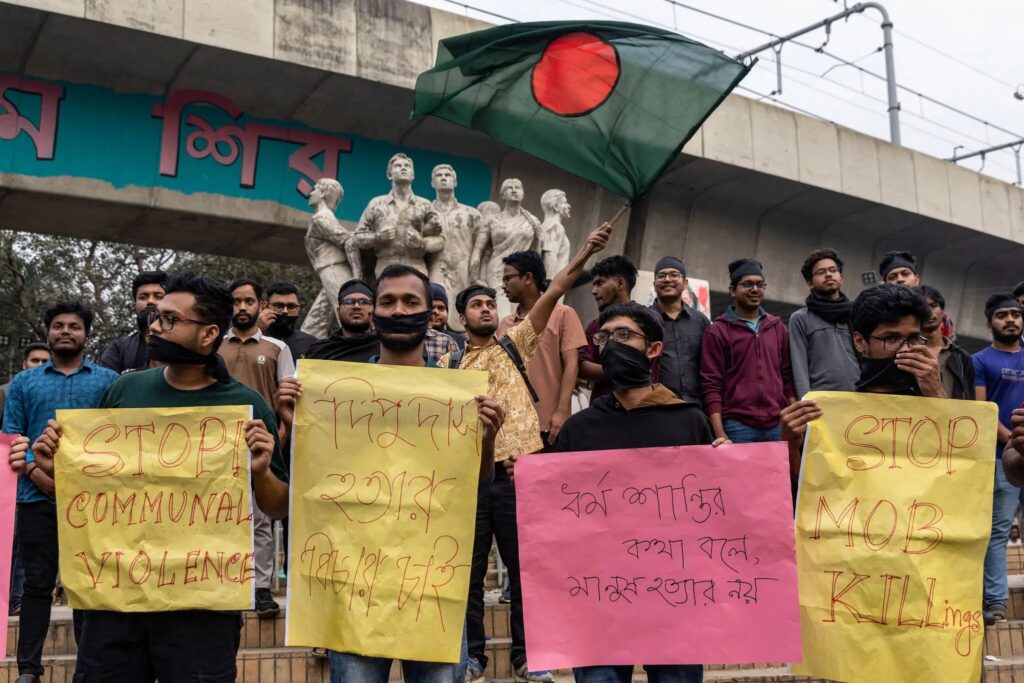
Students held a silent protest at Dhaka University in Bangladesh’s capital on Sunday to condemn the lynching of a Hindu garment worker. Credit Abdul Goni/Agence France–
Sectarian violence has surged, with attacks on Hindu temples and minorities reported in 2024-2025, fueling fears of creeping theocracy. This resurgence taps into historical grievances, portraying secular elites as corrupt and out of touch.
Anti-India Narrative and Foreign Policy Frictions
Anti-India rhetoric has intensified, with protests targeting Indian interests, including vandalism of diplomatic properties. Perceptions blame India for propping up Hasina’s regime, viewing her exile in India as evidence of interference. Issues like water-sharing disputes (Teesta River) and border killings exacerbate mistrust.
Hasina, from exile, has accused the Yunus government of “manufacturing” anti-India hostility through extremists. This narrative, amplified on social media, frames India as an overbearing neighbor, bolstering nationalist and Islamist appeals.
Structural and Institutional Failures Behind the Backlash: Democratic Decay and Loss of Legitimacy
Authoritarianism under Hasina hollowed out institutions, eroding public trust. When governments prioritize control over accountability, they invite radical challenges. Bangladesh’s case mirrors global patterns, from Egypt to Venezuela, where suppressed dissent breeds extremism.
Social Grievances and Economic Pressures
A youth bulge—over 30 million under 30—faces unemployment rates above 12%, corruption, and inflation. Rapid urbanization has strained resources, making religious networks attractive for social support. Islamists exploit these by offering identity-based solutions.
India’s strategic embrace of the Awami League delivered short-term security and connectivity gains but came at a long-term cost. By aligning too closely with one regime and overlooking democratic backsliding, New Delhi became entangled in Bangladesh’s internal legitimacy crisis. As external actors, particularly the United States, recalibrated their approach, Bangladesh turned into a contested arena of regional and global influence—reshaping power equations in India’s eastern neighbourhood.
Where Did India Go Wrong? Strategic and Policy Questions
India’s Bangladesh policy over the past decade has been largely shaped by pragmatism and security-centric thinking. While this approach delivered tangible gains, it also contained structural weaknesses that became evident once Bangladesh entered a phase of political upheaval. The backlash India now faces is not accidental; it is the cumulative result of strategic over-reliance, perception gaps, and insufficient engagement beyond the ruling elite.
Over-Reliance on a Single Political Partner
India’s engagement with Bangladesh came to hinge almost entirely on its close partnership with the Awami League (AL) and Sheikh Hasina personally. From New Delhi’s perspective, this alignment was logical. Hasina’s government demonstrated consistent cooperation on issues vital to Indian interests: dismantling anti-India insurgent networks in Bangladesh, sharing intelligence, denying sanctuary to Northeast Indian militants, facilitating transit and connectivity projects, and maintaining a broadly India-friendly foreign policy posture.
However, this hyper-personalised diplomacy carried long-term risks. By placing nearly all its strategic bets on one political force, India failed to cultivate meaningful relationships with other stakeholders in Bangladesh’s political ecosystem—particularly the Bangladesh Nationalist Party (BNP), civil society groups, student movements, and emerging youth-led platforms. When the Hasina regime abruptly collapsed, India found itself diplomatically exposed, with limited channels of influence among alternative power centres.
More damaging was the perception—widely shared among Bangladeshi opposition groups—that India had not merely supported the Awami League but had turned a blind eye to its authoritarian excesses. As elections grew less competitive, opposition leaders were jailed or marginalised, and security forces gained sweeping powers, India’s continued endorsement of Hasina was interpreted as tacit approval of democratic erosion. This fed a powerful narrative that India preferred “stability over democracy,” even if that stability came at the cost of political pluralism.
Such perceptions proved combustible once public anger against authoritarian governance erupted. India, by association, became a convenient target—portrayed by Islamist and nationalist actors alike as an external enabler of repression. A more balanced diplomatic posture, involving discreet engagement with opposition parties and public advocacy for democratic norms, might have softened this backlash and preserved India’s credibility as a partner of the Bangladeshi people rather than of one regime.
Failure to Read Political Under-Currents
Another critical lapse was India’s failure to adequately read the depth of popular discontent beneath Bangladesh’s surface stability. Rapid economic growth and infrastructure expansion under Hasina masked growing resentment among students, urban youth, and sections of the middle class who felt politically excluded and economically insecure. India’s policy establishment, focused on state-to-state deliverables, underestimated how quickly these grievances could translate into mass mobilisation.
By the time protests gained momentum, India’s diplomatic messaging appeared reactive rather than anticipatory. This reinforced the impression that New Delhi was out of sync with ground realities and overly dependent on intelligence and assessments filtered through the ruling establishment in Dhaka.
Soft Power Deficit and Erosion of Grassroots Goodwill
India and Bangladesh share deep civilisational, linguistic, and cultural ties rooted in history, literature, music, and the shared memory of 1971. Yet, paradoxically, popular goodwill toward India has eroded in recent years. Border-related issues—particularly shootings by border forces, unresolved river-water disputes, and contentious narratives around migration—have diluted the emotional reservoir that once underpinned bilateral ties.
India’s soft-power outreach has not kept pace with these challenges. Educational exchanges, youth programmes, media engagement, and cultural diplomacy have remained limited relative to the scale of India-Bangladesh relations. As a result, anti-India rhetoric has found fertile ground among younger generations with no lived memory of India’s role in Bangladesh’s liberation.
A stronger investment in people-to-people diplomacy—student scholarships, joint academic programmes, cultural residencies, and civil society partnerships—could have countered hostile narratives and created constituencies resistant to anti-India mobilisation.
The Role of the United States: Strategic Interests and Contested Interpretations
The United States has emerged as a significant—though often indirect—factor in Bangladesh’s recent political trajectory. Washington’s stated focus has been on democratic norms, electoral integrity, and human rights, but its actions have been interpreted in sharply divergent ways within Bangladesh and the wider region.
US Sanctions, Security, and Political Signalling
The U.S. decision in 2021 to impose sanctions on Bangladesh’s Rapid Action Battalion (RAB) over alleged human rights abuses marked a turning point. From Washington’s perspective, the sanctions were intended to pressure Dhaka into reforming its security practices and restoring accountability. Yet in Bangladesh, and particularly among Hasina’s supporters, the move was seen as a direct weakening of the regime’s coercive capacity at a time of rising political tension.
Critics argue that the sanctions emboldened opposition forces and signalled waning international support for Hasina, thereby accelerating the regime’s loss of confidence and control. Supporters counter that without such pressure, authoritarian excesses would have continued unchecked. Regardless of intent, the sanctions altered the internal balance between the state and its challengers.
Yunus, Western Ties, and Conspiracy Narratives
The emergence of Muhammad Yunus as chief adviser of the interim government further complicated perceptions. Yunus’s longstanding ties with Western institutions, global NGOs, and financial bodies made him a symbol—rightly or wrongly—of Western influence in Bangladeshi politics. Islamist and conservative forces quickly framed his rise as evidence of foreign engineering, feeding conspiracy theories of regime change orchestrated from abroad.
While there is no credible evidence that the United States directly orchestrated the downfall of Hasina, its sustained emphasis on human rights, electoral sanctions, and civil society engagement undeniably shaped the political environment. In a deeply polarised society, such external pressure was easily recast as meddling, reinforcing nationalist and Islamist narratives hostile to both the West and India.
Complex Strategic Dilemma
For India, the evolving role of the United States in Bangladesh presents a complex strategic dilemma. On the one hand, India publicly shares the normative commitment to democratic governance and human rights. On the other, sudden political transitions in neighbouring countries—especially those driven by external pressure—often generate instability that directly impacts India’s security, borders, and regional influence.
Strategic Lessons
India’s missteps in Bangladesh were not born of hostility or neglect, but of overconfidence in elite-centric diplomacy and a persistent underestimation of democratic legitimacy as the foundation of long-term stability. The Bangladesh crisis underscores a critical lesson for India’s neighbourhood policy: regional influence cannot rest solely on transactional relationships with ruling regimes, however cooperative they may appear in the short term.
Political durability in South Asia depends as much on societal consent as on state-to-state alignment. When democratic institutions erode and popular legitimacy collapses, external partners associated with incumbent regimes inevitably share reputational costs. India’s strategic calculus must therefore move beyond regime stability toward institutional resilience.
Going forward, India will need to recalibrate its approach—diversifying political engagement across party lines, strengthening people-to-people diplomacy, investing in cultural and educational exchanges, and aligning strategic interests with democratic pluralism. In Bangladesh, as elsewhere in the region, legitimacy ultimately flows not from governments alone, but from societies. Ignoring that reality carries long-term costs India can ill afford.
Democratic Renewal and Institutional Reform
Restoring political legitimacy in Bangladesh will require credible, inclusive, and timely elections—possibly by 2026—under conditions that ensure fairness and transparency. Judicial independence and constitutional safeguards must be strengthened, particularly to address the gaps exposed during the transition to interim governance. Without institutional repair, political volatility will persist regardless of leadership changes.
Countering Extremism Through Inclusion
History suggests that repression alone cannot defeat radicalism; it often accelerates it. A sustainable response to Islamist mobilisation lies in social inclusion—expanding access to education, employment, and political participation, especially for youth. Structured dialogue and non-violent political accommodation can undercut extremist narratives more effectively than coercion.
Regional Cooperation Beyond Bilateralism
India–Bangladesh relations should move beyond a narrow bilateral framework toward broader regional cooperation. Platforms such as BIMSTEC offer opportunities for economic integration, connectivity, and climate resilience that benefit societies on both sides of the border. Expanding sub-regional cooperation can dilute nationalist anxieties and re-anchor relations in shared material interests.
At a Crossroads: Democracy and Unfinished Transition
Bangladesh’s current turbulence is the product of unresolved historical tensions, authoritarian overreach, and shifting geopolitical alignments. Sheikh Hasina’s long rule delivered administrative continuity and economic growth, but at the cost of democratic vitality—creating the conditions for the resurgence of Islamist forces and the spread of anti-India sentiment. As of 2025, with the Yunus-led interim administration confronting political fragmentation and renewed ideological contestation, the stakes are high.
Bangladesh’s future will depend on its ability to reconcile stability with democracy, authority with accountability, and sovereignty with regional cooperation. By addressing internal fractures and recalibrating external relationships- particularly with India- Bangladesh can still reclaim its secular, pluralist foundations and chart a more resilient and inclusive path forward.
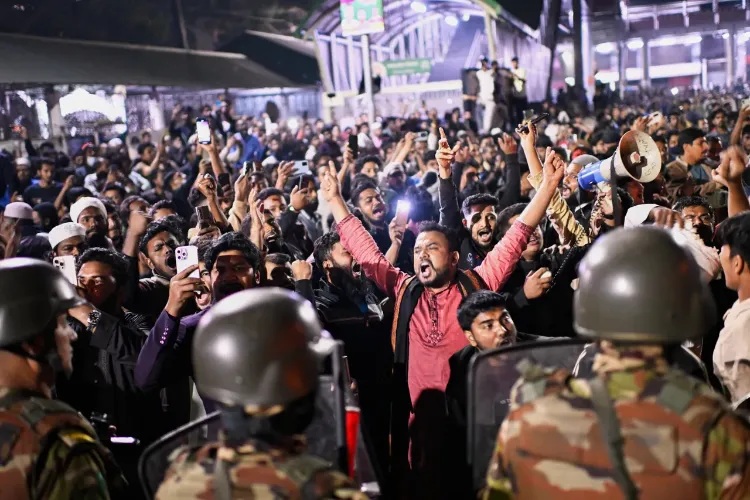
Anti-Bangladesh protests held in Jammu
Lynching Horror: Dipu Chandra Das Beaten, Hanged, and Burned by Mob
In early December 2025, a tragic incident shocked Bangladesh and strained bilateral relations with India when an Indian factory worker, identified as 28-year-old Ravi Kumar from Uttar Pradesh, was lynched by a mob in the industrial town of Tongi, near Dhaka. The mob, reportedly incited by rumors spread on social media, attacked him with bricks, sticks, and machetes, leading to his brutal death on the spot. Police arrived late and were unable to prevent the lynching; two suspects were later arrested, but the incident drew widespread condemnation.
Bangladesh’s interim government under Muhammad Yunus expressed regret and promised a thorough investigation, while Indian officials, including the Ministry of External Affairs, condemned the killing and called for swift justice and protection of Indian nationals working in Bangladesh. The episode fueled existing anti-India

