


A defining moment at the highest court of the United States, Neal Katyal’s decisive triumph in a high-stakes tariff dispute underscores the power of constitutional advocacy—and shines a spotlight on a proud Indian-American voice shaping global trade jurisprudence at the Supreme Court of the United States.
His story is one of selective cultural pride: fully American in his professional achievements, yet deeply influenced by Indian ideals of justice, equality, and public service.
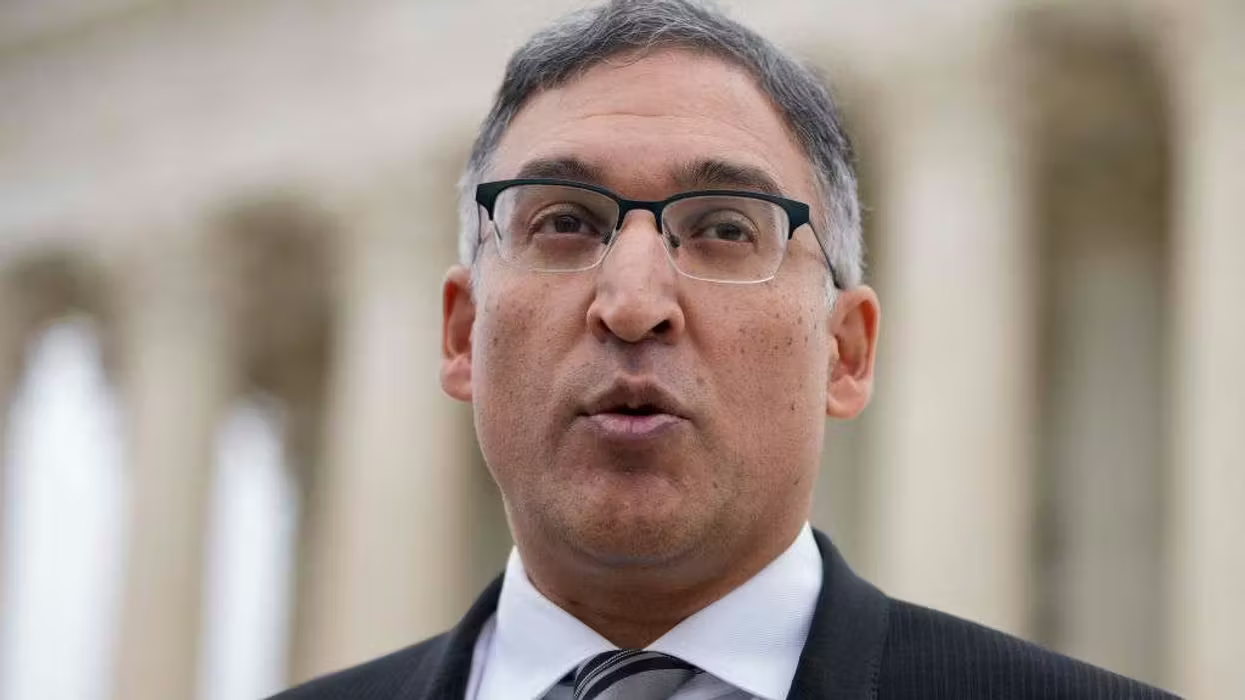
FILE PHOTO: Neal Katyal talks to reporters outside the U.S. Supreme Court. (Photo by Drew Angerer/Getty Images)
In a significant ruling,, the U.S. Supreme Court delivered a major setback to certain tariff policies implemented during the Trump administration. Neal Katyal, one of America’s most accomplished appellate lawyers, argued and won the case on behalf of affected businesses and importers.
The decision limited the executive branch’s unilateral authority to impose broad tariffs under national security pretexts without sufficient congressional oversight or evidence-based justification. Legal analysts described it as a critical check on executive overreach in trade policy—a victory that once again placed Katyal at the forefront of high-stakes constitutional and economic litigation.
For Neal Katyal, this triumph is not just another line on an already extraordinary résumé. It is a powerful reminder of the journey that brought him—from the son of Indian immigrants in Chicago to the lawyer who has argued more cases before the U.S. Supreme Court than any other minority attorney in history.
Roots in India, Rise in America
Neal Kumar Katyal was born on March 12, 1970, in Chicago to Indian immigrant parents. His father, an engineer, and his mother, a pediatrician, arrived in the United States in the 1960s seeking better opportunities. Like many Indian families of that generation, they instilled in their children the values of hard work, education, discipline, and service to society—core principles deeply rooted in Indian culture.
Growing up in a middle-class Indian-American household, Neal was raised with a strong sense of cultural identity alongside full immersion in American life.
His parents emphasized the importance of giving back, intellectual curiosity, and standing up for justice—ideals that would later echo in his legal philosophy. He has often spoken about how his mother and father’s immigrant story shaped his worldview: the belief that opportunity must be earned through effort, but also protected through law and institutions.
A Conscious Connection to Indian Constitutional Ideals
Throughout his career, Neal Katyal has repeatedly drawn inspiration from India’s constitutional tradition—particularly the vision of Dr. B.R. Ambedkar, the principal architect of the Indian Constitution. Katyal has described Ambedkar’s emphasis on equality, social justice, and the rule of law as profoundly influential on his own understanding of constitutional protection for marginalized communities.
In interviews and public lectures (including at institutions in India), he has highlighted parallels between the Indian Constitution’s commitment to affirmative action, fundamental rights, and inclusive democracy and the U.S. Constitution’s promise of equal protection under the law.
In an era of global challenges to democratic norms and economic fairness, voices like Katyal’s—rooted in both American constitutional tradition and Indian ideals of justice—remain vital
This conscious connection is not incidental—it forms a central part of his personal story and public persona. Whether defending voting rights, challenging executive overreach, or protecting religious freedom, Katyal’s arguments often reflect a deep appreciation for constitutional safeguards that uplift the disadvantaged—values he traces back to Ambedkar and the Indian freedom struggle.
From Chicago to the Highest Court
After graduating from Dartmouth College and Yale Law School, Katyal clerked for Judge Guido Calabresi and Justice Stephen Breyer. He joined the U.S. Department of Justice, eventually serving as Acting Solicitor General (2010–2011)—the first Indian-American to hold that position.
Since entering private practice, he has argued more than 50 cases before the Supreme Court, securing landmark victories in areas ranging from national security (Hamdan v. Rumsfeld) to religious freedom (American Legion v. American Humanist Association) and election law (Moore v. Harper). His tariff case win in 2026 further solidified his reputation as a master of complex economic and constitutional issues.
A Role Model for the Diaspora
Neal Katyal’s Indian origin remains a proud and visible part of his identity. He frequently speaks about his parents’ journey, the sacrifices they made, and how their values continue to guide him. In India, he is celebrated as an inspiring figure—proof that children of immigrants can reach the pinnacle of American legal life while staying connected to their roots.
His story is one of selective cultural pride: fully American in his professional achievements, yet deeply influenced by Indian ideals of justice, equality, and public service. As he continues to shape U.S. law at the highest level, Neal Katyal embodies the best of the Indian diaspora—ambitious, principled, and committed to using law as an instrument of fairness and progress.
In an era of global challenges to democratic norms and economic fairness, voices like Katyal’s—rooted in both American constitutional tradition and Indian ideals of justice—remain vital. His victory in the tariff case is only the latest chapter in a remarkable career that continues to inspire millions, both in the United States and in India

