


As tensions periodically rise between the United States and Iran, Washington’s military footprint across the Middle East becomes strategically significant. A network of air bases, naval fleets, missile-defense systems, and forward-deployed troops under United States Central Command enables the U.S. to project power, secure vital maritime routes, and respond rapidly to any escalation. From the massive Al Udeid Air Base in Qatar to the naval headquarters of the United States Fifth Fleet in Bahrain, this military architecture forms the backbone of America’s strategic posture in the Gulf region.
By Arti Singh
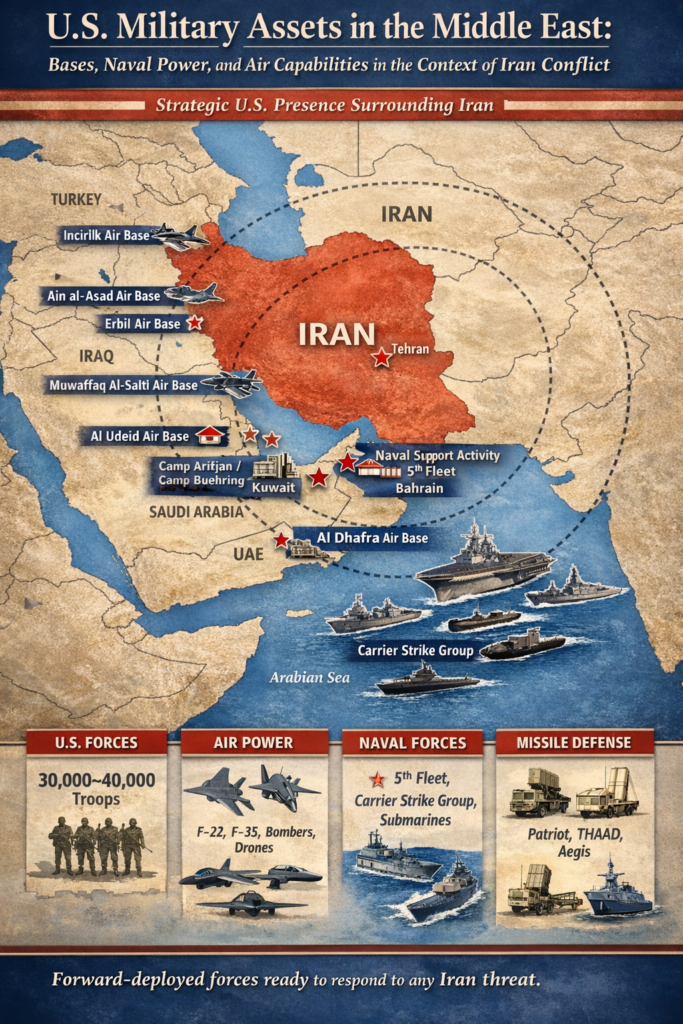
The United States maintains an extensive military presence in the Middle East primarily under the command of United States Central Command. This network of bases, naval forces, air assets, and missile-defense systems allows the U.S. to respond rapidly to crises, deter adversaries, and protect key strategic routes such as the Persian Gulf and the Strait of Hormuz. In the event of a conflict with Iran, these assets provide the U.S. with forward-deployed strike capability and defensive infrastructure across the region.
Overall Military Presence
The United States generally maintains between 30,000 and 40,000 troops across the Middle East. The number can increase during periods of tension or military escalation. American forces are stationed in a network of permanent bases, forward operating sites, logistics hubs, and naval facilities spread across the Gulf region, Iraq, Jordan, and nearby areas.
This forward deployment allows the U.S. to maintain rapid response capability, conduct air and naval operations, support regional allies, and deter threats from Iran and Iran-aligned groups.
Major U.S. Bases in the Gulf Region
Qatar
One of the most important U.S. installations in the region is Al Udeid Air Base. It is the largest American military facility in the Middle East and serves as a forward headquarters for CENTCOM. The base hosts thousands of personnel and supports bomber aircraft, surveillance platforms, aerial refueling tankers, and command-and-control operations. In a conflict scenario, it would function as a major hub for air operations.
Bahrain
In Bahrain, the U.S. operates Naval Support Activity Bahrain, which serves as the headquarters of the United States Fifth Fleet. This fleet oversees naval operations in the Persian Gulf, Arabian Sea, and parts of the Indian Ocean. Its primary missions include maritime security, monitoring Iranian naval activity, and ensuring the safety of global shipping routes.
Kuwait
Kuwait hosts several important U.S. Army installations, including Camp Arifjan and Camp Buehring. These bases serve as logistics and troop-deployment centers supporting operations across the region. They are particularly important for ground forces and supply chains.
United Arab Emirates
In the United Arab Emirates, the United States operates Al Dhafra Air Base. This base hosts advanced aircraft such as stealth fighters, reconnaissance planes, and drones. It plays a key role in surveillance, intelligence gathering, and air-power projection in the Gulf.
Iraq
The U.S. maintains a smaller but strategically important presence in Iraq. Major installations include Ain al-Asad Airbase and facilities near Erbil in the Kurdish region. These bases are relatively close to Iran’s western border and are used for intelligence operations, counter-militia missions, and regional security support.
Jordan
Jordan hosts several facilities supporting American air and surveillance operations. The Muwaffaq al-Salti Air Base and other outposts help monitor developments in Iraq and Syria.
U.S. Naval Forces in the Region
The U.S. Navy provides some of the most powerful and flexible assets in any potential conflict with Iran. Carrier strike groups frequently operate in waters near the region, particularly the Arabian Sea and the Persian Gulf.
An aircraft carrier typically carries 60 to 70 aircraft, including fighters, electronic warfare planes, and surveillance aircraft. These carriers are escorted by destroyers and cruisers equipped with advanced missile systems capable of launching long-range cruise missiles.
The Navy also deploys nuclear-powered attack submarines, which can conduct stealth operations and launch precision strikes against land targets if required.
Air Power and Strategic Strike Capability
U.S. air power in the Middle East is distributed across regional bases and naval carriers. Aircraft commonly deployed include stealth fighters, multirole strike aircraft, reconnaissance planes, and aerial refueling tankers.
These aircraft provide several operational advantages:
- Long-range precision strike capability
- Air superiority over contested zones
- Intelligence, surveillance, and reconnaissance missions
- Support for naval and ground forces
Strategic bombers may also be deployed temporarily to regional bases or nearby locations in the Indian Ocean during periods of heightened tension.
Missile Defense Systems
Because Iran possesses a large arsenal of ballistic missiles and drones, the United States maintains a layered missile defense network across the region. This includes Patriot missile batteries, THAAD systems, and naval missile-defense platforms on destroyers.
These systems are designed to intercept ballistic missiles and protect U.S. bases, personnel, and allied countries such as Saudi Arabia, the UAE, and Israel.
Strategic Geography and Military Positioning
The geographical distribution of U.S. forces effectively places Iran within range of multiple American bases and naval platforms. Forces stationed in Gulf states to the south, Iraq to the west, and naval assets in surrounding waters allow the United States to conduct operations from several directions if necessary.
This positioning is intended to provide both deterrence and rapid response capability in the event of military escalation.
Potential Risks and Vulnerabilities
Despite its technological and operational superiority, the U.S. military presence in the region faces risks. Many American bases are within range of Iranian ballistic missiles, cruise missiles, and drones. Iran also maintains allied militia groups across the region that could target U.S. facilities.
As a result, regional bases rely heavily on air defenses, hardened infrastructure, and dispersal of assets to reduce vulnerability during a conflict.
In summary, the U.S. military posture in the Middle East consists of a wide network of bases, air power, naval forces, and missile defenses designed to deter adversaries and maintain regional stability. In the context of a potential confrontation with Iran, this infrastructure provides the United States with significant operational reach and strategic flexibility across the region.
Comparing Iran’s Military Power with the United States and Israel
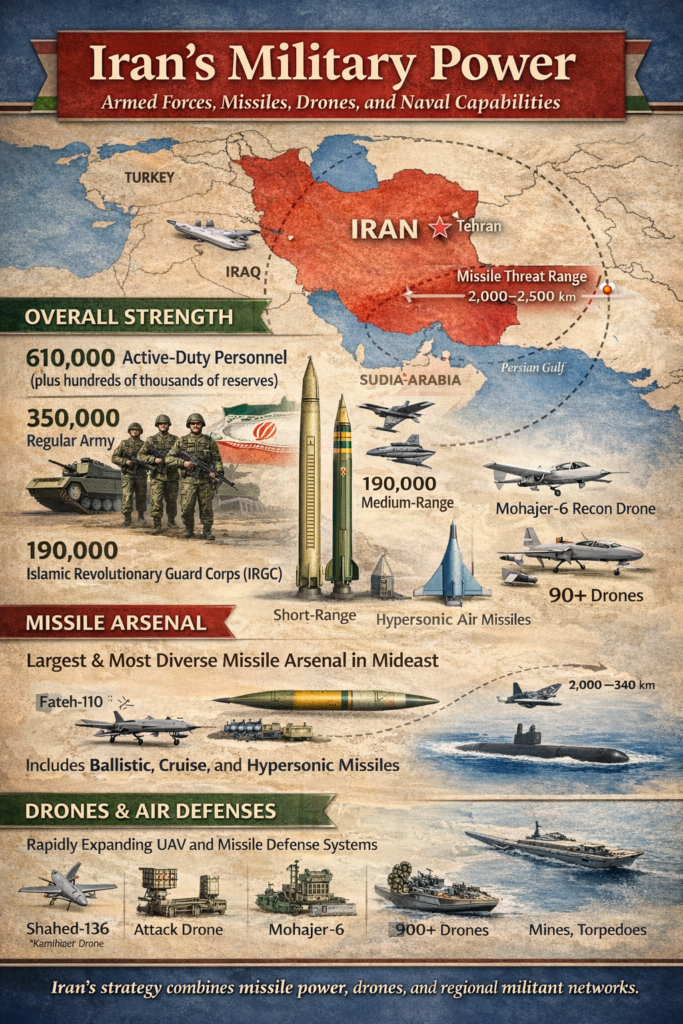
In conventional military terms, Iran is significantly weaker than the United States and Israel, both of which possess far more advanced air forces, precision-strike capabilities, and technological superiority.
The United States maintains the world’s most powerful military, with global power-projection assets such as aircraft carrier strike groups, stealth bombers, and an extensive network of overseas bases under United States Central Command. Israel, though smaller, has one of the most technologically sophisticated militaries in the region, equipped with advanced fighter aircraft such as the F-35, integrated missile defense systems, and a widely assumed nuclear deterrent.
However, Iran compensates for its conventional limitations through a strategy focused on deterrence, asymmetric warfare, and missile power. Rather than competing directly with U.S. or Israeli air and naval superiority, Iran has invested heavily in ballistic missiles, drones, cyber capabilities, and naval tactics designed to disrupt maritime traffic in the Persian Gulf. These capabilities allow Tehran to threaten U.S. bases and allied infrastructure across the region and potentially disrupt global oil supplies through the strategically critical Strait of Hormuz.
Another key dimension of Iran’s strategic posture is its network of regional partners and allied militias across the Middle East. Through the external operations wing of the Islamic Revolutionary Guard Corps, often referred to as the Quds Force, Iran has built influence in several conflict zones, including Lebanon, Iraq, Syria, and Yemen. This network provides Tehran with the ability to exert pressure on adversaries indirectly and to open multiple fronts in the event of a wider regional conflict, complicating military planning for both the United States and Israel.
About the Author
Arti Singh is a seasoned journalist and alumna of the India Today Media Institute. She has worked with major news channels like Aaj Tak and ABP News in editorial and production roles. She also led PR for the US-based company GirishGPO, blending media, communications, and corporate strategy. With deep experience in newsroom operations, reporting, and content creation, she specializes in broadcast journalism and modern media.

