


Ukraine’s war with Russia has become more than a military conflict—it has evolved into a testing ground for the future of warfare. Driven by necessity, Ukraine has built a dynamic ecosystem of drones, artificial intelligence, battlefield data, and defense startups that is reshaping how wars are fought and how military technologies are developed.
As the country transforms hard-earned combat experience into a global export, it is offering the world a glimpse of an emerging era in which data, algorithms, and rapid innovation may prove as decisive as tanks, aircraft, and soldiers. This article examines how Ukraine’s battlefield innovations are influencing military strategy worldwide while raising critical questions about the role of AI in the use of force.
By Newswriters News Desk
Ukraine’s AI Battlefield: How War Is Creating a New Global Defense Industry
The wars of the twentieth century were often won through industrial capacity, manpower, and conventional military strength. The wars of the twenty-first century, however, are increasingly being shaped by data, artificial intelligence, and rapid technological adaptation. Nowhere is this transformation more visible than in Ukraine, where four years of continuous conflict have turned the country into one of the world’s most important laboratories for military innovation.
What began as a desperate struggle for survival following Russia’s full-scale invasion has evolved into an ecosystem of drone manufacturers, software developers, military engineers, and frontline soldiers working together to create new forms of warfare. In the process, Ukraine is emerging not only as a defender of its territory but also as a global exporter of military technology, battlefield expertise, and combat data.
From Battlefield to Database
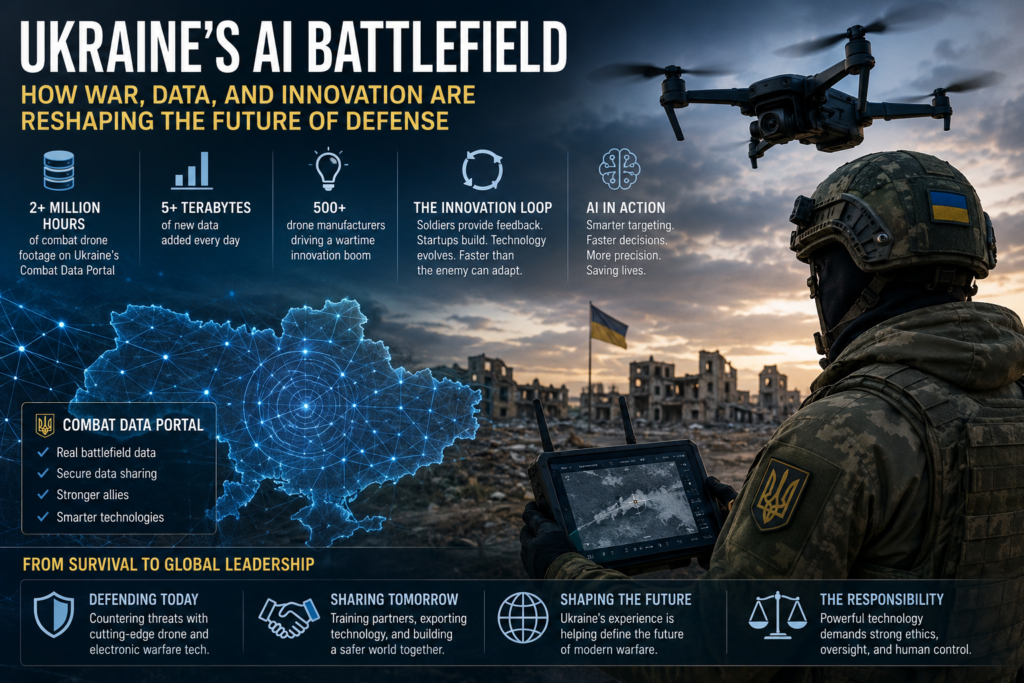
One of the most significant developments in recent years has been Ukraine’s effort to systematically collect and organize battlefield information. Modern warfare generates enormous amounts of digital data through surveillance drones, reconnaissance systems, sensors, and combat operations. Unlike previous wars, where much of the operational knowledge remained dispersed among military units, Ukraine has transformed this information into a strategic national asset.
Millions of hours of combat drone footage now provide an unparalleled record of modern warfare. Such data is invaluable for training artificial intelligence systems because it exposes algorithms to real-world battlefield conditions rather than simulated environments. The value of these datasets extends far beyond Ukraine’s borders. Allied countries and defense companies increasingly view combat data as a critical resource for developing the next generation of autonomous and semi-autonomous military systems.
In this sense, Ukraine is exporting not only weapons but also knowledge. The country’s battlefield experience has become a commodity with significant strategic value.
The Rise of a Wartime Innovation Economy
Perhaps the most remarkable aspect of Ukraine’s defense transformation is the speed at which innovation has occurred. Before the war, the country’s drone manufacturing sector was relatively limited. Today, hundreds of companies are engaged in developing drones, software systems, electronic warfare solutions, and AI-enabled technologies.
Unlike traditional defense industries, which are often dominated by large corporations and lengthy procurement cycles, Ukraine’s innovation ecosystem operates more like a technology startup environment. Small companies rapidly design prototypes, deploy them in combat situations, receive feedback from soldiers, and modify their products accordingly.
This model has created what many observers describe as an “innovation loop.” Frontline soldiers identify operational challenges, engineers develop solutions, and combat experience immediately informs the next generation of technology. The result is an unusually fast cycle of experimentation and improvement.
Such an approach offers an important lesson for military organizations worldwide. In an era when technological change occurs at unprecedented speed, adaptability may become more valuable than possessing the most advanced weapon at any given moment.
Drones and the Logic of Asymmetrical Warfare
Ukraine’s technological emphasis reflects a broader strategic reality. Facing an adversary with greater resources and larger military reserves, Ukraine has sought to compensate through innovation and agility.
Drones have become central to this strategy. Relatively inexpensive compared to traditional military hardware, they provide reconnaissance, targeting, and strike capabilities that can significantly alter battlefield dynamics. The widespread use of First-Person View (FPV) drones demonstrated how commercial technologies could be adapted for military purposes.
However, early drone systems faced significant limitations. Russian electronic warfare capabilities frequently disrupted communications, rendering many drones ineffective. This challenge accelerated the development of autonomous navigation systems, anti-jamming technologies, and AI-assisted operations.
The evolution of Ukrainian drone technology illustrates how battlefield pressures can drive rapid technological advancement. Every operational weakness becomes a problem requiring immediate solutions, and those solutions often generate entirely new capabilities.
Artificial Intelligence as a Force Multiplier
Artificial intelligence is increasingly becoming the defining feature of modern military operations. In Ukraine, AI is being integrated into multiple stages of the decision-making process, including reconnaissance, target identification, navigation, and mission planning.
The most immediate benefit of AI lies in its ability to process information at speeds far beyond human capacity. Vast quantities of surveillance imagery that once required hours of analysis can now be processed in minutes. Algorithms can identify trenches, vehicles, defensive positions, and patterns of activity that might otherwise remain unnoticed.
AI also contributes to precision. Instead of merely identifying a military vehicle as a target, advanced systems can determine the most vulnerable points for attack, increasing the likelihood of mission success while potentially reducing resource expenditure.
This capability reflects a broader shift in warfare from mass destruction toward targeted effectiveness. Information superiority increasingly determines operational success.
The Ethical Challenge of Autonomous Weapons
While the military advantages of AI are evident, the technology also raises profound ethical and legal questions. As algorithms assume greater responsibility for identifying targets and recommending actions, concerns emerge regarding accountability and human oversight.
Military organizations often emphasize the principle of keeping a “human in the loop,” meaning that final decisions involving lethal force remain under human control. Yet technological developments continually test the boundaries of this principle.
The challenge is not merely technical but philosophical. If an AI system can identify threats more quickly and accurately than a human operator, pressure will inevitably grow to increase automation. However, delegating life-and-death decisions to machines raises fundamental questions about responsibility, morality, and international humanitarian law.
International organizations, including the United Nations, have repeatedly called for discussions on regulating autonomous weapons systems. The debate reflects a growing recognition that military AI could become one of the defining security issues of the coming decades.
A New Defense Export Power
Perhaps the most surprising consequence of Ukraine’s wartime innovation has been its emergence as a defense exporter. A country that once relied heavily on foreign military assistance is increasingly sharing expertise with partners facing similar security challenges.
Governments and defense institutions around the world are studying Ukrainian methods of drone warfare, electronic defense, and AI integration. The country’s experience has become relevant far beyond Eastern Europe, particularly as drone technology spreads across multiple conflict zones.
This shift represents a significant geopolitical development. Ukraine is no longer viewed solely as a recipient of military support but as a contributor to global defense innovation. Its influence increasingly derives from operational experience and technological expertise rather than traditional measures of military power.
Conclusion
Ukraine’s wartime experience demonstrates that the future of warfare will be shaped not only by weapons but by data, software, and the ability to innovate under pressure. The country has created a unique model in which soldiers, entrepreneurs, engineers, and government institutions collaborate in a continuous cycle of adaptation and improvement.
At the same time, the technologies emerging from this environment raise critical questions about the future role of artificial intelligence in armed conflict. The challenge for governments will be to harness the advantages of AI while ensuring that human judgment and accountability remain central to decisions involving the use of force.
As nations around the world race to develop military AI capabilities, Ukraine’s experience offers both a blueprint for innovation and a warning about the ethical dilemmas that accompany technological transformation. The battlefield of the future is already taking shape, and its most valuable resource may not be weapons themselves, but the data and intelligence that guide them.

