


Cold War 2.0 is transforming international politics, economics, technology, and security. Unlike the ideological rivalry between the United States and the Soviet Union during the twentieth century, the new Cold War revolves around artificial intelligence, cyber warfare, semiconductors, supply chains, and strategic influence. This article explains the origins, characteristics, major players, and global implications of Cold War 2.0, while examining why many experts believe the world has entered a new era of great-power competition.
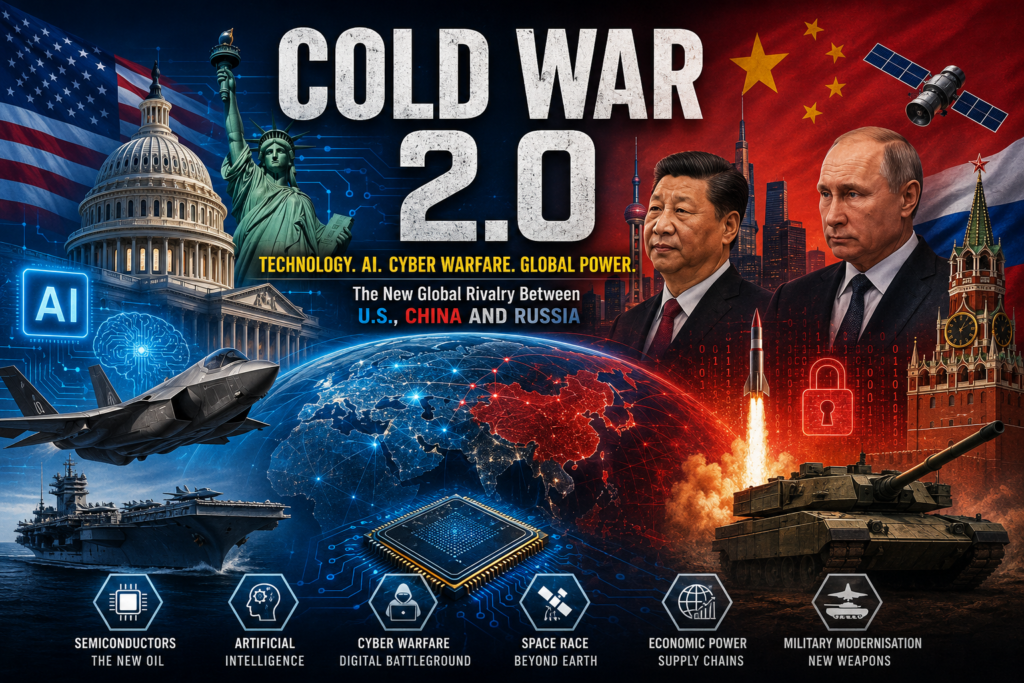
The term Cold War 2.0 has increasingly become part of discussions on international relations, strategic affairs, and global politics. Diplomats, military analysts, journalists, and academics frequently use it to describe the growing rivalry among major powers, particularly the United States and China, with Russia playing an influential strategic role. Although the phrase does not refer to a formally declared conflict, it captures a period of sustained competition across political, economic, technological, military, and diplomatic domains.
The world today is witnessing a contest for influence that extends far beyond conventional military power. Artificial intelligence, semiconductor manufacturing, cybersecurity, digital infrastructure, rare earth minerals, global supply chains, and space exploration have become critical arenas of competition. While military deterrence remains important, technological leadership and economic resilience are increasingly regarded as decisive factors in determining global power.
Unlike the original Cold War of the twentieth century, today’s rivalry is not primarily ideological. Instead, it is driven by strategic competition over who will shape the international order of the twenty-first century.
Understanding the Original Cold War
The first Cold War emerged after the Second World War and lasted from approximately 1947 until the collapse of the Soviet Union in 1991. It was a prolonged confrontation between the United States and the Soviet Union without direct military conflict between the two superpowers.
The rivalry was defined by competing political and economic ideologies. The United States championed liberal democracy and capitalism, while the Soviet Union promoted communism and state-controlled economies. Both sides expanded military alliances, accumulated vast nuclear arsenals, and competed for influence across Asia, Africa, Latin America, and Europe.
Proxy wars in Korea, Vietnam, Afghanistan, and several African countries reflected this global contest. Intelligence agencies engaged in extensive espionage operations, while the Space Race symbolized technological superiority. Despite numerous crises, including the Cuban Missile Crisis, the threat of mutually assured nuclear destruction prevented direct war between the superpowers.
What Is Cold War 2.0?
Cold War 2.0 describes the current phase of strategic competition among major global powers. Although there is no universally accepted definition, the term broadly refers to the intensifying geopolitical rivalry led by the United States and China, with Russia remaining a significant military and geopolitical actor.
Unlike the twentieth-century Cold War, the new rivalry is less about spreading competing political ideologies and more about securing economic leadership, technological dominance, military superiority, and geopolitical influence.
The competition spans multiple sectors simultaneously. Governments are investing heavily in artificial intelligence, quantum computing, advanced manufacturing, cybersecurity, space technology, biotechnology, and semiconductor production. These technologies are increasingly viewed as essential components of national security rather than merely engines of economic growth.
Why the Term “Cold War 2.0” Has Gained Popularity
Several developments over the past decade have contributed to the widespread use of the phrase.
Trade disputes between the United States and China evolved into broader technology restrictions, export controls, and investment screening. Concerns over cybersecurity, intellectual property protection, supply chain vulnerabilities, and strategic dependence on critical technologies intensified.
The COVID-19 pandemic further exposed the risks associated with excessive dependence on global supply chains concentrated in a few countries. Many governments subsequently adopted policies aimed at reshoring manufacturing, diversifying suppliers, and protecting strategic industries.
Meanwhile, the Russia–Ukraine conflict heightened geopolitical tensions, increased defence spending across Europe, and reinforced discussions about a changing global security architecture.
Together, these developments have convinced many analysts that the international system is entering a prolonged period of strategic rivalry resembling certain aspects of the original Cold War.
Technology Has Become the Primary Battlefield
Perhaps the most defining feature of Cold War 2.0 is the central role of technology.
Artificial intelligence is now viewed as a strategic asset capable of transforming military operations, intelligence gathering, healthcare, education, transportation, and industrial productivity. Countries are investing billions of dollars to secure leadership in AI research and applications.
Semiconductors have emerged as another critical area of competition. Modern economies depend on advanced computer chips for everything from smartphones and automobiles to military equipment and supercomputers. Consequently, semiconductor manufacturing has become a matter of national security.
Similarly, quantum computing promises revolutionary advances in computing power, encryption, and scientific research. Nations that lead in quantum technologies may gain significant economic and military advantages.
Competition also extends to 5G and future communication networks, cloud computing, robotics, biotechnology, autonomous systems, and advanced manufacturing.
Cybersecurity and Information Warfare
Unlike the original Cold War, where military deployments and nuclear deterrence dominated strategic thinking, Cold War 2.0 increasingly unfolds in cyberspace.
Cyberattacks on governments, financial institutions, healthcare systems, energy infrastructure, and private corporations have become regular features of international competition. Cyber espionage enables states to gather intelligence, steal technological innovations, and influence political processes without crossing traditional military thresholds.
Information warfare has also become far more sophisticated. Social media platforms enable rapid dissemination of misinformation, disinformation, propaganda, and AI-generated content capable of shaping public opinion and influencing elections.
The digital information environment has therefore become a new strategic battlefield where narratives can influence international relations almost as much as military power.
Economic Competition Is National Security
One of the biggest differences between the first Cold War and Cold War 2.0 is the level of economic interdependence.
During the twentieth century, the American and Soviet economies operated largely independently. Today, however, the world’s largest economies remain deeply interconnected through trade, investment, manufacturing, finance, and technology.
This creates a paradox. Countries compete intensely while remaining economically dependent on one another.
Governments increasingly use tariffs, export controls, sanctions, investment restrictions, and industrial policies to protect strategic industries. Supply chain resilience, energy security, food security, and access to critical minerals have become essential components of national security planning.
Rather than pursuing complete economic separation, many countries are seeking diversification to reduce vulnerabilities while preserving global trade.
Military Competition Continues
Although economic and technological competition dominate headlines, military modernization remains an important feature of Cold War 2.0.
Major powers continue to invest in next-generation fighter aircraft, aircraft carriers, submarines, missile defence systems, hypersonic missiles, drones, autonomous weapons, and nuclear modernization.
Space has also become an increasingly contested domain. Satellites support communication, navigation, intelligence gathering, weather forecasting, and military operations. Anti-satellite weapons and space-based surveillance systems have added a new dimension to strategic competition.
Unlike previous decades, future conflicts are likely to combine conventional military operations with cyberattacks, electronic warfare, artificial intelligence, and autonomous technologies.
The Role of Strategic Alliances
International partnerships have also evolved significantly.
The United States continues to strengthen security partnerships with allies across Europe and the Indo-Pacific. NATO has expanded its strategic focus beyond Europe, while newer groupings such as the Quad and AUKUS reflect changing security priorities in the Indo-Pacific region.
China has expanded its diplomatic, economic, and infrastructure partnerships through initiatives connecting Asia, Africa, Latin America, and Europe. Russia, despite economic challenges, continues to exert influence through military capabilities, energy resources, and strategic partnerships.
Unlike the rigid military blocs of the twentieth century, today’s international system is more flexible. Many countries cooperate with different partners depending on the issue rather than joining exclusive camps.
Is Cold War 2.0 Really a New Cold War?
Not all scholars agree with the label “Cold War 2.0.”
Critics argue that the comparison oversimplifies today’s international environment. The original Cold War was fundamentally ideological, whereas current rivalries revolve around economics, technology, security, and geopolitical influence.
Moreover, today’s major powers remain deeply interconnected through trade and global markets. Most countries are unwilling to choose exclusive alliances and instead pursue pragmatic, issue-based cooperation.
For these reasons, many experts prefer terms such as “great-power competition,” “strategic competition,” or “the new geopolitical rivalry.”
Nevertheless, the expression Cold War 2.0 remains useful because it highlights the sustained, multidimensional competition shaping international politics without implying an inevitable direct military confrontation.
The Road Ahead
The future of Cold War 2.0 will depend largely on how successfully major powers manage competition while avoiding military escalation.
Artificial intelligence, quantum computing, biotechnology, cybersecurity, climate technologies, and space exploration will continue to influence the global balance of power. At the same time, international cooperation will remain essential for addressing shared challenges such as climate change, pandemics, terrorism, nuclear proliferation, and financial stability.
The defining characteristic of the emerging international order is likely to be competition coexisting with cooperation—a relationship in which countries compete fiercely in technology and geopolitics while collaborating where mutual interests demand.
Conclusion
Cold War 2.0 represents one of the most significant transformations in international relations since the end of the twentieth century. While it echoes the original Cold War through strategic rivalry, military modernization, and competition for influence, its defining features are fundamentally different. Technology, artificial intelligence, cyber capabilities, economic resilience, supply chains, and information warfare have become the new instruments of geopolitical power.
Whether the phrase ultimately becomes a permanent historical label or simply a temporary description of the current international environment, it reflects a reality that governments, businesses, universities, and citizens cannot ignore. Understanding Cold War 2.0 is essential for interpreting global politics, anticipating future conflicts, and navigating an increasingly interconnected yet intensely competitive world.
About the Author
Muneshwar Prasad is a communication scholar and researcher specializing in communication studies, with a particular focus on the intersection of media, technology, and society. He writes on contemporary issues, offering research-based analysis of developments shaping public discourse, governance, and international affairs. His work also explores the impact of emerging technologies, particularly artificial intelligence, on journalism, media, and digital communication.

