


The wave of youth discontent sweeping across the world reflects deep-seated anger and frustration. At its core, this is a revolt against an established system and a political class that young people increasingly see as having failed them—repeatedly offering diminishing opportunities, deepening inequalities, and inadequate responses to their aspirations. Many now feel sidelined by systems that no longer appear capable of delivering a fair or hopeful future.
By News Desk
The alienation runs so deep that even highly qualified young people struggle to find meaningful opportunities. New technologies are rapidly eliminating traditional jobs, while large sections of the youth remain unequipped for the roles that remain or emerge—largely because of inadequate education and training. As a result, growing numbers are being pushed to the margins of the system, left without a clear path or future.
An Global Overview
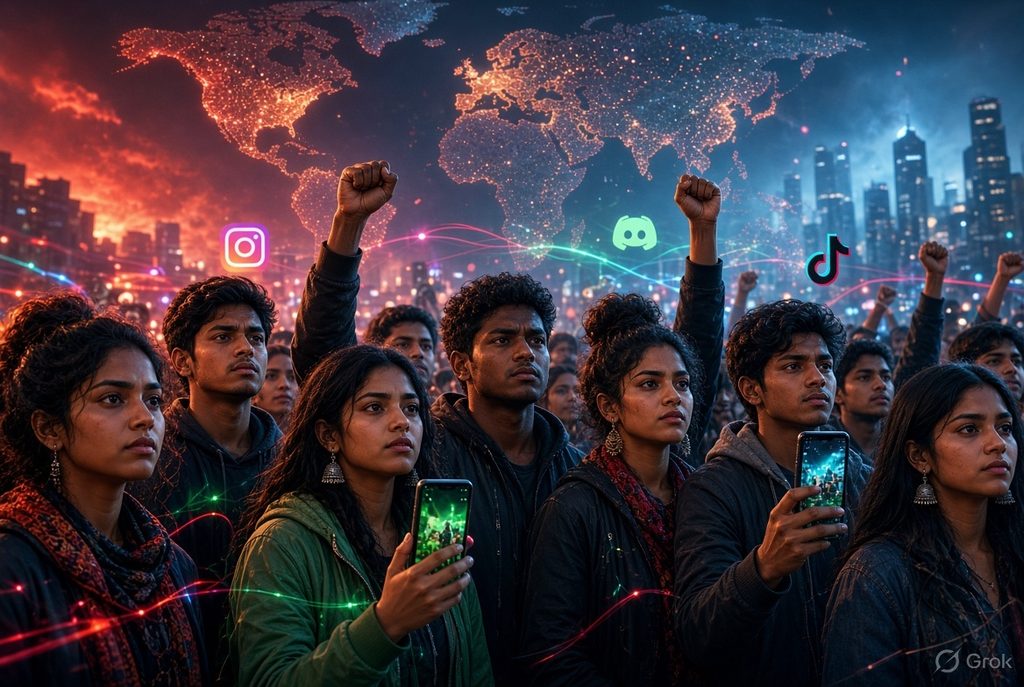
After the Arab Spring, social media and digital platforms became even more central to protest. Movements grew more decentralised, faster to organise, and increasingly led by younger generations who had grown up with smartphones and social networks. The tools changed—from Facebook and Twitter to Instagram, TikTok, Discord, and encrypted messaging apps—but the pattern remained: digital platforms amplified grievances, coordinated action, and created rapid transnational inspiration.
From Colour Revolutions to the Arab Spring
Earlier non-violent uprisings in post-Soviet states against electoral fraud and authoritarian rule predated the full rise of Facebook and Twitter. They relied mainly on traditional independent media, SMS text messaging, blogs, and early internet forums.
- Georgia – Rose Revolution (2003): Protests against electoral fraud forced President Eduard Shevardnadze to resign. Youth group Kmara (“Enough”) and independent television (especially Rustavi-2) played major roles.
- Ukraine – Orange Revolution (2004): Massive street protests after a disputed presidential election. Mobile phones and SMS networks helped coordinate crowds in Kyiv’s Independence Square.
- Kyrgyzstan – Tulip Revolution (2005): Similar protests over election results led to the ouster of President Askar Akayev. Independent media and early internet activity were important.
- Moldova’s 2009 “Twitter Revolution” made heavier use of emerging social platforms.
Iran’s Green Movement (2009) is often called one of the first true “Twitter revolutions.” After disputed presidential elections, protesters used Twitter, YouTube, and Facebook to organise demonstrations, share videos of crackdowns, and appeal for international attention despite heavy state censorship. The movement was ultimately suppressed, but it demonstrated social media’s power for both mobilisation and global visibility.
The Arab Spring (2010–2012) marked the watershed moment when social media became central to large-scale revolutionary mobilisation.
In Tunisia, the self-immolation of street vendor Mohamed Bouazizi in Sidi Bouzid sparked protests. Videos and images of police brutality spread rapidly on Facebook, helping turn local anger into a nationwide uprising that forced President Zine El Abidine Ben Ali to flee after 23 years in power.
In Egypt, the Facebook page “We Are All Khaled Said” (created after the police killing of a young man) and the April 6 Youth Movement helped organise the 25 January protests. Twitter and YouTube coordinated actions and documented events in Tahrir Square. President Hosni Mubarak resigned after 18 days.
The wave spread to Libya, Yemen, Syria, Bahrain, and elsewhere. Social media served three main functions: tactical coordination, documentation of repression, and transnational inspiration (the “contagion” effect). While outcomes varied—some regimes fell, others survived through repression or civil war—the Arab Spring established social media as a core tool of modern protest.
Post-2011 Landmark Movements
In the years immediately following 2011, several landmark movements emerged. Occupy Wall Street (2011) and its global offshoots used social media to spread the slogan “We are the 99%” and organise occupations against economic inequality. Turkey’s Gezi Park protests (2013) began over a redevelopment plan but quickly became a broader challenge to authoritarianism, coordinated largely through Twitter.
Hong Kong’s Umbrella Movement (2014) and the much larger 2019 protests against an extradition bill relied heavily on Telegram, LIHKG forums, and encrypted apps to organise leaderless, highly mobile demonstrations. Black Lives Matter, which began as a hashtag in 2013 and exploded globally after 2020, showed how a digital phrase could mobilise millions across continents. The #MeToo movement (2017) similarly demonstrated the power of hashtags to turn individual testimonies into a worldwide reckoning.
From the mid-2010s onward, youth-led and Gen Z protests became increasingly prominent. Climate strikes inspired by Greta Thunberg, anti-corruption campaigns, and movements against police violence or economic hardship spread through Instagram, TikTok, and WhatsApp. Many of these protests shared a common feature: they were often leaderless or loosely networked, making them harder for governments to suppress by targeting a single organisation.
The 2024–2026 Gen Z Wave
The period from 2024 to 2026 marked a new wave of intense Gen Z-led uprisings, particularly in the Global South and parts of Europe.
In 2024, Bangladesh’s student-led July Uprising (also called the Monsoon Revolution or Gen Z Revolution) began over civil-service job quotas and rapidly expanded into a broader challenge to authoritarianism. It forced the resignation of long-time Prime Minister Sheikh Hasina on 5 August 2024.
Kenya saw repeated youth protests against tax increases, cost-of-living pressures, and police violence. In 2025, a cascade of movements followed:
- Nepal’s protests against a social-media ban and elite corruption toppled the government within days.
- Madagascar’s youth demonstrations over power and water shortages helped force President Andry Rajoelina from office.
- Indonesia, the Philippines, Peru, Morocco (“Gen Z 212”), Mexico, and Timor-Leste all experienced significant youth mobilisations against corruption, inequality, and unaccountable elites.
By 2026, the wave reached both South Asia and Western Europe with particular intensity. In India, the “Cockroach Movement” (or Cockroach Janta Party) emerged after a senior judicial figure compared unemployed graduates to cockroaches.
Combined with anger over exam paper leaks, high youth unemployment, and perceived systemic failure, the movement organised large protests in Delhi and other cities, using social media to mobilise young people who felt shut out of economic opportunity. It has continued to challenge authorities on issues including electoral processes.
In France, high-school students launched nationwide blockades and marches from late September 2026 against overcrowded classrooms, teacher shortages, decaying school infrastructure, and a stressful university admissions system (Parcoursup). The protests drew hundreds of thousands of participants, met with police responses including tear gas, and quickly inspired similar student actions in Belgium, Italy, and Greece.
Other countries have also seen notable youth unrest in this period, including continued student demonstrations in the United States (related to immigration enforcement, Palestine, and broader political discontent), student marches in Brazil, and anti-austerity or education-focused protests in Spain, Chile, and elsewhere.
Common Drivers and the Digital Difference
Across these post-2011 movements—from Occupy and Gezi to the 2024–2026 Gen Z uprisings in Bangladesh, Nepal, India, France, Madagascar, and beyond—a consistent picture emerges. Social media and digital tools have made it possible for young people to organise rapidly, share evidence of injustice instantly, and draw inspiration across borders. Yet the underlying drivers remain stubbornly similar: economic insecurity, inadequate education and employment opportunities, corruption, and a deep sense that established political systems have failed a generation.
Common drivers across these countries include scarce entry-level jobs (exacerbated by technology and economic pressures), perceived elite corruption and unaccountability, inadequate education systems, and a sense that the political class has repeatedly failed young people. Many movements have been decentralised, organised via social media, and explicitly identified as Gen Z-led.
Social media accelerates mobilisation, amplifies grievances, and makes state censorship harder, but success still depends on offline organisation, political context, and elite responses.
Early coloured revolutions showed the power of independent media and mobile phones; the Arab Spring marked the arrival of Facebook, Twitter, and YouTube as primary instruments of protest. Today’s platforms lower the barriers still further, enabling leaderless, highly adaptive campaigns that can spread from one country to another in days rather than months.
Digital platforms accelerate and amplify these protests, but the deeper crisis of hope and opportunity continues to fuel them. The anger burst of recent years is not merely a technological phenomenon—it is a generational one.

