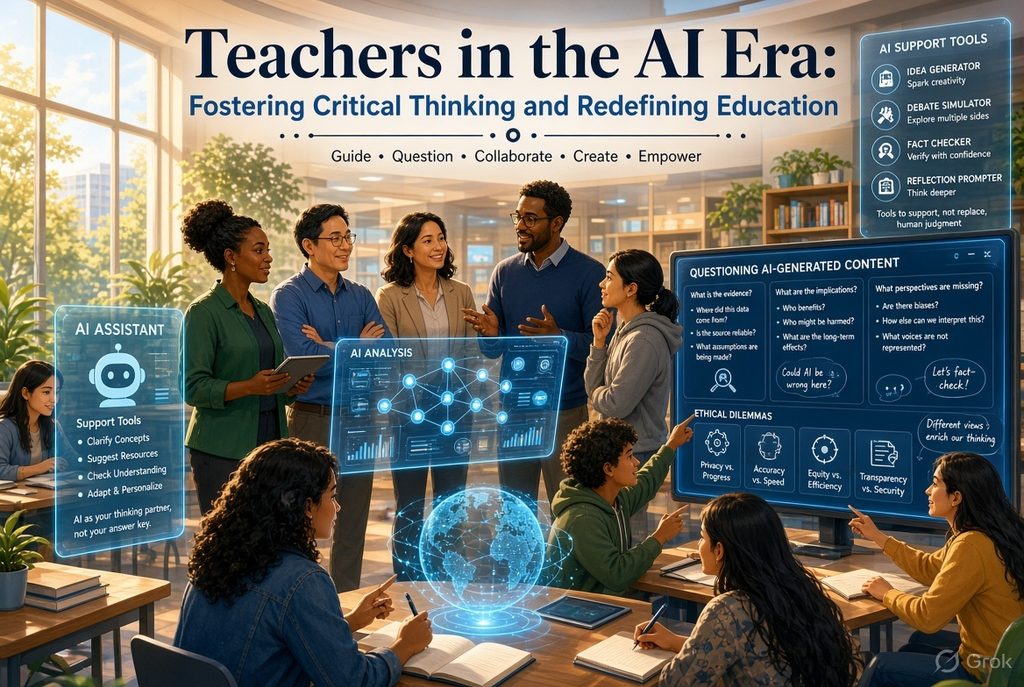


AI may be able to explain, generate and assess—but education is about more than information. In an AI-driven classroom, teachers remain central to developing critical thinking, curiosity, judgment and human connection.

By Editorial Desk
Artificial intelligence is rapidly changing the educational landscape. AI tools can generate explanations, summarise complex texts, create learning materials, translate languages, analyse data and provide students with instant feedback. As these capabilities expand, an important question is emerging:
What should be the role of a teacher when AI can perform many of the tasks traditionally associated with teaching?
The answer is not to compete with AI, but to redefine teaching around those qualities that technology cannot easily replicate.
For decades, teaching has involved transmitting knowledge, explaining concepts, assessing learning and guiding students through structured curricula. AI can increasingly assist with many of these functions. A student can now ask an AI system to explain a difficult concept in several ways, generate examples, practise a language or receive immediate feedback on a piece of writing. This may reduce the teacher’s role as the primary source of information.
But education is about much more than access to information.
Teachers provide context, judgment, motivation and human connection. They understand the social and emotional dimensions of learning and can recognise when a student is struggling, disengaged or simply approaching a problem differently. An AI system may identify that a student has repeatedly answered a question incorrectly; a teacher can explore why and decide how best to respond.
This makes the teacher’s role as a learning facilitator and mentor increasingly important.
In an AI-driven classroom, teachers will need to help students ask better questions rather than merely provide answers. They can encourage curiosity, critical thinking and intellectual independence. When students use AI to generate an essay, for example, the teacher’s task should not simply be to determine whether AI was used. More importantly, students should be asked to examine the accuracy of the generated material, identify missing perspectives, verify sources and develop their own arguments.
This also places AI literacy among the emerging responsibilities of teachers. Students need to understand that AI-generated information is not automatically accurate or objective. AI systems can produce factual errors, fabricated references and biased representations. Teachers therefore have an important role in teaching students how to question, verify and responsibly use AI-generated content.
The teacher may also become a designer of learning experiences. Instead of spending considerable time on repetitive content delivery, educators can devote more attention to discussions, collaborative projects, problem-solving, field-based assignments and personalised learning. AI can support these activities, while the teacher provides direction and ensures that technology serves genuine educational objectives.
Assessment will also require rethinking. Traditional assignments that can easily be completed by generative AI may become less meaningful. Teachers may increasingly assess students through presentations, discussions, projects, reflections, portfolios and problem-based tasks that demonstrate understanding rather than simply the ability to produce text.
There is, however, a danger in assuming that technology automatically improves education. Excessive dependence on AI could weaken independent thinking, creativity and the ability to struggle productively with difficult problems.
Digital access is also unequal, and not every student or institution has the same technological resources. Teachers will therefore remain essential in ensuring that AI adoption does not deepen existing educational inequalities.
Ultimately, AI is likely to change what teachers do, rather than eliminate the need for teachers. The educator of the AI era may be less a transmitter of information and more a mentor, facilitator, critical evaluator, learning designer and ethical guide.
The central challenge is not whether AI can teach. It is whether educators can use AI to create better opportunities for students to think, question, create and learn independently. In that transformation lies the continuing—and perhaps renewed—importance of the teacher.