


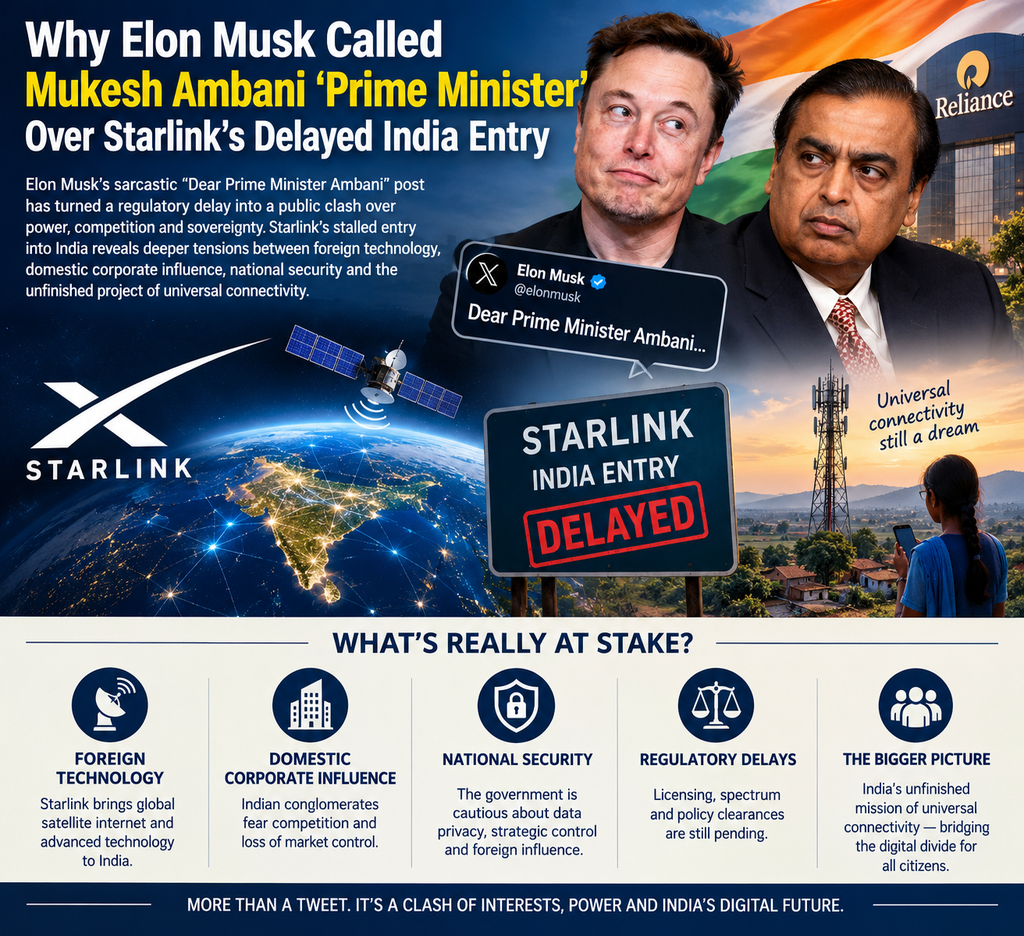
Elon Musk’s sarcastic “Dear Prime Minister Ambani” post has turned a regulatory delay into a public clash over power, competition and sovereignty. Starlink’s stalled entry into India reveals deeper tensions between foreign technology, domestic corporate influence, national security and the unfinished project of universal connectivity.
By Sheikh Mishal
In early October 2026, Elon Musk escalated a long-running regulatory dispute into a personal and political confrontation. Addressing Reliance Industries chairman Mukesh Ambani as “Dear Prime Minister Ambani,” Musk offered a mock apology for failing to recognise him as “the real boss of India.” The post accused Ambani of protecting “monopolistic exploitation” and asked whether he would nevertheless allow Starlink to compete.
The remark, coming after earlier references to unnamed “oligarchs” and the direct question “Is Ambani the real boss of India?”, crystallised Musk’s frustration with the slow progress of Starlink’s commercial launch in one of the world’s largest and most strategically important internet markets.
The episode is more than a billionaire’s social-media outburst. It exposes the complex interplay of technology policy, national security, corporate power and political economy that shapes India’s approach to satellite broadband.
The Regulatory Journey
Starlink first attempted to enter India around 2021 by accepting pre-orders without a licence, prompting a government intervention and refunds. After policy reforms opened the sector, SpaceX secured a Global Mobile Personal Communication by Satellite (GMPCS) licence from the Department of Telecommunications in June 2025 and authorisation from the Indian National Space Promotion and Authorisation Centre (IN-SPACe) the following month.
The company has invested in ground infrastructure, including roughly 20 gateway sites, and publicly stated that it has designed India-specific controls to keep user data within the country and meet local security requirements.
Yet commercial service remains blocked. Three licensed non-geostationary operators—Starlink, Bharti-backed Eutelsat OneWeb and Reliance Jio Satellite Communications—sit at broadly the same stage. All await final security clearances, primarily from the Ministry of Home Affairs and related agencies, and formal spectrum assignment. Spectrum is to be allocated administratively rather than through auction, with usage charges expected in the range of 4–5 per cent of adjusted gross revenue, subject to final Cabinet-level approval.
Security as the Core Constraint
Indian authorities have framed the delay primarily in terms of security. Satellite networks raise distinctive challenges: traffic can potentially route through foreign gateways, inter-satellite laser links may bypass terrestrial control points, and terminals can operate in remote or sensitive areas with limited oversight. Past seizures of Starlink equipment in the Andaman and Nicobar Islands and in Manipur, even if the service was not officially active, reinforced concerns about unauthorised use.
The rules imposed on GMPCS licensees reflect these anxieties. Indian user traffic must pass through domestic gateways. Lawful interception and monitoring facilities must function inside the country. Data must not be mirrored or decrypted abroad. Authorities must retain the ability to restrict service geographically or for specific users during emergencies.
These conditions apply equally to all three licensees, the government has insisted. The Ministry of Communications rejected Musk’s discrimination claims as “baseless and misconceived,” emphasising a “fair and non-discriminatory” framework.
From the state’s perspective, the caution is rational. India has long treated communications infrastructure as a domain of sovereignty, especially given its experience with internet shutdowns in restive regions and its complex neighbourhood. Allowing a foreign-controlled low-Earth-orbit constellation to operate without robust local control carries risks that no government can ignore lightly.
Competition, Influence and the “Oligarch” Charge
Musk’s counter-narrative centres on commercial protectionism. Reliance Jio dominates India’s mobile market and is simultaneously building its own satellite capabilities. Starlink has signed distribution partnerships with both Jio and Airtel, yet Musk portrays Ambani’s influence as the decisive obstacle. The “Prime Minister Ambani” formulation is deliberately provocative: it suggests that formal governmental authority has been subordinated to private power.
This framing resonates with long-standing Indian debates about the relationship between large business houses and the state. Critics of the current political economy often point to the concentration of economic power and the perceived proximity of certain industrialists to decision-makers. Opposition leader Rahul Gandhi’s response to Musk—“Welcome to India, Elon. Wait till you discover the other guy”—played into that discourse, though the government has maintained that no monopoly is being permitted in satellite communications.
At the same time, the security requirements predate the current public spat and apply across the board. Treating the delay solely as the product of one industrialist’s lobbying risks oversimplifying a multi-agency process involving genuine technical and strategic considerations. It also underplays the fact that domestic operators face the same clearance gates.
Broader Stakes
The controversy sits at the intersection of several larger questions. First is the digital divide. Large parts of rural and remote India still lack reliable high-speed connectivity. Starlink’s low-Earth-orbit architecture is particularly well suited to such geographies and has demonstrated value in disaster response worldwide. Denying or delaying such capacity carries human and economic costs.
Second is the balance between openness and control. India wants foreign technology and capital while retaining sovereign oversight of critical infrastructure. The same tension appears in debates over data localisation, cloud computing and semiconductor supply chains. Starlink has become a high-visibility test case.
Third is the future structure of India’s telecom and space economy. Administrative spectrum allocation and partnership models with existing operators suggest a preference for managed competition rather than pure disruption. Whether this approach ultimately delivers affordable, widespread satellite broadband or simply preserves incumbent advantages remains an open question.
Conclusion
Musk’s “Prime Minister Ambani” remark was calculated theatre designed to force the issue into the open. It succeeded in generating headlines and political commentary. Yet the underlying obstacles are structural rather than purely personal. India’s insistence on domestic gateways, data localisation and security clearances reflects a coherent, if demanding, conception of technological sovereignty. The parallel progress of multiple licensees under the same rules undercuts simple narratives of selective blocking.
The episode nevertheless highlights real tensions. Consumers in underserved regions stand to benefit from genuine competition. Domestic industry has legitimate interests in developing sovereign capabilities.
The state has a non-negotiable duty to manage security risks. Navigating these competing claims without either protectionism or naïveté will determine whether satellite broadband becomes a tool of inclusion or another arena of concentrated power.
Musk’s provocation has made the trade-offs visible; resolving them requires more than sarcasm or defensive statements. It requires clear, time-bound decisions that balance security, competition and the public interest in connectivity.
About the Author
Sheikh Mishal is a communication scholar and Manager, Outreach at Newswriters.in & CommCraft

