


BOOK REVIEW
A compelling account of how AI, drones, Big Tech and advanced computing are transforming warfare—and challenging the traditional hierarchy of global power
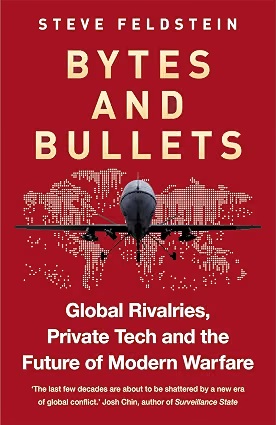
Book: Bytes and Bullets: Global Rivalries, Big Tech, and the New Shape of Modern Warfare
Author: Steve Feldstein Publisher: St. Martin’s Press Publication: 2026
Bytes and Bullets argues that the world is entering a new era in which technological capability is becoming the principal currency of geopolitical and military power. AI, drones, satellites, semiconductors, data and autonomous systems are transforming warfare, while the most important innovations increasingly originate in private companies rather than governments.
By Muneshwar Prasad
The battlefield of the 21st century is no longer defined only by tanks, fighter aircraft, missiles and soldiers. Increasingly, it is shaped by algorithms, artificial intelligence, drones, satellites, data centres, semiconductors and private technology companies.
That is the central premise of Steve Feldstein’s Bytes and Bullets, a timely and ambitious examination of how technological change is transforming warfare, geopolitics and the global balance of power. Feldstein, a senior fellow at the Carnegie Endowment for International Peace, argues that the world is entering a new era in which technological capability is becoming one of the principal determinants of national power.
The book arrives at a particularly significant moment. The wars in Ukraine and the Middle East have demonstrated the growing importance of drones, satellite communications, AI-assisted targeting and other relatively inexpensive technologies. At the same time, the strategic competition between the United States and China is increasingly being fought over semiconductors, artificial intelligence, computing power and technological standards.
From American unipolarity to technological competition
Feldstein begins with the post-Cold War world, when the United States emerged as the dominant global power. The 1990s generated expectations that economic interdependence, globalisation and American technological superiority would produce a relatively stable international order.
That assumption has now been shattered.
China has emerged as a formidable technological competitor, while countries such as Iran, Turkey, Israel and the United Arab Emirates have developed significant technological and military capabilities of their own. Feldstein’s argument is not simply that America’s relative power is declining; it is that the nature of power itself is changing.
Technology is at the centre of that transformation.
The rise of the private military-technological complex
Perhaps the book’s most important argument concerns the changing relationship between governments and technology companies.
During much of the 20th century, governments and military establishments were the principal sources of strategic technological innovation. Defence contractors subsequently converted government-funded research into military systems.
The digital age has reversed much of this relationship.
Some of the most consequential technologies—AI systems, cloud computing, satellite communications, autonomous drones and advanced semiconductors—are being developed by private companies rather than government laboratories.
This creates a new kind of military-industrial complex: one in which Silicon Valley and other technology centres can become as strategically important as traditional defence industries.
It also raises a profound question:
Who should ultimately control technologies capable of making life-and-death decisions—the state, the military or private corporations?
Feldstein does not treat this merely as a technological question. It is fundamentally a question about power, accountability and democracy.
The drone revolution
One of the book’s most revealing themes is the democratisation of military technology.
Sophisticated weapons were once largely the preserve of major military powers. That is changing rapidly.
Cheap drones, commercially available components, satellite connectivity and increasingly sophisticated software can give relatively small states and even non-state actors capabilities once available only to major powers.
The war in Ukraine provides perhaps the clearest demonstration. Relatively inexpensive drones can locate targets, gather intelligence and attack equipment many times their own cost.
Feldstein uses such examples to challenge the conventional assumption that military superiority automatically follows from possessing the largest and most expensive weapons platforms. A technologically innovative smaller actor can sometimes offset a huge conventional disadvantage.
AI and the changing “kill chain”
The most disturbing part of the book concerns artificial intelligence and autonomous warfare.
Traditionally, the military “kill chain” involved a series of human decisions: identifying a target, assessing it, deciding whether to attack, selecting the weapon and evaluating the outcome.
AI has the potential to compress these stages dramatically.
Machines can process enormous amounts of data, identify patterns, track targets and potentially recommend—or eventually make—decisions at speeds impossible for humans.
This creates a fundamental dilemma.
What happens when the speed of warfare exceeds the ability of humans to understand and control it?
The danger is not simply that machines might make mistakes. It is that autonomous systems could accelerate escalation before political or military leaders have time to intervene.
Feldstein therefore sees the AI arms race as more than a competition for technological supremacy. It is also a race involving human control over increasingly autonomous systems. A recent review of the book described this prospect as deeply disturbing, particularly because autonomous technologies could reduce or eliminate human involvement in parts of the targeting process.
China and the new technological balance
China occupies a central place in Feldstein’s analysis.
The competition between Washington and Beijing is no longer confined to trade or conventional military strength. It increasingly involves AI, semiconductors, advanced computing, manufacturing capacity and access to data.
China’s particular strength, Feldstein suggests, lies in its ability to combine technological innovation with enormous manufacturing capacity and state-directed investment.
This creates an important strategic challenge for the United States. Maintaining technological leadership requires not only inventing new technologies but also being able to manufacture, scale and deploy them.
The book consequently challenges the assumption that America’s technological lead will automatically survive.
Technology is also changing who can become a military power
An especially interesting aspect of Feldstein’s argument is that technological competition is no longer exclusively a contest between superpowers.
The diffusion of technology allows smaller countries to develop independent capabilities.
Iran is an important example. Despite decades of sanctions, it has developed sophisticated drone and missile capabilities. Turkey has become a significant drone producer. Israel has developed advanced military technologies. Other regional powers are also investing heavily in autonomous systems and AI.
The result is a more complicated international system in which technological capability is increasingly distributed rather than concentrated exclusively in a handful of great powers.
The book’s larger warning
The deeper message of Bytes and Bullets is that technological change is occurring faster than the institutions designed to regulate it.
International law, arms-control mechanisms and traditional concepts of deterrence were largely developed for an earlier technological era.
They are now confronted by weapons and systems that can be developed by private companies, distributed globally and modified rapidly.
This creates a regulatory dilemma. Governments cannot simply prevent technological diffusion. Nor can they leave technologies with potentially enormous military consequences entirely to market forces.
The challenge is to find a balance between innovation, national security,
Corporate freedom and democratic accountability: A strength—and a limitation
One of the book’s greatest strengths is Feldstein’s ability to connect developments that are often examined separately. He moves between Silicon Valley, Beijing, Ukraine and the Middle East to demonstrate that AI, drones, semiconductors and data infrastructure are components of a much larger transformation.
The book is also remarkably current. Recent reviews note that it draws heavily on developments in Ukraine and the Middle East and on the rapidly evolving technology race between the United States and China.
Its principal limitation is that Feldstein’s focus is heavily centred on the United States-China rivalry and the strategic choices confronting Washington. Readers looking for a more balanced examination of the technological trajectories of other powers may find the treatment of regional actors less developed.
There is also a danger, inherent in any book about rapidly evolving technology, that some predictions may become outdated quickly. AI and autonomous systems are advancing so rapidly that today’s technological assumptions can become obsolete within a few years.

Why the book matters
Bytes and Bullets is ultimately not just a book about future warfare. It is a book about the changing architecture of power.
Its central insight can be expressed in a simple equation:
Data + Computing + AI + Software + Manufacturing = New Strategic Power
The implications extend far beyond the battlefield.
The same technologies that enable autonomous weapons also influence elections, political communication, surveillance, misinformation, intelligence gathering and public opinion. The companies developing these technologies therefore increasingly occupy a strategic position between governments and citizens.
For journalists, media professionals, policymakers and students of international affairs, this is particularly important. Understanding contemporary geopolitics increasingly requires understanding technology—and understanding technology increasingly requires understanding who controls it.
Verdict
** Bytes and Bullets is a timely and thought-provoking examination of the intersection of technology, warfare and geopolitics. Its greatest contribution is to show that the technological revolution is not merely changing the weapons used in war; it is changing who possesses power, how that power is exercised and how quickly conflicts can escalate.**
Feldstein leaves readers with an unsettling but important question: if machines increasingly determine what humans can see, target and attack, who will ultimately decide where technology’s limits should lie?
That question makes Bytes and Bullets worth reading—not only for those interested in military affairs, but for anyone trying to understand the emerging relationship between AI, technology, politics and global power.

